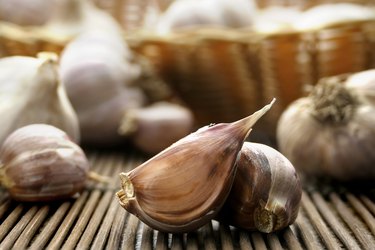
Garlic can be a useful component of any heart-healthy diet, especially as a flavor-enhancer that renders a low-sodium diet more palatable. And fresh garlic has other benefits, too. But is garlic good for hypertension?
Garlic’s Unique Properties
Video of the Day
Garlic has long been a subject of research interest due to its antioxidant properties and its allicin content — allicin being a sulfur component that promotes the dilation of blood vessels and also inhibits angiotensin II, a protein that constricts blood vessels, according to research published in the Journal of Clinical and Experimental Cardiology in April 2016.
Video of the Day
According to the National Center for Complementary and Integrative Health (NCCIH), a division of the National Institutes of Health, garlic may be helpful in the setting of high blood pressure, but the evidence isn't strong enough to support the use of garlic as a blood-pressure-lowering agent.
What the Research Tells Us
Garlic may have a modest effect on blood pressure, but probably not enough to replace medication for someone who needs drugs to reach blood pressure goals.
There does seem to be some effect, though, perhaps enough to warrant further investigation. The Journal of Clinical and Experimental Cardiology review article, which looked at the impact of a variety of dietary components on blood pressure, found more than a few studies reporting decreases in systolic blood pressure (the upper number) and diastolic blood pressure (the lower number) in people taking garlic supplements in the form of garlic powder, garlic oil and garlic extract.
A more recent article, an umbrella review of 16 meta-analyses of the effects of garlic on multiple health outcomes, published in Food Science and Nutrition in August 2019, also found an association between garlic consumption — averaging 600 to 900 milligrams daily in supplemental form — and what the study authors deemed to be a significant decrease in blood pressure.
While these differences may be statistically significant in a scientific analysis — the range reported in the meta-analysis was a decrease of 5 to 8 millimeters of mercury (mmHg) in systolic blood pressure and about 3 to 4 mmHg in diastolic blood pressure — they might not make a big enough difference to help someone with hypertension.
"These studies show an 8 percent reduction, lowering systolic and diastolic blood pressure by 5 mmHg and 3 mmHg, respectively. So if your blood pressure was 150 mmHg over 100 mmHg, it only went down to 145 mmHg over 97 mmHg," says Kate Patton, MED, RD, a registered dietitian at the Cleveland Clinic who works primarily with the preventive cardiology clinic.
According to the Mayo Clinic, 145/97 would still be considered stage II hypertension. (Anything over 140/90 meets that definition.) Stage I hypertension is defined as a systolic reading of 130 to 139 or a diastolic reading over 80.
Other Possible Benefits
Blood pressure reduction aside, there may be other ways garlic can benefit health. The Food Science & Nutrition review found associations between garlic and the prevention of some forms of cancer, particularly gastric cancer. Studies covered in the analysis also found lower cholesterol and better diabetes outcomes in people who consumed garlic.
Also, garlic may play a role as a component of an overall healthy diet. A landmark study re-published in June 2018 in the New England Journal of Medicine described a 30 percent reduction in the incidence of major cardiovascular events in high-risk individuals who consumed a Mediterranean diet supplemented with extra virgin olive oil or nuts.
"One of the components people in that study ate is sofrito, a sauté of garlic, onions and tomatoes in extra virgin olive oil," Patton says. "So, garlic was just a very small part of that study, but it is one part of an over-arching healthful diet associated with reducing the risk of heart disease, to which hypertension is a contributor."
But again, while the NCCIH acknowledges that garlic is generally safe eaten in the form of food, it can increase the risk for bleeding and may interfere with some drugs. The agency recommends coordinating with your doctor if you intend to use garlic supplements or any other complementary or integrative approach in the management of your health.
- Journal of Clinical and Experimental Cardiology: "Role of Dietary Components in Modulating Hypertension"
- National Center for Complementary and Integrative Health: "Garlic"
- Food Science & Nutrition: "Allium Vegetable Consumption and Health"
- Kate Patton, MED, RD, CSSD, LD, registered dietitian, Cleveland Clinic
- Mayo Clinic: "High Blood Pressure – Diagnosis and Treatment"
- New England Journal of Medicine: "Primary Prevention of Cardiovascular Disease With a Mediterranean Diet Supplemented With Extra-Virgin Olive Oil or Nuts"
Is this an emergency? If you are experiencing serious medical symptoms, please see the National Library of Medicine’s list of signs you need emergency medical attention or call 911.