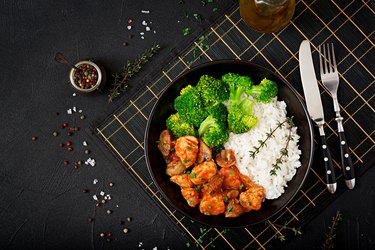
The chicken and broccoli diet is often followed by athletes and celebrities who want to gain muscle or lose weight. Most people won't put on weight if they're only eating these two healthy foods, but they also may not get enough nutrients and calories.
Tip
It is possible to gain weight by eating a chicken and broccoli diet, but it is more likely that you will lose weight. Whether you gain or lose weight depends on the size of your chicken and broccoli diet portions and your activity levels.
Video of the Day
Video of the Day
Calorie Consumption and Healthy Diets
According to the Dietary Guidelines for Americans, most healthy diets range between 1,600 and 3,200 calories per day, and should incorporate a variety of different foods. The exact number of calories you need is determined by your age, sex and how active you are.
Although healthy diets can involve less or more than these amounts, your body still requires a variety of different essential nutrients and a minimum caloric intake.
Harvard Health Publishing recommends that women consume no less than 1,200 calories per day. Men should consume no less than 1,500 calories per day. While you may want to reduce your calories to speed up your weight loss, consuming too few calories can lead to health issues like nutritional deficiencies and hormone imbalances — and it may even prevent you from losing weight.
Most people consume about 2,000 calories per day, which are made up of three main components: protein, fat and carbohydrates. According to the Food and Drug Administration, most people should consume about 65 grams of fat, 50 grams of protein and 300 grams of carbohydrates.
For your digestive system to function, some of these carbohydrates need to come from fiber. Based on American Diabetes Association recommendations, you need 14 grams of fiber for every 1,000 calories you consume.
Chicken and Broccoli Diet Macros
When people consume a diet primarily made up of chicken and broccoli, chicken provides the fat and protein, while broccoli provides carbohydrates. However, chicken tends to be a fairly lean meat. Unless you've selected a fatty cut, like chicken wings or thighs, chicken is mainly going to provide you with protein.
If you're trying to lose weight, this is actually a good thing: According to an April 2015 study in the American Journal of Clinical Nutrition, increasing your protein consumption by as much as twice the recommended amount can help support weight loss. However, if you're trying to gain weight, eating only chicken and broccoli may not be the best diet for you.
According to the USDA, 100 grams (3.5 ounces) of chicken breast is equivalent to 157 calories. This is made up of 3.2 grams of fat and 32.1 grams of protein. There are no carbohydrates in chicken. In comparison, the same amount of chicken thighs has 221 calories, with 16.5 grams from fat and 16.6 grams from protein.
Every 100 grams of broccoli (equivalent to just over a cup) has 34 calories. There are also 2.8 grams of protein, 0.4 grams of fat and 6.6 grams of carbohydrates, 2.6 grams of which come from fiber.
This means that the chicken and broccoli diet will contain substantial amounts of protein and carbohydrates, but will be fairly low in fat unless you specifically select a fatty cut of meat. It also means that to eat according to nonstarvation diet standards, you'd have to eat a substantial amount of these two foods.
Unless you integrate a wider variety of foods into your diet, you're more likely to lose weight than gain weight when eating just chicken and broccoli.
Chicken and Broccoli Diet Nutrients
According to an April 2017 review in the Journal of the American Association of Nurse Practitioners, most American adults don't get enough fiber. People on alternative diets, like the chicken and broccoli diet, consume even less — just 10 grams per day.
You need to consume enough dietary fiber to maintain the health of your digestive system and regulate your blood sugar levels. Fiber also helps absorb any dietary fat that you ingest. Because there is no fiber or other carbohydrates in chicken, all your dietary fiber needs to come from the broccoli.
Based on the Harvard Health Publishing and American Diabetes Association dietary recommendations, women need to consume at least 16.8 grams of fiber per day, while men need at least 21 grams of fiber.
There are 2.4 grams of fiber in every cup of broccoli, so this means that women would need to consume at least 7 cups (637 grams) of broccoli per day, which is the equivalent of 217 calories. Men would need to consume nearly 9 cups (796 grams) of broccoli, or 271.5 calories.
The remaining calories in your diet could technically come from chicken and other chicken-based products, like chicken broth. However, to meet the minimum recommended caloric intakes per day, this would be the equivalent of about 450 grams of chicken thighs for women and 550 grams of chicken thighs for men, or 820 grams of chicken breasts for women and 1 kilogram of chicken breasts for men.
You should be careful about consuming large amounts of meat, because protein can affect your weight. Most people should consume about 0.8 grams of protein per kilogram that they weigh. However, this number can go up to a maximum of 3.5 grams per kilogram of body weight, according to a March 2016 study in the journal_ Food and Function_.
Read more: 19 High-Fiber Foods — Some May Surprise You!
Chicken and Broccoli Diet Portions
Although the FDA recommendation is 50 grams per day, you can vary your protein consumption a fair amount. The exact amount of protein you can consume depends mainly on your weight, but can also vary based on your activity levels.
The average American man weighs 195.7 pounds (88.77 kilograms), while the average American woman weighs 168.5 pounds (75.21 kilograms). This means that the average man needs at least 71 grams of protein per day, while the average woman needs at least 60 grams of protein per day.
In contrast, the most protein you could consume as a woman is about 263 grams per day, while the most protein you could consume as a man is about 311 grams per day.
Both chicken breasts and chicken thighs allow you to consume a safe amount of protein if you intend to eat the minimum recommended amount of calories. For women:
- 450 grams of chicken thighs contains 74 grams of protein.
- 820 grams of chicken breasts contains 184.5 grams of protein.
For men:
- 550 grams of chicken thighs contains 91 grams of protein.
- A kilogram of chicken breasts contains 225 grams of protein.
If you're intending to eat larger portions and get more calories from chicken, you might approach the maximum tolerable amount of protein you should consume. Avoiding this is simple, though — just select fattier cuts of chicken or increase your carbohydrate intake.
- Journal of the American Association of Nurse Practitioners: "Fiber Supplements and Clinically Proven Health Benefits: How to Recognize and Recommend an Effective Fiber Therapy"
- American Journal of Clinical Nutrition: "The Role of Protein in Weight Loss and Maintenance"
- MyFoodData: "Nutrition Comparison of Raw Chicken Breast, Raw Chicken Thigh, Raw Chicken Wings, and Broccoli"
- Diabetes Care: "Nutrition Therapy Recommendations for the Management of Adults With Diabetes"
- Food and Drug Administration: "Total Carbohydrate"
- Food and Drug Administration: "Protein"
- Food and Drug Administration: "Total Fat"
- Harvard Health Publishing: "Calorie Counting Made Easy"
- Health.gov: "Dietary Guidelines for Americans, 2015-2020: Appendix 2. Estimated Calorie Needs per Day, by Age, Sex, and Physical Activity Level"
- Centers for Disease Control and Prevention: "Body Measurements"
- Food and Function: "Dietary Protein Intake and Human Health"
- Food and Nutrition Board: Institute of Medicine: "Dietary Reference Intakes (DRIs): Recommended Dietary Allowances and Adequate Intakes, Total Water and Macronutrients"