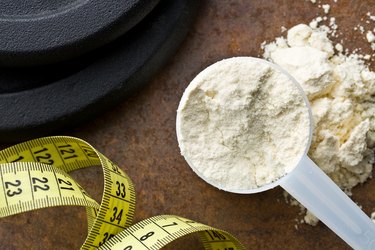
Few supplements are as popular as whey protein. It doesn't promise massive changes, but it can help you build muscle. Unlike many supplements, whey protein has been heavily researched and there's plenty of evidence to show how it helps and how it may hurt. It's often promoted as a supplement for serious bodybuilders, but it's actually relatively harmless.
Being a Smart Consumer
Video of the Day
When you start any supplement, you have to make sure it's safe, healthy and actually does what it claims to do. According to the U.S. Food and Drug Administration's website, they're not allowed to review dietary supplements for safety and effectiveness before they're marketed. That means you have to be a smart consumer and weigh the pros and cons of the protein powder you're buying.
Video of the Day
Importance of Protein
As one of the three macronutrients, protein is an important part of your diet. The other two macronutrients are carbohydrates and fat. Some diets are low-carbohydrate and others are low-fat, but protein is nonnegotiable. You need protein in your diet to stay healthy.
How Much Do You Need?
An article from Harvard Health says that a sedentary person should have 0.36 gram of protein per pound of body weight per day. That's 54 grams of protein per day if you weigh 150 pounds.
If you're active or trying to maintain your muscle mass while losing weight your protein requirements jump up to about 0.54 to 0.90 gram per pound of body weight, according to a 2016 study from Nutrition Bulletin. That's 81 to 135 grams of protein for a 150-pound person. The number jumps up when you're active because muscle tissue breaks down and needs to be rebuilt using protein.
Whether you're a runner or weightlifter, your body is breaking down protein faster than someone who isn't exercising. That means you need more protein, and a supplement can help you add it to your diet.
Why Is Whey Special?
Whey protein is derived from cow's milk. An article from Whey Protein Institute explains that whey is separated when cheese is produced. Enzymes are used to separate whey from the cheese. It's then dehydrated and turned into powder form, which is what you consume.
Muscle-Building Benefits
A 2016 study published in Sports Medicine shows that adding whey protein can help you build muscle faster and get stronger even when compared to other protein supplements that don't contain whey. This study is important because it shows that whey protein is more helpful than other protein supplements. Other options are pea protein, soy protein and various others from animal and vegetable sources.
Amino Acids in Whey
One of the things that makes whey protein more effective is the amino acids it contains. All protein is made of amino acids. In the human body, there are 20 total says an article from the University of Arizona, and each plays a different role. It's important to have all of them in your diet, but your body makes a handful of them. The nine essential amino acids can't be made by the body. You can get them only from your diet.
Three of these essential amino acids are particularly interesting for those looking to build muscle. The so-called branched-chain amino acids, which are isoleucine, leucine and valine, seem to be particularly important in the muscle-building process. In fact, a 2017 study published in Frontiers in Physiology shows that taking those three amino acids alone was enough to stimulate muscle growth.
Whey protein is particularly high in these amino acids, which makes it a powerful muscle-building form of protein.
Whey Protein for Weight Loss
When you're trying to lose weight, you have to cut down the amount of food you eat. However, your protein requirements actually go up, not down. That means you need to increase the amount of protein in your diet while eating less food.
Adding a protein supplement helps because they're a concentrated shot of protein with few calories. For example, one serving of Optimum Nutrition's Gold Standard Whey Protein has 24 grams of protein and 110 calories. That's a significant chunk of your protein requirement for the day with fewer calories than a can of cola.
High Protein for Weight Loss
A high-protein diet can actually benefit your health if you're struggling to lose weight. Protein satisfies your hunger longer than fat or carbs. If you're eating less, it's easier to lose weight. Losing weight helps with many health risks, including heart disease and diabetes.
On the other hand, whey protein powder can help you gain or maintain weight. If you have a fast metabolism or struggle to eat enough, whey protein shakes can bolster your diet. Ingesting liquid protein isn't as bothersome to your digestive system as regular protein from meat or vegetable sources. Drinking your protein means that your stomach doesn't have to work as hard to digest it. Plus, whey protein powders are usually flavored and taste delicious.
Management of Type 2 Diabetes
There's some evidence that taking a whey protein supplement can help a person with Type 2 diabetes manage glucose levels. A 2015 study published in the World Journal of Diabetes says that it can help because of the high level of amino acids and satiating effect of protein.
The rush of amino acids can cause your body to release insulin even without ingesting carbohydrates, which helps bring down blood glucose levels. The researchers mention that there need to be more studies to determine the proper dose of whey protein.
Read more: How to Lose Weight With Whey Protein Shakes
Drawbacks of Whey Protein
Just like any supplement, whey protein has some potential dangers, especially if you consume too much. Whey protein is safe for most people, but there are still some exceptions to consider.
Digestive Problems
Since it's derived from dairy, whey protein can be tough on your stomach. If you're lactose intolerant or allergic to dairy, avoid this supplement. Opt for a vegetarian protein powder instead. Since whey protein usually tastes better when mixed with milk, it can be difficult to digest.
Sketchy Manufacturers
The real danger of whey protein isn't as simple as a side effect. The real danger is in the supplement industry itself. Since the FDA can't closely monitor every supplement that's made, some sketchy products slip through the cracks. An article from Harvard Health sheds light on the reality of the situation.
An organization called the Clean Label Project tested 134 protein products and found that many of them contained heavy metals that could be dangerous to your health. Some of them were pesticides and some were carcinogens like BPA. The problem was questionable manufacturing practices, which caused contamination of the powders.
Luckily, the Clean Label Project still screens whey protein powders and includes a list of safe products on its website.
High-Protein Diet Risks
There's plenty of controversy over the dangers of high-protein diets. Whey protein supplements make it incredibly easy to boost your protein intake, which means that you can eat a high-protein diet without being too full.
Even if you're using whole foods, there's still controversy around high-protein diets. Some of the complaints are that they weaken bones and damage your kidneys. However, according to a 2015 study published in Advances in Nutrition, there isn't an inherent danger to eating a high-protein diet for healthy people.
Kidney Problems
High-protein diets are only dangerous if you have pre-existing kidney problems. After you digest and use protein, there are byproducts that your kidneys have to pull out of your bloodstream. They're getting rid of waste that you don't want floating around your body. The more protein you eat, the more work the kidneys have to do.
If you have a kidney condition, you should check with your doctor before using a whey protein supplement. Otherwise, the added protein in your diet isn't necessarily dangerous. In fact, a 2016 study published in the Journal of the International Society of Sports Nutrition showed that men who ate up to 3.3 grams of protein per kilogram of body weight over four months experienced no adverse side effects. That's roughly three times the amount of protein that an active person needs.
Whey Protein Myths
Anecdotes and early studies performed on whey protein gave rise to the belief that whey protein isn't good for your kidneys or liver. These misconceptions have been debunked. The only time it's dangerous is if you have a pre-existing problem that forces you to lower your protein intake.
Whey protein won't raise your cholesterol levels, according to a 2016 study published in the European Journal of Clinical Nutrition. The same studies showed that whey protein actually lowers triglyceride levels.
Read more: Whey Protein vs. Whey Isolate
Whole Foods Still Rule
While whey protein can help, it's meant to be used as a supplement to your diet. Eating protein from vegetables and animal products like meat remains the best option. While whey protein is fortified with some vitamins and minerals, there are many more in whole foods.
Meat has an incredible collection of vitamins, particularly B vitamins. It also has fat-soluble vitamins that you can't get from vegetables. Sources of protein like beans have healthy fiber that's good for heart and digestive health. Food sources of protein come with a host of benefits that whey protein simply can't match.
Correction: An earlier version of this story incorrectly identified the amount of protein a 150-pound person should get a day.
- FDA: Dietary Supplements: What You Need to Know
- Whey Protein Institute: How Whey Protein Is Made
- Sports Medicine: Effects of Whey Protein Alone or as Part of a Multi-Ingredient Formulation on Strength, Fat-Free Mass, or Lean Body Mass in Resistance-Trained Individuals
- Frontiers in Physiology: Branched-Chain Amino Acid Ingestion Stimulates Muscle Myofibrillar Protein Synthesis Following Resistance Exercise in Humans
- Optimum Nutrition: Gold Standard 100% Whey
- Harvard Health: The Hidden Dangers of Protein Powders
- Advances in Nutrition: Controversies Surrounding High-Protein Diet Intake: Satiating Effect and Kidney and Bone Health
- Journal of the International Society of Sports Nutrition: The Effects of a High-Protein Diet on Indices of Health and Body Composition – A Crossover Trial in Resistance-Trained Men
- World Journal of Diabetes: Whey Protein: The “Whey” Forward for Treatment of Type 2 Diabetes?
- Harvard Health: How Much Protein Do You Need Every Day?
- European Journal of Clinical Nutrition: Effect of Whey Protein on Blood Lipid Profiles: A Meta-Analysis of Randomized Controlled Trials
- University of Arizona: Department of Biochemistry and Molecular Biophysics: The Chemistry of Amino Acids
- Clean Label Project: 2018 Protein Powder Study
- Nutrition Bulletin: Protein Intake for Athletes and Active Adults: Current Concepts and Controversies