
















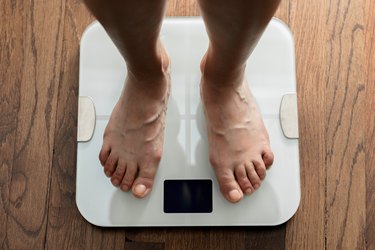























































There is no one standard for calorie intake for a human being. Many variable, including gender, age, and level of physical activity all play a role in determining an appropriate caloric intake. Generally speaking, the more active you are, the more calories you need. As you get older, you usually need fewer calories. Men generally need a higher caloric intake than women. If you take in more calories than you need, you will typically gain weight.
Age 18 to 35
If you're between ages 18 and 35, you are generally at your most physically active stage and your metabolism is running at a high rate. As a result, you need more calories at this age to maintain your weight. The ideal calorie range for women between 18 and 35 is between 1,760 and 2,400 calories, depending on weight. For men, the range is from 2,480 to 3,500 calories per day. If you are inactive, such as sitting in an office all day and not getting any physical activity, you should subtract a compensatory amount of between 500 and 1,000 calories from your daily requirement, depending on your weight.
Age 35 to 55
As you head toward middle-age, your metabolism tends to slow and you may not be as physically active as you were in your youth. Consequently, your need for calories also reduces in middle age. Women should generally get between 1,570 and 2,150 calories in this age range, while men should drop down to a 2,300 to 3,000-calorie range. Again, you can make an adjustment to these numbers upwards or downwards based on your level of physical activity.
Over Age 55
Once you reach age 55 and older, you need fewer calories to maintain your body weight. Women typically require 1,430 to 1,720 calories at age 55 or older, while men need 1,900 to 2,600.
Calorie Composition
In terms of a healthy lifestyle, the composition of your calorie intake is an important factor as well; not just the amount of calories you consume. In spite of weight-loss ideas that promote totally abandoning one type of food, such as carbohydrates or fats, your body actually needs carbohydrates, fats and protein. Since fat is dense with calories, you should limit the amount of fat that you eat. However, your body does need some level of fat for proper functioning. Total elimination of fat will reduce your caloric intake, but it's not a healthy long-term solution for your body.


Member Comments