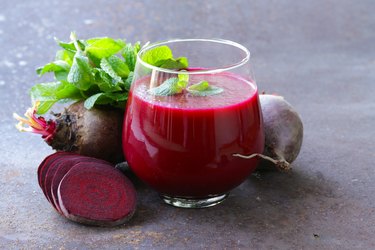
Drinking a glass of fresh beet juice can provide the nutritional benefits of beets and important antioxidants, naturally occurring nitrates and anti-inflammatory betacyanins.
There are many health benefits of beet juice: The vibrant, red liquid has been linked to increased energy, decreased blood pressure, heart health and more.
Video of the Day
Video of the Day
Beets can be enjoyed in so many ways, and they boast plenty of nutrition whether they're raw, cooked or juiced.
We'll take a look at the many benefits beets have to offer as well as the best ways to include beets in your diet. In order to get the most out of beets — which are sometimes called beetroots — it's important to know how best to prepare and enjoy them.
Beets Nutrition
Beetroots are packed with vitamins, minerals and nutrients and they're naturally fat-free. Here's a look at the nutritional profiles of raw beets, cooked beets and beet juice, as these slightly differ.
The Nutrition of Raw Beets, Cooked Beets and Beet Juice
Type of Beet (per cup) | Calories | Fiber | Sugar | Protein |
|---|---|---|---|---|
Beet Juice | 100 | 2 g | 20 g | 3 g |
Raw Beets | 56 | 3.8 g | 9.2 g | 2.2 g |
Boiled and Drained Beets | 75 | 3.4 g | 14 g | 2.9 g |
Beets contain a high amount of natural sugars, and juicing them will give you a concentrated dose, as you can see in the chart above. This amount may be of particular concern if you're counting calories to lose weight or if you have diabetes.
Vitamins and Minerals Found in Beets and Beet Juice
Beets — no matter their form — are a great source of many vitamins and minerals, including vitamin C, iron, potassium, magnesium, manganese and copper.
Beets are also rich in folate, a B vitamin that the body needs to produce red and white blood cells in bone marrow, per the U.S. National Library of Medicine.
Folate
Folate is especially important pregnant people and those trying to get pregnant, as it can help prevent low birth weight and promote development for the baby.
A deficiency in folate is associated with a higher risk for birth defects in the baby, per the NIH.
Manganese
Drinking a glass of beet juice will supply you with a generous amount of manganese — about 25 percent DV per cup.
Manganese is an essential mineral your body needs for the synthesis and activation of many enzymes that regulate metabolism and aid in the proper function of your immune system, per the NIH.
The Health Benefits of Beets and Beet Juice
Thanks to their impressive nutrient profile, beets provide a bevy of health benefits that researchers continue to study.
1. Beets May Improve Muscle Function
Beets contain natural nitrates, which are the precursors for nitric oxide. Nitric oxide is involved in the regulation of blood flow, muscle contraction and respiration in your body.
People with systolic heart failure who were administered concentrated beet juice experienced a 13 percent improvement in muscle contractile velocity and power, per a small July 2015 study in Circulation: Heart Failure. The researchers suggested that beet juice may enhance other aspects of physical function in people with heart disease by boosting muscle energy.
2. Beets May Help Lower Blood Pressure
Research suggests that drinking beet juice has a positive effect on blood pressure levels in both the short and long terms. A November 2014 study in Hypertension found that participants with hypertension who drank about one cup of red beet juice every day for four weeks experienced improved effects on their blood pressure — some noticeable within 24 hours.
Researchers observed that those who consumed beet juice showed a 20 percent improvement in the elasticity of blood vessels. The study authors that it was the high levels of nitrates in beets that was responsible for the reduction in blood pressure.
3. Beets Have Antioxidant and Anti-Inflammatory Potential
Another major benefit of beets is their rich source of betalains, the antioxidants responsible for the rich red pigment in beets. Betalain displays strong antioxidant, anti-inflammatory and detoxification properties that benefit the body in many ways, per an April 2015 study in Nutrients.
Researchers noted that the chemo-preventive activity of betalains has been shown to protect against oxidative stress for the management of inflammation in lung, skin and liver cancer cells. Compelling evidence also suggests that betalains kill colon cancer cells as well as breast cancer cells, per March 2017 research in Food Chemistry and August 2016 research in Molecular and Cellular Biochemistry, respectively.
4. Beets May Boost Exercise Performance
The nitrates found in beets may help you get the most out of your workout. Nitrates can reduce the oxygen cost of exercise, improve blood flow to the muscles and enhance oxygenation, all of which play a role in improving endurance and performance.
A May 2014 study in Sport Medicine found that supplementing with nitrates — including the kinds found in beets — shows promise for enhancing certain aspects of exercise. This study found that participants who supplemented with beet juice experienced a 15 percent longer time period before exhaustion kicked in during a run, as well as increased power and number of repetitions of resistance exercises.
Nitrates may improve the efficacy of the mitochondria, where cell energy is generated in order to carry out activities, found an August study in the Journal of Applied Physiology. Researchers found that nitrates in beet juice increased the range and speed of a muscle's ability to efficiently contract during large muscle mass exercise.
Similarly, a separate December 2014 study in Medicine and Sports in Sports and Exercise found that participants who drank a nitrate-rich beet concentrate for one week saw improved cardiovascular function at rest and energy metabolism during exercise.
Researchers warn that while the efficacy of nitrate shows promise, it may depend on a number of factors, including the personal health of an individual, the type of exercise they're performing as well as the amount of nitrate consumed. More research is necessary to better understand the potential benefits of beet juice on exercise.
The Health Benefits of Beet Greens
When you buy fresh beets, you'll notice that they come with a leafy green top, similar to that of a carrot or radish. These greens contain their own kinds of benefits, and you should certainly consider eating them, too — doing so will help cut back on food waste.
Better yet, beet greens are good for you. Beet leaves are packed with vitamins and minerals, including potassium, magnesium and vitamin C. They're also an incredible source of vitamin K, with 127 percent of the recommended daily value (DV), per the FDA.
You can cook beet greens similar to the ways you'd cook any dark, leafy green, like Swiss chard. Here's a recipe for Sautéed Beet Greens With Garlic and Olive Oil for some inspiration.
Drinking Beet Juice: Raw vs. Cooked Beets
Is it healthier to drink beet juice from raw beets or cooked beets? Interestingly enough, the nutrients of your drink can somewhat vary depending on how the beets you're using are prepared.
You can make a healthy beet drink from either raw beets or cooked beet. If you juice raw beets, you should make sure they are well-scrubbed and free of dirt or peeled.
Cooking beets may reduce some of their nutritious value, according to a July 2016 study published in Acta Scientiarum Polononrum Technologia Alimentaria, which found that heating beneficial betacyanin decreased its antioxidant capacity by around 7 percent.
Although this amount is not significant, consider that cooking also reduces some of the vitamin and mineral content in beets. Therefore you may want to opt for juicing raw instead of cooked beets to get the maximum benefits.
Some of the differences in important nutrient content between raw and cooked beets is as follows. These values are for two beets, each 2 inches in diameter.
Nutrients in Cooked Beets vs Raw Beets
Calcium | Manganese | Iron | Potassium | Vitamin C | |
|---|---|---|---|---|---|
Cooked Beets | 16 mg (1% DV) | 0.3 mg (14% DV) | 0.8 mg (4% DV) | 305 mg (6% DV) | 3.6 mg (4% DV) |
Raw Beets | 26.2 mg (2% DV) | 0.5 mg (23% DV) | 1.3 mg (7% DV) | 533 mg (11% DV) | 8 (9% DV) |
Juicing raw beets, or eating the whole beet, can help retain many of the beets' nutrients. A December 2016 study in the Journal of Current Research in Nutrition and Food Science showed that beets typically lose nutrients, with the exception of vitamin C, when pickled.
Pickling beets may also reduce some of their benefits. A December 2016 study in the Journal of Current Research in Nutrition and Food Science showed that beets typically lose nutrients, with the exception of vitamin C, when pickled.
Consider Adding Beet Fiber Back Into Beet Juice
You'll lose fiber content whether you're drinking the juice of raw beets or cooked beets.
You need fiber in your diet for a well-functioning digestive tract and to keep you regular by providing bulk to your stool.
After you juice the beets, you can reserve some of the pulp to mix back into your beet drink to replace the lost fiber. Or you can add the pulp to other dishes, such as salads, soups or stir-fries.
Dietary fiber slows digestion, making you feel satiated longer. This may help you avoid overeating, which is beneficial for managing your weight. And fiber can help improve your blood cholesterol level and reduce your risk for heart disease, stroke and type 2 diabetes, according to the American Heart Association.
- Acta Scientiarum Polonorum Technologia Alimentaria: The Effect of Thermal Treatment on Antioxidant Capacity and Pigment Contents in Separated Betalain Fractions
- American Heart Association: Whole Grains, Refined Grains, and Dietary Fiber
- USDA Dietary Guidelines: Daily Nutritional Goals for Age-Sex Groups Based on Dietary Reference Intakes and Dietary Guidelines Recommendations
- USDA Branded Food Products Database: Organic Beet Juice
- Circulation: Heart Failure: "Acute Dietary Nitrate Intake Improves Muscle Contractile Function in Patients With Heart Failure"
- Hypertension: "Dietary Nitrate Provides Sustained Blood Pressure Lowering in Hypertensive Patients"
- National Institutes of Health: "Folate"
- Journal of Psychiatric Research: The Association of Folate and Depression
- Nutrients: "The Potential Benefits of Red Beetroot Supplementation in Health and Disease"
- Food Chemistry: "Betalains Increase Vitexin-2-O-xyloside Cytotoxicity in CaCo-2 Cancer Cells"
- Molecular and Cellular Biochemistry: "Beet Root Juice Protects Against Doxorubicin Toxicity in Cardiomyocytes While Enhancing Apoptosis in Breast Cancer Cells"
- Journal of Applied Physiology: "Effect of Dietary Nitrate Supplementation on Conduit Artery Blood Flow, Muscle Oxygenation, and Metabolic Rate During Handgrip Exercise"
- Medicine and Science in Sports and Exercise: "Nitrate Supplementation Enhances the Contractile Properties of Human Skeletal Muscle"
- Sports Medicine: Dietary Nitrate Supplementation and Exercise Performance
- My Food Data: "Beet Greens"
- New York Times: "Sautéed Beet Greens With Garlic and Olive Oil"
- U.S. National Library of Medicine: "Vitamin B9 benefits"
- Journal of Current Research in Nutrition and Food Science: "Changes Occur on Nutritional Value of Beetroot (“Beta Vulgaris”) after Pickling"
- NIH: "Maganese"