
































Protein is one of the most essential building blocks required for growth in the human body. Nutrition education specialist Janice R. Hermann, Ph.D., notes that every cell in the human body requires protein in some way. The American Academy of Pediatrics, or AAP, regularly reviews and adjusts its dietary guideline recommendations for children based upon current medical information, so following their guidelines is one of the best ways to ensure that your child is receiving proper nutrition.
General Recommendations
The latest dietary policy guide for pediatricians from the AAP appeared in the February 2006 edition of the "Pediatrics" journal. These recommendations state that a 1-year-old should consume 1.5 oz. of lean meat or beans and 2 cups of milk or dairy every day, adding up to almost 26 g of protein per day. As children grow, their protein needs increase overall. The AAP states that a 14- to 18-year-old child requires 5 to 6 oz. of lean meat or beans and 3 cups of milk or dairy, accounting for roughly 61 g of protein every day.
Considerations
Though the AAP has general recommendations for children's protein needs, every child is different and you should always speak to your pediatrician and a registered dietitian about what is best for your child. For example, males generally require more protein than girls do, for muscle maintenance and growth as they get older, and a physically active child will need more protein than a sedentary child.
Protein by Weight
A more specific way to determine a child's protein need is by his weight. The USDA/Agricultural Research Service's Children's Nutrition Research Center at the Baylor College of Medicine reports that healthy children from the ages of 1 to 3 years need 0.55 g of daily protein for every pound of body weight. As a child enters each of the 4-to-6, 7-to-14 and 15-to-18 age ranges, daily protein needs decrease by 0.05 g. Following a weight-specific recommendation may help your child achieve a more precise daily protein intake than following general recommendations from the AAP.
Soy Protein
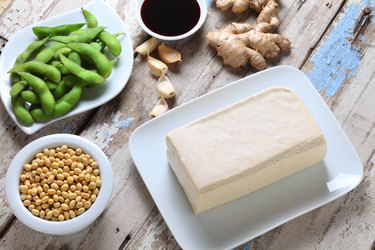
For infants who are not yet old enough to eat solid foods, the AAP states that maternal breast milk is the best source of nutrition. However, most infants drink formula milk by 2 months of age. The AAP states that formulas made with soy protein instead of bovine milk are nutritionally adequate and safe for children. Formulas made from soy may also be useful for children with allergies or lactose intolerance. However, the protein in soy formula does not have any nutritional advantage over cow's milk formula.
References
- "Pediatrics"; Dietary Recommendations for Children and Adolescents: A Guide for Practitioners; Samuel S. Gidding, et al.; February 2006
- "Pediatrics"; Soy Protein-Based Formulas: Recommendations for Use in Infant Feeding; William J. Klish, et al.; January 1998
- USDA/ARS Children's Nutrition Research Center at Baylor College of Medicine; How Much Protein Do Children Need?; May 2004
- Oklahoma State University; Protein and the Body; Janice R. Hermann, Ph.D., RD/LD
- U.S. Department of Agriculture National Nutrient Database for Standard Reference


