Many naturopathic and alternative health enthusiasts say alkaline water — whether purchased in bottles or created from your own tap with a (pricey) do-it-yourself ionizing purifier — is an extra-healthy type of water to drink.
In these circles, there are many claims around the benefits of alkaline water, including that it slows the aging process, increases energy, helps people with fertility issues, regulates your body's pH level and prevents chronic diseases like cancer.
Video of the Day
Video of the Day
No matter what, water itself is essential to our lives. After all, more than 60 percent of our bodies consists of water, and staying hydrated is important to every bodily function. That's why experts agree you should get around 11.5 to 15.5 cups of water per day through drinking or water-rich foods, according to the National Academies of Science, Engineering and Medicine.
But are the claims about alkaline water true? And is it better than regular water?
Here, learn what exactly alkaline water is, the truth about its health benefits and more.
First, What Is Alkaline Water?
If you're going to learn more about alkaline water, you'd have to start by understanding pH — i.e., the measure of the acidity or alkalinity of any substance or solution, per the U.S. Geological Survey.
The pH (potential hydrogen) scale runs from 0 to 14, with 7 as the neutral mid-point. Liquids with a pH of 1 are very acidic, and liquids with a pH of 13 are very alkaline, according to the U.S. Geological Survey.
Pure water is smack dab in the middle with a pH that is close to 7.
Alkaline water, also called ionized water, has a higher pH than regular water — generally between 7 and 9.5. It is made with a device called an ionizer, which changes the chemical composition of the water, per the Cleveland Clinic.
Potential Health Benefits of Alkaline Water
Some small studies have shown possible benefits of drinking alkaline water, but keep in mind that the research here is limited and much more of it needs to be done before we can say for sure that alkaline water produces these effects.
1. Could Help With Acid Reflux
One October 2017 study in JAMA Otolaryngology — Head & Neck Surgery had 85 people use proton pump inhibitors to relieve acid reflux and 99 treat acid reflux with the Mediterranean diet and alkaline water.
Over two years, the medication didn't work any better than the diet and alkaline water, and findings leaned in favor of diet and water changes.
It's important to point out here, of course, that this study had the participants change their diet along with drinking alkaline water, so it's impossible to tell if alkaline water alone would make a difference in acid reflux symptoms.
2. May Support Bone Health
Some studies suggest alkaline water may help slow bone loss, but more research needs to be done to determine this connection and whether it influences a person's overall bone density, per the Mayo Clinic.
3. Might Benefit Athletes
One September 2017 study in Biology of Sport found that soccer players who drank alkaline, low-mineralized water after anaerobic exercise had improved hydration status and their bodies used lactic acid more efficiently.
The study was small, though, and it's not clear why alkaline water would produce these benefits.
4. Could Have Health Benefits After Menopause
An October 2022 study in PLOS One followed 304 postmenopausal people, some of whom drank regular water and some alkaline water.
After a number of weeks, those who drank alkaline water had slightly lower diastolic blood pressure, lower fasting plasma glucose and longer sleep duration versus those who drank regular water.
The study authors mention, however, that drinking water (no matter the kind) has the potential to benefit your health in these ways, and more studies need to be done on alkaline water benefits specifically.
Claims About Alkaline Water With No Supporting Evidence
1. That It Makes Your Body 'Less Acidic'
People who swear by alkaline water believe it works by making our bodies less acidic. They think the Standard American Diet (SAD) contributes to a condition called chronic low-grade acidosis, a condition associated with health issues including hormonal problems, loss of bone and metabolic problems, per a June 2017 review in Nutrients.
But you don't need alkaline water to balance your body's pH. In fact, each part of your body has its own pH level that can skew slightly more acidic or alkaline on its own, according to an October 2011 review in the Journal of Environmental and Public Health. (Note: This is an older review, but it's the most comprehensive one done to date on the topic.)
Your blood, for example, has a pH of approximately 7.4 — slightly alkaline. It's essential for our bodies to maintain this pH within a tight range, per Merck Manuals. Even a small fluctuation of as little as .05 in our blood pH can have severe health risks.
On the other hand, your stomach acids (which digest your food), have an acidic pH between 1.5 to 3.5, per the review above.
While there are things that can neutralize acid in your body, like taking antacids for your stomach, you really don't want to get rid of all the acid in your body, through any means. Acids — like stomach acid — are actually important for digesting food and other body processes, per the National Library of Medicine (NLM).
Beware of claims that you can have "too much acid in your body," or that alkaline water can "prevent diseases caused by too much acid." None of these claims are true, per the Cleveland Clinic.
If you're concerned about your body's pH, talk to your doctor, who can guide you in the right direction.
Tip
For most people, alkaline water is not better than regular water, and it doesn't makes our bodies "less acidic," per the Mayo Clinic. There is not enough research to show that it is better than regular water or that it can prevent diseases of any kind, either.
2. That It Can Prevent or Cure Cancer or Other Chronic Diseases
In regard to preventing diseases like cancer, there are no peer-reviewed studies demonstrating that drinking alkaline water can reduce a person's cancer risk or help them to better fight cancer, per a June 2016 review in the BMJ.
3. That It Can Boost Brain Health or Prevent Alzheimer's
Some studies have tried to find a benefit of alkaline water on cognition and the reduction of Alzheimer's disease risk, but there's not enough research to support this.
4. That It Can Solve Fertility Issues or Slow the Aging Process
There is simply no research to support these claims.
Possible Risks of Drinking Too Much Alkaline Water
While it's not exactly dangerous to drink alkaline water every day, going overboard could potentially cause issues if you also take certain medications.
While rare, drinking too much alkaline water, or drinking water with a high pH, may disrupt your body's normal pH. For some people, this could lead to a condition called metabolic alkalosis, which may cause confusion, nausea, vomiting, hand tremors, muscle twitching and tingling in the face, hands or feet, per the Cleveland Clinic.
You're more likely to develop metabolic alkalosis if you've consumed excessive amounts of antacids, baking soda, water pills, certain laxatives or steroids, per the Cleveland Clinic.
Most of the time, though, if you drink alkaline water, your body can regulate itself and its pH on its own.
How Alkaline Water Is Made
There are two types of alkaline water, and they're made in different ways. They include the following, per Baylor Scott & White Health:
- 'Artificial' alkaline water: This is generally tap water that's run through an electrical ionizer to make the pH more alkaline. Proponents of alkaline water say this is achieved through a process called electrolysis, where acidic molecules and alkaline molecules in water are separated. However, there's not enough quality research to support these claims.
- Bottled spring or mineral water: Natural spring water that passes through rocks and soil and picks up various minerals, which affect its pH. Naturally occurring mineral water contains alkalizing compounds, such as calcium, silica, potassium, magnesium and bicarbonate.
While you can purchase ionizing machines, they are not generally advised, because they cannot incorporate natural essential minerals into the water, like spring water has.
There are also other drinks that are alkaline, including alkaline herbal teas, coconut water and some green juices.
Which Bottled Waters Are More Alkaline?
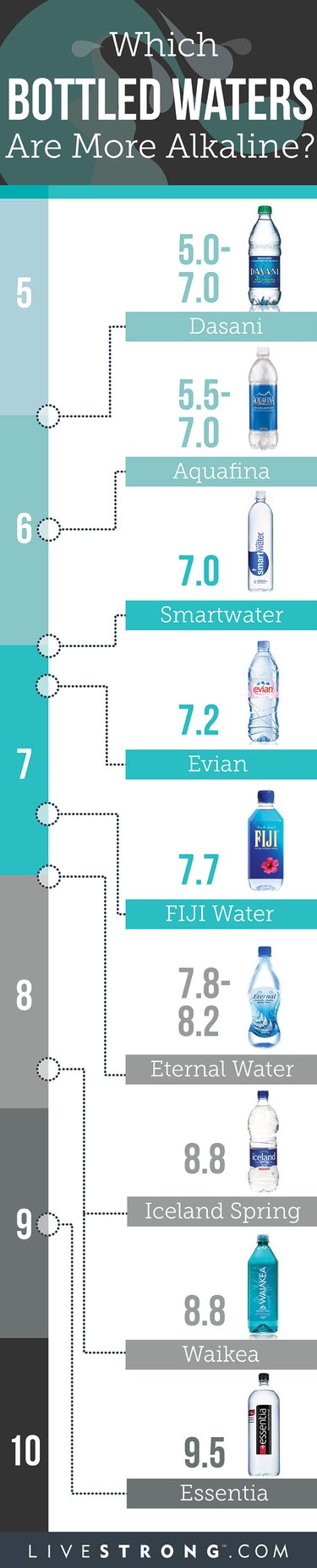
If you're still convinced alkaline water is worth drinking, there are different bottled mineral water brands that are considered more alkaline. Here is a rundown of the pH for many of the brands you can find in stores:
Essentia says its water is created from regular water on which they use reverse osmosis, followed by the addition of minerals and then an ionizing process. According to its website, Essentia guarantees a pH of 9.5 (which is more alkaline).
Waikea Hawaiian Volcanic Water says its natural spring water is naturally filtered through thousands of feet of porous volcanic rocks. The source is located at the eastern base of the Mauna Loa volcano. Waikea's website says their water has a pH between 7.6 and 8.2 (which is more alkaline) and contains magnesium, potassium, calcium, sodium and silica.
Iceland Spring says its spring water — from a natural source located in a in a nature reserve called Heiðmörk near the capital Reykjavik — is at a pH of 8.8 (which is more alkaline), per Iceland Spring's website.
Eternal Water (naturally-occurring from spring sources throughout the U.S.) says its water ranges between 7.8 and 8.2 pH, depending on many different environmental factors, per Eternal Water's website.
FIJI Water says its natural artesian water comes from an aquifer in the Fiji Islands, and the water's pH is 7.7. (which is more alkaline), per its website.
Evian mineral water from France has a pH of 7.2 (which is more alkaline than tap water), per its website.
Smartwater has a "balanced" pH of about 7.0, or neutral, per its website.
Aquafina is public tap water that is purified through a process that includes reverse osmosis and other filtering and purification methods. Aquafina's pH ranges between 5.5 and 7.0 (which is neutral to more acidic than tap water), per Pepsi's website.
Dasani is created with public tap water, which is then filtered using reverse osmosis. They then add a blend of minerals. According to various reports, Dasani's pH is somewhere between 5 and 7, which is acidic to neutral.
The Bottom Line
It is possible that alkaline water may provide some health benefits, to some people, in certain circumstances., such as acid reflux. But currently there is no way of knowing with 100 percent certainty whether drinking alkaline water is truly going to benefit your health. The studies haven't produced any hard evidence yet.
Until we have more hard evidence, you may want to stick to regular (filtered) tap water for most of your hydration. It's most important that you drink water and keep yourself hydrated.
- U.S. Geological Survey: "pH Scale"
- Nutrients: "Diet-Induced Low-Grade Metabolic Acidosis and Clinical Outcomes: A Review"
- Merck Manuals: "Overview of Acid-Base Balance"
- The Journal of Environmental and Public Health: "The Alkaline Diet: Is There Evidence That an Alkaline pH Diet Benefits Health?"
- National Library of Medicine: "Antacids"
- Mayo Clinic: "Alkaline Water: Better for You Than Plain Water?"
- BMJ: "Systematic review of the association between dietary acid load, alkaline water and cancer"
- PLOS One: "Associations of alkaline water with metabolic risks, sleep quality, muscle strength: A cross-sectional study among postmenopausal women"
- JAMA Otolaryngology Head & Neck Surgery: "A Comparison of Alkaline Water and Mediterranean Diet vs Proton Pump Inhibition for Treatment of Laryngopharyngeal Reflux"
- Cleveland Clinic: "Here’s Why Alkaline Water Doesn’t Live Up to the Hype"
- Biology of Sport: "The effect of mineral-based alkaline water on hydration status and the metabolic response to short-term anaerobic exercise"
- Cleveland Clinic: "Metabolic alkalosis"
- Baylor Scott & White Health: "Is alkaline water worth the hype?"
- Essentia Water
- Waiakea.com
- Iceland Spring
- Eternal Water
- Fiji Water
- Evian
- Pepsi.com