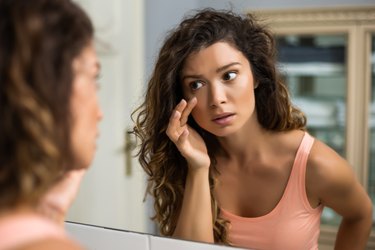
"Xanthelasma" may sound unfamiliar, but it's a familiar sight for some. These bumps on the skin won't hurt you, but it's a good idea to look at what's causing them and how you may prevent more from forming.
Zainab Laftah, MBChB, a consultant dermatologist at the London Dermatology Centre in London, England, describes them as "cholesterol bumps — soft yellow deposits that typically appear on the eyelids (xanthelasma) or over joints (xanthoma)."
Video of the Day
Video of the Day
Caused by a buildup of cholesterol beneath the skin, these bumps are generally harmless but can still be annoying and may point to other issues, notes the American Osteopathic College of Dermatology. The good news: Xanthelasma affects only 1.1 percent of women and 0.3 percent of men, according to a December 2017 review in Clinical, Cosmetic and Investigational Dermatology.
Cholesterol and Xanthelasma
To understand xanthelasma, you need to know a bit about cholesterol.
According to the U.S. National Library of Medicine (NLM), cholesterol is a fat-like substance (or lipid) found in all body cells and certain animal products. Your body needs some cholesterol to perform important functions, such as processing the food you eat and creating molecules (called hormones) that help your body function.
But too much cholesterol can cause issues. Cholesterol bumps on your skin may be harmless on their own, but other complications, like cholesterol that forms plaque and builds up in your blood vessels, put you at risk for serious heart concerns, notes the American Heart Association (AHA).
The researchers of an April 2018 review, published in the Journal of Cutaneous and Aesthetic Surgery (JCAS), point to two main risk factors for xanthelasma: age (over 40) and high cholesterol (specifically, hyperlipidemia, meaning high levels of blood fats like triglycerides and cholesterol, notes the NLM). High cholesterol can be genetic, meaning it's a family trait, or caused by a diet high in cholesterol.
According to Dr. Laftah, "50 percent of patients with xanthelasma and xanthoma have underlying raised cholesterol or triglyceride levels."
Other less common risk factors for those bumps include pregnancy, obesity, diabetes, liver issues and the use of certain medications — all of which can impact cholesterol levels.
Xanthelasma bumps have certain unique characteristics that distinguish them from other common skin bumps like warts, pimples or milia (skin bumps formed by keratin protein), reports the JCAS review. It says they tend to be:
- Soft.
- Thin or only slightly raised.
- Uniquely shaped (meaning they may have sides and aren't always circular).
- Present around both eyes (not just one).
- Symmetrical
(meaning each bump's shape has two similar halves).
What to Do
If you think you've developed cholesterol bumps, talk with your doctor. You'll be asked about your personal and family health history, and your doctor may order a cholesterol test, also known as a "fasting lipid screen," notes Dr. Laftah.
Cholesterol bumps won't go away on their own once they appear, and it's never a good idea to pick or poke at them. "Home 'DIY' treatments should be avoided due to the risk of complications such as infection, bleeding and scarring," Dr. Laftah explains.
However, if you're already dealing with cholesterol bumps, three key steps may help:
- Lifestyle changes: The AHA notes that a heart-healthy diet with fewer animal products like meat, eggs and dairy (including cheese) can reduce how much cholesterol you consume. And to keep hyperlipidemia at bay, the more physically active you can get, the better.
- Medication: If cholesterol remains a concern even after lifestyle changes, your doctor may prescribe a cholesterol-lowering medication, such as a statin. These drugs don't treat cholesterol bumps on their own, but they can help to address cholesterol levels that are too high, notes the AHA.
- Topical peels or surgery: If xanthelasma constantly
reappears or affects a large area of your eyelids, the JCAS review notes that chemical peels, procedures involving
removal with lasers and special substances, liquid cold therapy or surgical
excisions can remove cholesterol deposits. Keep in mind, however, that these
procedures aren't always covered by insurance and may have complications,
including the possibility that cholesterol bumps will reappear.
- Zainab Laftah, MBChB, consultant dermatologist, London Dermatology Centre, London, United Kingdom
- American Osteopathic College of Dermatology: “Xanthelasma”
- Clinical, Cosmetic and Investigational Dermatology: “Xanthelasma Palpebrarum – A Brief Review”
- U.S. National Library of Medicine: “High Blood Cholesterol Levels”
- American Heart Association. “Prevention and Treatment of High Cholesterol (Hyperlipidemia)”
- Journal of Cutaneous and Aesthetic Surgery: “Xanthelasma: An Update on Treatment Modalities”
- American Heart Association: “Cholesterol Medications”
Is this an emergency? If you are experiencing serious medical symptoms, please see the National Library of Medicine’s list of signs you need emergency medical attention or call 911.