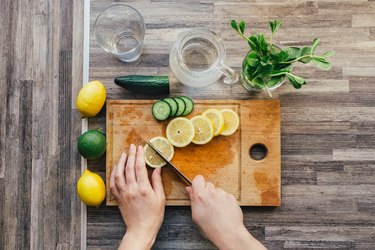
Lemons and limes are very similar, and they're both nutritious, just like other citrus fruits. Although the difference between limes and lemons is minimal, lemons have twice as much vitamin C compared to limes — making them slightly healthier.
Tip
Lemons and limes are fairly similar. However, gram for gram, limes' vitamin C content is less than that of lemons. This means that lemons have a slight nutritional advantage.
Video of the Day
Read more: 12 Foods With Surprising Health Benefits
Video of the Day
Lime vs. Lemon Nutrition
Limes are usually smaller than lemons. According to the USDA, 100 grams (about 3.5 ounces) of lime supply less than a gram of protein and 10.5 grams of carbohydrates, 2.8 grams of which come from fiber. Lime vitamin C content is 32 percent of the daily value (DV). They also have 7 percent of the DV for copper.
There are many other essential nutrients in limes, but these are only present in small amounts. You'll find between 1 and 4 percent of vitamin A, B-complex vitamins, vitamin E, vitamin K, selenium, phosphorus, magnesium, potassium, calcium and iron in 100 grams of limes.
Comparatively, the USDA says that 100 grams of lemon has 1.1 grams of protein and 9.3 grams of carbohydrates, 2.8 of which come from fiber. Lemons have 59 percent of the daily value for vitamin C and 5 percent of the DV for vitamin B6.
Lemons also have small amounts (between 1 and 4 percent) of most essential vitamins, including vitamin A, B-complex vitamins and vitamin E. You'll also find small amounts of copper, zinc, calcium, iron, potassium, magnesium and manganese in every 100 grams of lemons.
As you can see, there aren't too many differences between limes and lemons. Both of these citrus fruits have roughly the same amounts of carbohydrates, fiber and protein. Both are rich in ascorbic acid and have a small amount of many other essential nutrients.
If you're comparing limes versus lemons to get enough ascorbic acid, you should probably consume lemons. Limes' vitamin C content is about half of the vitamin C content of lemons.
Consuming Lime vs. Lemon
Limes and lemons are fairly similar nutritionally. However, you're likely aware of how different limes and lemons smell, taste and look.
In general, limes are green and lemons are yellow. However, unripe lemons are green, just like limes. Similarly, ripe limes become yellow, just like lemons.
Although both of these citrus fruits are acidic, you'll find that lemons tend to have a more sour, tart flavor compared to limes. Limes tend to have a slightly more bitter flavor than lemons. Despite these differences, you can use both limes and lemons as ingredients in a variety of foods and beverages, including cocktails, juices, tarts, desserts, marinades and pickled foods.
You also even can use the rinds of lemons and limes to flavor your water. The Mayo Clinic recommends freezing lemons and limes and using them in place of ice cubes, or squeezing them into tea.
According to a January 2013 study in the International Journal of Ayurvedic and Herbal Medicine, these citrus fruits are also rich in beneficial bioactive compounds, like flavonoids, that act as antioxidants. These nutritional benefits aren't only in the fruit's juice, but its rind.
Read more: 12 Ways to Make Water Taste (Much) Better
Limes and lemons share many of the same qualities and benefits, but they also have the same downsides. Both of these citrus fruits are very acidic. According to a January 2014 study in the Procedia Technology Journal, the high acid content in citrus fruits like lemon can damage tooth enamel.
Fortunately, most people aren't interested in drinking pure lemon or lime juice. As long as you've diluted the juice and brush your teeth regularly, you shouldn't experience any issues.
- USDA: "Nutrition Comparison of Limes and Lemons"
- Procedia Technology: "Effect of Acid Erosion Followed by Remineralization Process on Microhardness of Dental Enamel"
- International Journal of Ayurvedic and Herbal Medicine: "Health and Medicinal Properties of Lemon (Citrus Limonum)"
- Mayo Clinic Health System: "Are You Struggling to Drink Enough Water Daily?"