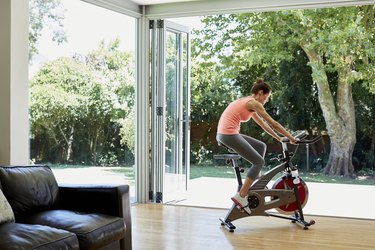
Got a pain in your butt? It could be piriformis syndrome — a tight muscle compressing your sciatic nerve. While exercise can be beneficial for this condition, using an exercise bike isn't the best cardio exercise for piriformis syndrome.
Tip
Avoid any exercises that worsen your symptoms. While exercising can be helpful, sitting on the buttock muscle while using a bike isn't the best cardio exercise for piriformis syndrome.
Video of the Day
What is Piriformis Syndrome?
The piriformis muscle doesn't get a lot of attention, until it starts to hurt. This deep buttock muscle primarily performs hip external rotation, turning your thigh outward, according to ExRx.net. A tight piriformis muscle can compress the large sciatic nerve on each leg, which branches off nerves from your lower back and travels down the back of your thigh, splitting into two smaller nerves in your lower leg.
Video of the Day
According to an April 2014 review in the Journal of Evolution of Medical and Dental Sciences, piriformis syndrome causes buttock pain that typically occurs when standing up from a seated or squatting position. This pain — sometimes referred to as "sciatica" — can also spread to your lower back and down your leg, all the way to your foot. You might also have numbness or tingling in your leg. Walking usually lessens pain from piriformis syndrome, and rest can make it worse. While the underlying cause of this condition isn't always evident, there are some contributing factors.
Piriformis syndrome can develop from a habit that is common among males — carrying a wallet in the back pocket. Sitting on this object puts direct pressure on the piriformis muscle, rotates your hips and throws your spine off kilter. Other causes of piriformis syndrome include hip surgery, exercising more intensely than your body is used to, injury, scoliosis, leg-length discrepancy and foot problems, according to Mayo Clinic.
Symptoms of piriformis syndrome can mimic other medical conditions, such as a pinched nerve in the lower back, arthritis in the spine, disc degeneration, hip disorders or even a tumor in the pelvis. It's important to determine the cause of your symptoms before attempting gym exercises for sciatica caused by piriformis syndrome.
Gym Exercises for Sciatica
Avoid any exercises that increase your symptoms — particularly activities that are performed in a seated position, such as rowing, using a recumbent stepper, upper body ergometer or riding a bike (upright or recumbent). Walking up stairs often makes piriformis syndrome worse, so avoid using stair-climbing machines as well. These aren't the best choice of gym exercises for sciatica caused by piriformis syndrome, but there are other ways to get your cardio in.
Try using an elliptical machine or walking on a treadmill. Keep these machines on a flat incline to reduce the risk of increased pain. Exercising in water also reduces the amount of body weight on your affected leg.
Consider water walking or jogging, or swimming at a leisurely pace. Avoid swimming strokes that put significant strain on your hip joints, such as breaststroke and butterfly. Don't use flippers — these increase strain on your hip muscles, including the piriformis. Consider placing a pull buoy between your legs and swim using only your arms.
Read more: Piriformis Syndrome and Walking
Stretch It Out
Piriformis syndrome can be treated with exercises such as stretching. These exercises should target not only the piriformis, but other muscles that attach to the pelvis as well. For the best results, see a physical therapist for an individualized treatment program.
Hold each stretch for 20 to 30 seconds and repeat three times, as explained by BayCare Clinic and the American Academy of Orthopaedics Surgeons. Stretching might be uncomfortable, causing a strong pulling sensation. However, your pain should not increase. If it does, you are stretching too far.
Move 1: Knee to Chest
- Lie on your back.
- Bend one knee and bring it toward your chest. Keep the opposite leg straight.
- Grasp your knee with your hands and gently pull it closer to your chest until you feel a stretch in your buttock.
Move 2: Figure 4 Stretch
- Lie on your back with your knees bent and feet on the floor.
- Cross the ankle of your affected leg over the opposite thigh, just above the knee. Your thighs will now form a "figure 4".
- Gently press the knee of your affected leg away from you until you feel a strong stretch in your buttock.
Make this stretch even more intense by lifting the opposite foot off the floor.
The Figure 4 Stretch can also be performed in a chair without using your arms:
- Sit on the edge of a firm chair.
- Cross the ankle of your affected leg over your opposite knee.
- Gently press down on your knee until you feel the stretch.
Increase the intensity of this stretch by leaning forward at your hips.
Move 3: Seated Twist
- Sit on the floor with both legs out straight.
- Bend the knee on your affected leg. Cross this foot over the opposite leg and place your foot on the ground, next to your knee.
- Reach behind you with the arm on the affected side, resting your hand on the ground for support.
- Twist your torso toward your bent leg.
- Place the opposite hand on the bent thigh and slowly push further into the stretch.
- Stop when you feel a strong pull in your buttocks.
Move 4: Knee to Opposite Shoulder
- Lie on your back.
- Bend the knee of your affected leg and raise it across your body, toward the opposite shoulder.
- Place the opposite hand on the outside of your knee and gently pull your knee toward you. Keep your lower back on the ground during this exercise.
Move 5: Supine Hamstring Stretch
- Lie on your back with your knees bent and feet on the floor.
- Lift the foot of your affected leg off the floor. Reach your arms around your thigh and clasp your hands together behind your knee.
- Slowly straighten your knee, pressing your heel up toward the ceiling. Stop when you feel a strong pull along the back of your thigh.
Move 6: Hip Flexor Stretch
- Stand with your feet hip-width apart.
- Take a large step backward with your affected leg and rest the ball of your foot on the ground.
- Bend both knees until the back knee is resting on the ground.
- Keeping your chest up, slowly shift your weight over your front leg until you feel a strong pull at the front of your hip on the back leg.
Intensify this stretch by squeezing your glute muscles and pushing your hips forward.
Release the Piriformis Muscle
Tight muscles, such as the piriformis, can lead to the development of trigger points — hyper-irritable groups of muscle fibers. According to Clarkson University Physical Therapy, these spots feel tender and tight, and are painful to the touch.
Trigger points and piriformis muscle tightness can be treated with direct pressure. Try foam rolling the affected area, as described by the National Academy of Sports Medicine:
- Sit on the foam roller.
- Cross the affected leg over the opposite leg, resting it on your thigh. Hold it in place with the opposite hand.
- Shift your weight on to the affected buttock. Place your other hand on the ground behind you for support.
- Roll back and forth along your piriformis muscle — this will be a small movement. When you hit a particularly sore spot, hold that pressure for 30 to 45 seconds.
Trigger point release can also be performed by lying with a tennis or lacrosse ball under the affected buttock. This will be painful, but try to maintain pressure on your trigger point until the pain subsides — it could take several minutes. This will help relieve tightness by temporarily reducing blood flow to the affected area.
Strengthen Your Core Muscles
Weakness of your deep hip and core muscles can contribute to piriformis syndrome by overworking the muscle. Strengthen your abdominal muscles and others deep in your hips, pelvis and lower back, as described by Princeton University Athletic Medicine, to help reduce the burden on your piriformis.
Begin with 10 repetitions of each exercise and work up to three sets in a row. If any exercise increases your pain, stop immediately.
Move 1: Abdominal Draw-In
- Lie on your back with your knees bent and feet on the floor.
- Place your hands on your hips, with your fingers over the edges of your abdominal muscles.
- Tighten your lower abs as if you are trying to pull your belly button up to your spine. Do not hold your breath. You should feel the muscles under your fingertips tightening.
- Hold for three to five seconds, then relax.
Progress this exercise by performing the abdominal draw-in with additional movements:
- Raise and lower one arm at a time. Progress to both arms at the same time.
- March your feet, raising and lowering one at a time, at a controlled pace.
- Slide one heel along the ground until that leg is straight. Slide it back up to your buttock and switch sides.
- Bring one knee in to your chest, then back to the starting position.
Move 2: Dead Bugs
- Lie on your back, like a "dead bug".
- Raise both arms up toward the ceiling.
- Bend your knees and raise them up until your lower legs are parallel to the ground. This is the starting position.
- Perform an abdominal draw-in and maintain this tightness throughout the exercise.
- Slowly lower your right arm to the ground over your head. At the same time, lower your left foot to the ground while keeping your knee bent.
- Return to the starting position and repeat on the opposite side.
- ExRx.net: "Hip External Rotators"
- Journal of Evolution of Medical and Dental Sciences: "Piriformis Syndrome: A Review"
- Harvard Health Publishing: "Ask Dr. Rob About Piriformis Syndrome"
- BayCare Clinic: "Stretching Exercises for Piriformis"
- American Academy of Orthopaedic Surgeons: "Hip Conditioning Program"
- National Academy of Sports Medicine: "Piriformis: Is It Really Tight? Really?"
- Clarkson University Physical Therapy: "Learn How to Manage Trigger Points"
- Princeton University Athletic Medicine: "Lumbar/Core Strength and Stability Exercises"