
Calcium begins to accumulate teen males' arteries but women typically do not get the calcium buildup until after menopause because estrogen protects women. Older people who develop significant osteoporosis have the greatest arterial calcification, a fact that suggests that calcium that should remain in bones winds up in arteries. A decline in estrogen is a major player, as are a lack of exercise, stress, smoking, poor dietary habits and a deficiency of vitamins D3 and K2. Preventing and slowing the buildup of calcium in your arteries can be done with a circulatory friendly diet, exercise and vitamin K2.
Dietary Measures
Video of the Day
Step 1
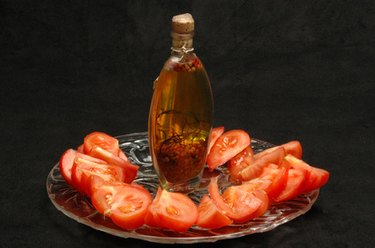
Follow the Cretan Mediterranean diet, which is rich in vitamins, minerals and specific fats and fiber that are heart and circulatory system friendly. This diet also emphasizes eating lots of green vegetables, which contain vitamin K2.
Video of the Day
A number of studies have shown that K2 consumption is linked to decreased arterial calcification. Researchers from several leading universities in the Netherlands including the University of Maastricht completed a study in 2004 called The Rotterdam Study in which they tracked the vitamin K2 intake of 4,800 elderly people with no history of heart disease. They found that those who took at least 45 micrograms a day of vitamin K2 had a 50 percent decrease in arterial calcification and cardiovascular mortality risk.
Step 2
Take a vitamin K2 supplement. As the daily amount of dietary K2 you get varies with the foods you consume, taking a supplement can help ensure there is no shortfall. Scientists have yet to determine the optimal dose for this vitamin. Most K2 products come in either 30- or 90-microgram capsules to be taken once daily or in soft-gel form and contain a form of K2 called menaquinone-7, which is readily assimilated and long-lived in the body. The Linus Pauling Institute at Oregon State University suggests "taking a multivitamin-mineral supplement and eating at least 1 cup of dark green leafy vegetables daily."
Step 3
Exercise regularly. Aerobic exercise has been shown to reduce arterial calcification. This kind of intense and taxing physical activity is not, however, the sole way to pull this off. A Johns Hopkins University study found that women 45 to 64 years old who walked briskly for 30 minutes or more two to three times a week had 33 percent less arterial calcification than women in the same age group who got less exercise or none.
The findings of a 2009 Korean study parallel this in that "short-duration exercise may effectively improve arterial stiffness even in patients with stable coronary artery disease."
Things You'll Need
Mediterranean Diet Cookbook
Vitamin K2
Tip
A Japanese fermented soybean food called natto contains about 1,000 micrograms of menaquinone-7 and 84 micrograms menaquinone-8 per 3 1/2-ounce serving.
Warning
People taking anti-coagulant or anti-platelet medications, or who have a bleeding disorder, should consult a licensed physician before taking supplemental vitamins K2.
In addition, people who have been sedentary for a long time or who have a chronic disease should discuss suitable forms of exercise with a physician.
- University of Washington: Osteoporosis and bond physiology; Vascular calcifications, leptins and lipids
- "American Journal of Clinical Nutrition"; Cretan Mediterranean Diet; S Renaud, M de Lorgeril, J Delaye, et al; 1995
- "The Journal of Nutrition"; The Rotterdam Study; Johanna M. Geleijnse, Cees Vermeer, Diederick E. Grobbeem et al. April 2004
- Johns Hopkins University
- The Effects of Short-duration Exercise on Arterial Stiffness in Patients
- "Natural Meicine Journal"; Vitamin K prevents coronary artery calcification; Dr. Alan R. Gaby