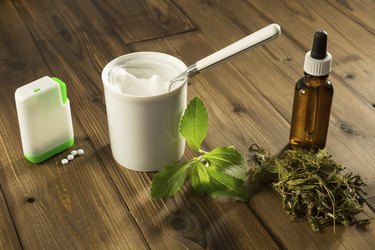
A plant-derived sweetener, stevia is used as a no-calorie sugar substitute in foods and drinks. Made from the Stevia rebaudiana plant, it is originally from South America, although it is now widely available in grocery stores and health food stores. Stevia is much sweeter than refined sugar, and some stevia preparations may affect your blood sugar levels.
Type of Stevia
Video of the Day
The U.S. Food and Drug Administration has only approved stevia that is made from rebaudioside, a natural compound in Stevia rebaudiana. Rebaudioside must be purified before it can be used as an additive, and stevia sweeteners made from stevia leaves or crude extracts of the plant are not approved for use. The sweetener made from refined rebaudioside is considered safe for use.
Video of the Day
Lowers Blood Sugar Levels
A 2005 publication of "Planta Medica" found that stevia sweetener made from stevioside, another component of the leaves similar to rebaudioside, lowered blood sugar levels, reducing insulin resistance in rats with diabetes. When administered twice daily, stevioside was also found to have an effect on blood glucose levels during glucose tolerance testing, lowering the rise of blood glucose levels in the test subjects. While the results are promising, long-term study on humans is needed, and stevioside is not currently approved for use in foods.
Compared With Aspartame
A 2010 issue of "Appetite" reported that human participants in a study preferred the taste of aspartame compared to sugar and stevia in the form of rebaudioside. However, while both aspartame and stevia led to lower blood glucose levels after a meal, only stevia caused lower insulin levels after eating. While there was no difference in the amount of food consumed, both the stevia and aspartame test groups ate slightly fewer calories, as these sweeteners contain fewer calories than sugar.
Possible Considerations
According to NYU Langone Medical Center, while stevia is considered safe for use, its effects on children, pregnant or breast-feeding women, and those with severe liver and kidney disease is not conclusive, so consult with a physician before consuming stevia. Because it is a sugar substitute, there is no documented upper intake level, although studies have shown no complications with doses as high as 15 milligrams per kilogram or 2.2 pounds of body weight per day. Because stevia tastes between 100 and 300 times sweeter than sugar, you generally need less stevia to achieve the same degree of sweetness.
- American Council on Exercise: The Truth About Stevia
- Drugs.com: Stevia
- Planta Medica: Mechanism of the Hypoglycemic Effect of Stevioside, A Glycoside of Stevia Rebaudiana
- Appetite: Effects of Stevia, Aspartame, and Sucrose on Food Intake, Satiety, and Postprandial Glucose and Insulin Levels
- NYU Langone Medical Center: Stevia
- University of California: Los Angeles: Toxicology of Rebaudioside: A Review