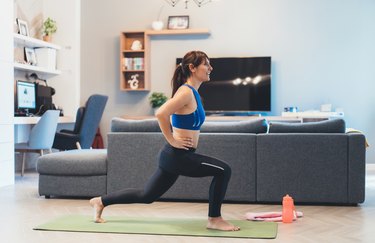
If your goal is strong glutes, taught hamstrings and powerful quads, lunges can help get you there. A long-time leg-day staple, lunges strengthen your entire lower body, challenge your balance and improve your mobility.
While all types of lunges can boost your strength gains, the variation you choose can affect the pressure on your joints, which can be problematic if you're experiencing knee pain. Choose the safest lunge variation for you and get ready to reap the strength-building benefits.
Video of the Day
The Benefits of Reverse Lunges
If you're looking for the most knee-friendly lunge, opt for reverse lunges. Unlike other lunge variations, reverse lunges are a more stable movement pattern, as you're stepping backward, according to the American Council on Exercise (ACE).
Stepping backward keeps your front foot firmly rooted, making it easier to ensure that your front knee doesn't extend beyond your toes.
They're particularly great for beginners, since the movement is more controlled, says Matt Cheng, CSCS. Plus, reverse lunges generally involve more glute engagement, so they're better for your booty than front lunges.
How to Do a Reverse Lunge
- Stand with your feet about hip-width apart, arms at your sides.
- Step with your right leg 3 feet behind you and bend your knees until they form 90-degree angles. Your back knee should hover an inch above the ground and your front thigh should be parallel to the ground.
- Keep most of your weight in the front leg as you press into your left heel and straighten your left leg.
- Bring the right leg back to the starting position and stand up.
- Repeat the motion with the opposite leg.
Tip
While performing a reverse lunge, keep about 70 percent of your weight on your front leg, Cheng says. That way, you'll feel both your quads and glutes fire up during the movement.
And as you perform a reverse lunge, make sure that your front knee doesn't go beyond your toes; keep your front knee over the ankle. For an added challenge, hold a pair of dumbbells while you perform the move.
The Drawbacks of Forward Lunges
Front lunges are a more challenging movement, placing more emphasis on your quads due to the forward movement, Cheng says. They can also be taxing on the knees, according to ACE.
The move propels your body forward, which can be jarring on your front knee and force it to bear more weight and the bulk of the stabilization work. Your knees also work in a broader range of motion to return to standing.
How to Do a Forward Lunge
- Stand with your feet about hip-width apart, arms at your sides.
- Step about 3 feet forward with your right leg, bending the knee until it forms a 90-degree angle. Keep most of your weight in your front leg.
- At the same time, bend your left leg to 90 degrees until your knee hovers an inch or two off the ground.
- Press into the heel of your right leg and use your glutes and hamstrings to press back to standing, bringing your right leg back to the starting position.
Tip
As you perform this move, take a peek down at your front leg to make sure your knee doesn't go beyond your toes. If you want to make this move more difficult, hold a pair of dumbbells.
2 Other Lunge Variations to Try
The reverse and forward lunge may be among the most popular, but lunge variations don't end there.
Multi-planar lunges (ones that require you to move in ways other than just forward and backward) — like the lateral and curtsy ones — can help improve your training by targeting different angles of your muscles and joints, according to the National Academy of Sports Medicine (NASM).
If you have preexisting knee issues, though, ease into these movements carefully and stop the exercise if you feel pain or discomfort.
1. Lateral Lunge
- Stand with your feet shoulder-width apart.
- With your right leg, step 3 feet to the right, keeping your toes pointing forward.
- Bend your right knee until your thigh is parallel with the ground.
- Keep your left toes pointing forward and left leg fully extended.
- Press into your right heel and use your right leg to straighten your leg and bring it back to meet the left.
- Repeat this movement on the left side.
Tip
As you perform this move, engage your core and keep your spine elongated, according to the NASM. Make sure the toes in your right leg stay behind your right toes.
2. Curtsy Lunge
- Stand with your feet about shoulder-width apart.
- Take a step back with your right leg, crossing it behind you, keeping your heel lifted off the ground.
- Bend your right knee until it hovers above the ground.
- At the same time, bend your front knee until your front thigh is parallel with the ground, squatting down as if you were curtsying.
- Press into your front heel and bring your right leg back to standing.
Tip
While you perform this lunge, keep your core engaged and hips pointing forward, according to the NASM. Try to center your shoulders and weight over the top of your hips.