When proteins are digested down, the body is left with amino acids, which help the body break down food, repair body tissue, grow and perform many other functions, per the U.S. National Library of Medicine (NLM). Amino acids can also be a source of energy.
One amino acid, called D-aspartic acid — also known as aspartic acid — helps every cell in the body work properly, per the NLM.
Video of the Day
Video of the Day
Other D-aspartic acid functions include helping with hormone production and release and maintaining your nervous system. It's a "non-essential" amino acid, meaning that your body produces it even if you don't get enough of it from the food you eat.
Here's a list of foods that contain aspartic acid.
How Much D-Aspartic Acid Do You Need?
There is no daily value (DV) for d-aspartic acid because your body produces it on its own (it's a non-essential amino acid).
1. Beef: 2,809 mg
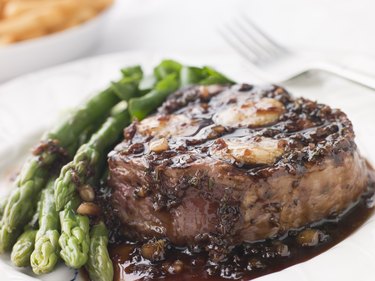
Beef steak is high in D-aspartic acid with 2,809 milligrams per 3 ounces cooked. Because meat is high in protein (and therefore amino acids), it tends to be a good source of aspartic acid.
And if you're looking for which foods have all nine essential amino acids, meat is a good place to start — animal proteins provide all the essential amino acids you need, per Cedars-Sinai.
Other types of meat, including pork and lamb, are also good sources of aspartic acid. Although there are some benefits of eating red meat in moderation, you should try to limit your intake to one to two servings (6 ounces or less) per week, per the Cleveland Clinic. Limit to 3 ounces or less per week if you have heart disease or high cholesterol.
2. Chicken Breast: 2,563 mg
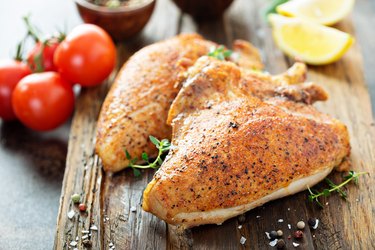
Like red meat, poultry such as chicken breast is a good source of D-aspartic acid with 2,563 milligrams per 3 ounces cooked. Chicken provides 27.3 grams of protein with just 0.9 grams of saturated fat, making it a healthy amino acid-rich food.
Other types of poultry also are a good source of this amino acid: Turkey breast provides 1,833 milligrams per 3 ounces cooked, while an equal amount of duck meat contains 1,955 milligrams.
Try it in these easy chicken recipes under 500 calories.
Should You Take D-Aspartic Acid Before Bed?
Some people take D-aspartic acid before bed to promote muscle growth or to increase testosterone, but there’s limited (and mixed) evidence behind this and it's not recommended by major medical organizations. Plus, it’s still unknown if D-aspartic acid is bad for you when taken in large amounts. A daily dose of 6 grams of D-aspartic acid actually decreased levels of weight-training men’s testosterone over two weeks in an April 2015 study in the Journal of the International Society of Sports Nutrition.
3. Nectarines: 886 mg
D-aspartic acid fruits include nectarines, which have 886 milligrams of the amino acid each. Fruits have all-around benefits for your health: Eating two servings of fruit and three servings of vegetables per day is associated with the lowest mortality rates in a March 2021 study published in Circulation.
4. Oysters: 775 mg
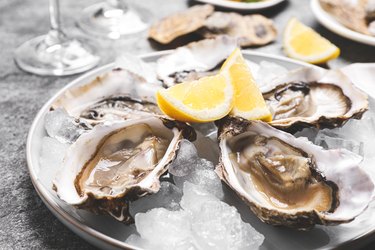
Oysters are a great source of D-aspartic acid, with 775 milligrams per 3 ounces raw. They're also an incredible source of certain vitamins and minerals — they provide 567 percent of the daily value (DV) for vitamin B12 and 128 percent of the DV for zinc.
Vitamin B12 keeps your blood and nerve cells healthy and also helps to create DNA, according to the National Institutes of Health (NIH). Meanwhile, zinc helps the immune system fight off viruses and bacteria, and it also helps to make DNA, per the NIH.
5. Eggs: 632 mg
One hard-boiled egg contains 632 milligrams of D-aspartic acid. Along with the D-aspartic acid in eggs, you'll also get 6.3 grams of protein and 23 percent of the DV for vitamin B12
Eggs have been both vilified and glorified in the nutrition world, but most experts agree that eating eggs in low or moderate amounts is safe for most people. Eggs aren't the absolute healthiest breakfast choice, but they're not the worst either, per Harvard T.H. Chan School of Public Health. Although they contain dietary cholesterol (which, by the way, is only weakly related to cholesterol in your blood), eggs also provide nutrients that might help lower heart disease risk.
Try these nutrient-dense egg recipes.
6. Asparagus: 500 mg
Asparagus offers 500 milligrams of D-aspartic acid per ½ cup cooked as well as 1.8 grams of heart-healthy fiber and only 20 calories. This fiber-rich staple is a great option if you're looking for D-aspartic acid foods that are vegetarian.
Many Americans fall short of the recommended daily amount of fiber, which is 25 to 38 grams, per the Academy of Nutrition and Dietetics.
7. Avocados: 474 mg
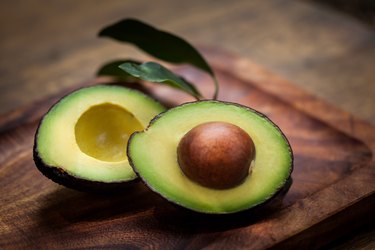
Another fruit source of D-aspartic worth calling out is the avocado, which has 474 milligrams per fruit. An avocado also offers 19.6 grams of healthy monounsaturated fats and 3.6 grams of healthy polyunsaturated fat.
Try it in these creative and flavorful avocado recipes.
Is There D-Aspartic Acid in Herbs?
As you can see from the list above, animal-based foods aren’t the only sources of D-aspartic acid. Even herbs contain aspartic acid, though in small amounts. For instance, you’ll get 18 milligrams of aspartic acid in ¼ cup of basil. Chopped chives contain 9 milligrams of aspartic acid per tablespoon.
- U.S National Library of Medicine: "Amino Acids"
- U.S National Library of Medicine: "Aspartic acid"
- MyFoodData: "Skirt Steak"
- Cedars-Sinai: "Are Animal Proteins Better for You Than Plant Proteins?"
- MyFoodData: "Pork Loin"
- MyFoodData: "Lamb Shank"
- Cleveland Clinic: "Is Read Meat Bad for You?"
- MyFoodData: "Lean Chicken Breast (Cooked)"
- MyFoodData: "Roasted Turkey Breast"
- MyFoodData: "Roast Duck"
- Journal of the International Society of Sports Nutrition: "Three and six grams supplementation of d-aspartic acid in resistance trained men"
- MyFoodData: "Asparagus (Cooked)"
- Academy of Nutrition and Dietetics: "Easy Ways to Boost Fiber in Your Daily Diet"
- MyFoodData: "Raw Pacific Oysters"
- National Institutes of Health: "Vitamin B12"
- National Institutes of Health: "Zinc"
- MyFoodData: "Hard Boiled Eggs"
- Harvard T.H. Chan School of Public Health: "Eggs"
- MyFoodData: "Nectarines"
- American College of Cardiology: "Fruit and Vegetable Intake and Mortality"
- MyFoodData: "Yellow Peaches"
- MyFoodData: "Apricots"
- MyFoodData: "Cherries (Sweet)"
- MyFoodData: "Plums"
- MyFoodData: "Bananas"
- MyFoodData: "Avocados"
- MyFoodData: "Basil"
- MyFoodData: "Chives"