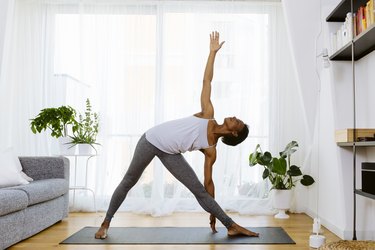
Motivation and willpower are key to a good workout. Workout room colors can play into building that motivation and willpower, as different hues can make a difference in how you feel. Not all workouts call for the same color, though.
High-Intensity Workouts
Video of the Day
The goal of high-intensity interval training, or HIIT, is to get your heart rate up and burn as many calories as possible. According to the American Council on Exercise, HIIT refers to alternating bouts of short-duration, high-intensity exercise and low-intensity active recovery. On a scale of 1 to 10 of perceived exertion, the high-intensity intervals are a 7 or above; while using max heart rate (MHR), the intervals are above 80 percent of MHR.
Video of the Day
If you like HIIT and want to choose home gym paint colors that support higher heart rates, go with either red or yellow. A small study published in February 2015 in Color Research and Application determined that heart rate is not only affected by color, but it increased when surrounded by red and yellow hues.
Red is also a good power choice if you want to feel like you're dominating your workout. A study published in January 2016 in Applied Cognitive Psychology found that the color red is associated with feelings of dominance and arousal.
Read more: How to Build the Best HIIT Workout For You
Calm, Low-Key Exercise
If red and yellow affect heart rate, it makes sense that the colors on the opposite side of the color wheel are more likely to elicit calmness. Low-key workouts, such as yoga and tai chi, often focus on controlling your breathing, relaxing your muscles and removing negative thoughts from your mind. For this type of workout, the best color to paint an exercise room is one that facilitates these goals of letting go and achieving serenity.
Research published in August 2018 in Frontiers in Psychology looked at how colors rated on a "calm" scale, finding that green elicited the highest levels of calmness, followed by blue and violet. Researchers of the study noted that blue is often associated with serenity and calm.
Orange was lowest on the "calm" scale, so it might not be the best home gym paint color to consider when creating a workout room that's dedicated to serene activities like yoga.
Read more: 10 Best Yoga Poses for Beginners
Focus on Happy Thoughts
If you're the type to switch around your workouts, doing yoga one day and running on the treadmill the next, you might be more focused on what color fits your mood versus what fits your workout.
If you want to decrease your feelings of negativity when you're working out, consider painting your home gym a shade of pink. According to the Paint and Decorating Retailers Association, this shade calms antagonistic behaviors — meaning you might feel like you're in a better mood when working out.
Read more: 12 Workouts to Improve Your Mood
Additionally, if you want to focus on being in a good mood during a workout, then you might want to avoid the color red in your workout room. Research published in February 2019 in Frontiers in Psychology looked at how colors are associated with various emotions and found that red was consistently linked to feelings of anger.
If happy is what you're going for, yellow is another option for your home gym paint color. A review of studies published in SAGE Open in February 2014 found that yellow is most often associated with words such as "cheerful," "joy" and "jovial."
- Frontiers in Psychology: "Interior Color and Psychological Functioning in a University Residence Hall"
- Paint and Decorating Retailers Association: "The Psychology of Color"
- Color Research and Application: "The Influence of Color on Student Emotion, Heart Rate, and Performance in Learning Environments"
- American Council on Exercise: "What Is High Intensity Interval Training (HIIT) and What Are the Benefits?"
- Frontiers in Psychology: "What Color Is Your Anger? Assessing Color-Emotion Pairings in English Speakers"
- Applied Cognitive Psychology: "How Red, Blue, and Green Are Affectively Judged"
- SAGE Open: "The Effects of Color on the Moods of College Students"