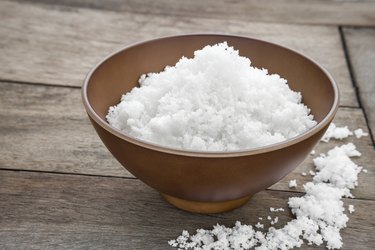
Between saccharin, aspartame, sucralose, stevia and the long-outlawed cyclamates, it's easy to be confused by all the artificial sweeteners. Judging which products are best for baking and which are best for use at the table is baffling enough without weighing the relative safety concerns. Sodium saccharin has 100-plus years of commercial use in the U.S. Scientists have exhaustively studied its relative safety over the decades.
Chemistry
Video of the Day
Sodium saccharin is the salt form of saccharin, an artificial sweetener. Like many other salts, it dissociates into its component parts when dissolved in water. The words "sodium saccharin" and "saccharin" are used interchangeably because saccharin is the component that has the sweet taste. Both names are easier to use than the true chemical name, which is 1,2-benzisothiazol-3(2H)-one,1,1-dioxide. This chemical has a molecular weight of 241.19. Sodium saccharin has 300 times the sweetening power of sugar. Inert bulking agents are commonly added to commercial products to make them easier to use.
Video of the Day
History
Sodium saccharin was first developed in 1878. Large-scale production began almost immediately. In the 1970s, conflicting studies in rats raised the possibility that sodium saccharin is carcinogenic so that U.S. Food and Drug Administration required that products made with saccharin include a warning label. Subsequent research in human and non-human primates showed that saccharin was safe for human consumption. For example, a January 1998 article published in the "Journal for the National Cancer Institute" showed that primates who were exposed to saccharin on a daily basis from birth showed no adverse effects. These reports led to a 2001 FDA declaration that saccharin was safe.
Uses
In addition to the little packets found in dishes on restaurant table tops, sodium saccharin is customarily used in canned fruit, flavored gelatin, dessert toppings, diet sodas, baked goods, jams, chewing gum, candy, and salad dressings. Unlike aspartame, sodium saccharin is heat stable so it can be used in cooking and baking without losing sweetness.
Fun Facts
The publication of Upton Sinclair's "The Jungle" sensitized the public to problems with adulterated food. This concern spread over to sodium saccharin. Although he had no data to support its safety, the head chemist of the Department of Agriculture proposed a ban on saccharin. President Theodore Roosevelt, a rather portly gentleman, responded, "Anyone who says saccharin is injurious to health is an idiot. Dr. Rixey gives it to me every day."
- Elmhurst College: Saccharin - The Oldest Sweetener
- "J. National Cancer Institute"; Long-Term Saccharin on Primates; S. Takayama et al.; January 1998
- FDA: Sugar - A Cautionary Tale; Update magazine; Food and Drug Law Institute; Suzanne White Junod, Ph.D.; July-August 2003
- "Chemical Heritage Magazine"; The Pursuit of Sweet: A History of Saccharin; Jesse Hicks; Spring 2010
- Food and Agriculture Organization of the United Nations: Sodium Saccharin