
















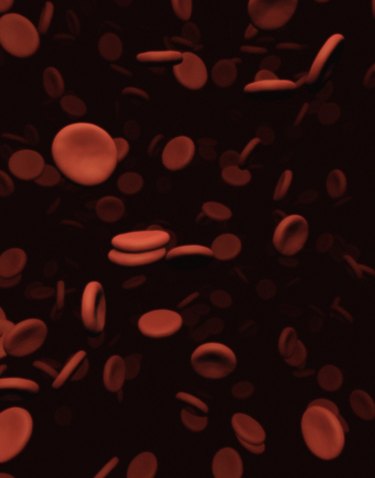















































Anemia is a common abnormality. Microcytic anemia, where the red blood cells are smaller than normal, is a disorder which is frequently seen by pediatricians, even though many children with this disorder have no symptoms or complaints. There are several types of anemia which can cause abnormally small red blood cells; there are three types which are common in children.
Microcytic Anemia
A child 2 to 4 years old should have a hemoglobin level of 12.5 g/dL; a child 4 to 6 years old should have a hemoglobin level that is 12.6 g/dL; children 6 to 10 years of age should have a hemoglobin level of 12.9 g/dL; and the normal hemoglobin level for children 11 to 15 years old is 13.4 g/dL. A level which is lower than the normal level is defined as anemia. Anemia is classified by the size of the red blood cell; in a microcytic anemia, the red blood cells are abnormally small.
Iron-Deficiency Anemia
The most common microcytic anemia in children is iron-deficiency anemia, per Joseph Irwin, M.D. in an article in the October 2001 issue of the “American Family Physician.” Most children with this anemia do not have any symptoms; only a minority may be tired, have a rapid heartbeat, breathe fast, are pale, and have a yellowish color in their skin and in the normally white part of the eye. The majority of the time, therefore, a physician will determine the child is anemic from routine lab tests. A child with this microcytic anemia will take iron supplements; the parents will be educated about a healthful diet, since having an iron-poor diet is the usual cause.
Lead Poisoning
According to the American Academy of Pediatrics, in a policy statement of October 2005, and reaffirmed January 2009, an estimated 25 percent of children live in housing that has lead paint and are, therefore, at risk of developing lead poisoning, another cause of microcytic anemia. In addition to lead paint, lead can be found in brass alloys, solder, fruit tree sprays, in the fumes of burning batteries and in home-glazed pottery. Repeatedly consuming a small amount of lead can cause lead poisoning and its symptoms of vomiting, abdominal pain, weight loss, headaches, irritability, constipation and weakness. The treatment for lead poisoning is a medication called succimer, which is taken for a total of 19 days.
Thalassemia
Red blood cells carry oxygen in their hemoglobin; normal hemoglobin has a structure made of two alpha chains and two beta chains. The thalassemias are genetic diseases which can cause microcytic anemia if there is a problem with the alpha or beta chain. Since there are four alpha hemoglobin genes, there are four kinds of alpha thalassemia diseases, as explained in “Current Diagnosis & Treatment in Family Medicine” by Brian Primack, M.D., Assistant Professor in the Departments of Medicine and Pediatrics at the University of Pittsburgh School of Medicine. Problems with the two beta hemoglobin genes can result in two beta thalassemia diseases. The symptoms and treatment, if any, will depend upon which type of thalassemia a child has.
References
- “Pediatrics”; Lead Exposure in Children; Committee on Environmental Health; 2005
- “American Family Physician”; Anemia in Children; Joseph Irwin, M.D., et al.; October 2001
- “Clinician's Pocket Reference”; Leonard Gomella, M.D., et al.; 2007
- “Current Diagnosis & Treatment: Pediatrics”; William Hay, Jr., M.D., et al.; 2011
- “Current Diagnosis & Treatment in Family Medicine”; Jeannette South-Paul, M.D., et al.; 2008
- “Williams Hematology”; Marshall Lichtman, M.D., et al.; 2010


