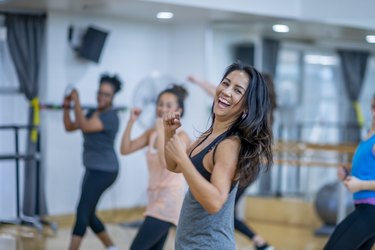
Let's get this party started! If you're looking for a fun workout class that doesn't actually feel like exercise, consider signing up for Zumba. This dance party-like fitness class has been gaining popularity — and for good reason. Every session offers a fun-yet-challenging workout that builds both cardiovascular fitness and strength.
Read on to find out everything you need to know about this popular workout.
Video of the Day
Video of the Day
What Is Zumba?
Zumba is a dance fitness workout set to Latin music and other international and upbeat styles like hip hop. "It's a lot like a cardio dance party," says Carissa Izquierdo, a licensed Zumba instructor in Los Angeles.
Zumba is built on a foundation of moves from each music style, with more traditional fitness elements — like squats and jumping jacks — layered on top to provide a full-body workout.
That said, no two classes are the same. Each instructor has a unique style and preference for certain types of music — some prefer to use faster, more upbeat music, whereas others opt for slower styles. Izquierdo recommends trying a few different classes and instructors to find the perfect one for you.
You can even find specialized Zumba classes, like Aqua Zumba (performed in a pool so it's easier on the joints), Zumba Gold (adapted specifically for active older adults), Zumba Kids (for kids ages seven to 11) and more!
Who Should Try Zumba?
Zumba is a great workout option for all fitness and ability levels. And no, you don't need to have any previous dance experience to take — and enjoy — a class. "Are you worried about not being a dancer when you go to a wedding or a party and there's a DJ?" Izquierdo asks. "[Zumba] is the same thing — you're just moving and having a good time."
Don't worry if you don't nail the choreography right away. Just like with any new workout, there's a learning curve, and remember: Everyone starts off as a beginner at some point. As long as you're moving and having fun, you're going to get a great workout, and the more classes you take, the more familiar you'll get with the moves.
Zumba is especially great for people who want to start a fitness routine but feel intimidated by the gym, since it offers tough cardio exercise, yet it's welcoming and fun, says Izquierdo. Best of all? You'll get a great workout without realizing it. "People are always surprised at how fast the hour goes by," Izquierdo says.
If you're already exercising, Zumba can inject some new energy into your routine or serve as an out-of-the-box cross-training workout. Simply swap out one of your usual cardio sessions for a Zumba class every once in a while. And for those who are cardio-averse, Zumba offers an interesting alternative to traditional steady-state running or cycling.
While Zumba is fun, it's not an easy workout by any means. Many men and young people in particular who go through a class for the first time are surprised by how intense it is, Izquierdo says. "I just got an Apple Watch, and I've been crazy about checking how many calories I'm burning. It's up to 600 [during Zumba]," she says. (Your individual calorie burn during Zumba will depend on factors like your height, weight, fitness level and effort.)
That said, if you absolutely dread any and all cardio, just don't like to dance or have a strong preference for intense weightlifting workouts, Zumba may not be your cup of tea.
Read more: 12 Workouts to Improve Your Mood
Zumba Class Format and Size
The length of a Zumba class may vary depending on where you go, but Izquierdo typically teaches for 55 minutes. Sessions are fast-paced — expect to transition right from one song to the next without a break.
The good news is that classes incorporate a mix of low- and high-intensity moves so you're not working at maximum effort for the duration. And the moves can always be modified to suit your fitness and ability level. For example, if the group is running in place for 30 seconds, you can dial down the intensity by simply marching or walking.
Classes are loud and full of energy, but instructors typically use nonverbal cues (like clapping, whistling, pointing) to signal movement and direction changes, "because we want everyone to feel the music and feel like they're at a party, rather than listening for instructions," Izquierdo says.
Expect to perform steps from traditional dance styles like merengue and salsa, with fitness moves like side steps and squats layered on top. "A lot of the steps repeat or add on," Izquierdo says. "For example, if for one song we're doing something with the feet, the next time the verse comes around we'll do the same thing with the feet but add a movement with the arms."
Many classes will also incorporate a brief warm-up and cooldown, and the format of those will change. For example, some instructors may bring down the intensity with a slow salsa and incorporate pauses for stretches. Izquierdo prefers to transition to a slower song and lead her students through a series of stretches.
How crowded the class is will depend on the location and time of day. During busy times, Izquierdo can get up to 40 people at once, whereas slower times attract a much smaller crowd. If you're curious, check with the gym, community center or studio you're interested in trying to find out their typical class size.
What to Bring and Wear to Zumba Class
Thankfully, you don't need to worry about bringing any special equipment to Zumba — just arrive ready for fun and sweat. Because you can expect to sweat a lot, you will want to bring water and a towel. "I forgot my towel one day when I taught my class, and I kept grabbing paper towels from the bathroom," Izquierdo says.
She recommends wearing typical workout clothes for Zumba. For footwear, choose cross-trainers over running shoes: "Running shoes are designed for the forward-backward motion, and trainers are designed for the left-and-right motion," she says. That said, if running shoes are your only option, by all means wear those as opposed to street sneakers.
Read more: 13 Foolproof Ways to Make Your Workout Fly By
Tips for Your First Zumba Class
You'll have more fun at your first Zumba class if you keep a few things in mind:
First, make sure to grab a spot in the room where you can see the instructor. This doesn't mean you have to be in the front row if you're not comfortable feeling like you're in the spotlight. But it might be smart to post up in the center where you'll be able to see the instructor's hand signals, Izquierdo says.
Second, be sure to take water breaks as needed. The class moves quickly, and you may not get an official water break, so be sure to pause and sip when your body tells you to.
Also, don't be afraid to modify the exercises if you need to. If the class starts doing jumping jacks but you know that move is hard on your knees, just step one foot out at a time while keeping the other foot on the floor and raise your arms overhead to mimic the motion. Let the instructor know beforehand if you have an injury or if you need any help during class.
And finally, remember to have fun. "[Zumba] is supposed to be a dance party, so don't feel too self-conscious," Izquierdo says. "As long as you keep moving, you'll have a good time."
Find a Zumba Class Near You
Because Zumba is so popular, it's pretty easy to find a ton of class options. You can search for classes in your area on the official Zumba website or check your local gym or community center for offerings. Pricing will vary depending on location.
If you prefer to try it out at home, there are also online streaming options. A couple include Zumba Digital Workouts (through the official Zumba site) and Studio SWEAT onDemand.