






















































Symptoms of an Injury to the Knee Cartilage

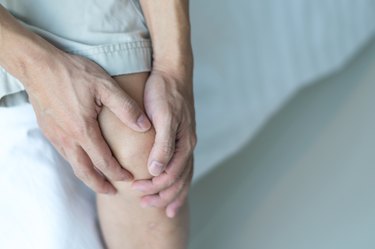
The knees are the largest joints in the body. Somewhat unique to the knee joints are the cartilage pads that provide cushioning and protection to the underlying bones. These pads separate the long bones of the thigh and lower leg and are known as the medial meniscus and the lateral meniscus. In an athlete, weekend warrior and even the average aging person, these cushions are vulnerable to injury. Certain signs and symptoms can help to differentiate a meniscus injury from other knee conditions.

Pain

Since it is usually the medial or lateral meniscus that is injured, the location of the pain depends on which meniscus is involved. A medial meniscus injury tends to cause pain on the inside part of the knee (the part adjacent to the opposite knee). Injury to the lateral meniscus causes pain more on the outside part of the knee. The pain is usually at the "joint line" where the knee bends. It tends to be a sharp pain that is aggravated by squatting or twisting movements.

Swelling

An injured meniscus usually causes some swelling. Unless the injury is severe, this swelling may take 24 hours or more to appear. If the injury is mild, the knee may not appear to be visibly swollen, but it may feel tight when you attempt to fully bend or straighten it. In cases where there may be subtle or diffuse swelling, it may help to measure the circumference of the painful knee in comparison to the non-painful side. A study in the "Irish Journal of Medical Science" found swelling of the knee joint to be one of the more reliable clinical signs of meniscus injury, being present 75 percent of the time.

Clicking/Popping

A tear or defect in a meniscus causes an irregularity to the contact points in the knee joint. In some cases, a fragment of the cartilage completely breaks off and moves around in the joint. This often results in some sort of popping, clicking or other unusual noise when the joint moves in certain ways.

Mechanical Symptoms

A meniscus injury may make it difficult to bend or straighten the knee fully. Loose or torn cartilage in the knee may only affect the movement of the joint under certain loading or movement conditions. At times, it can cause a sudden locking of the joint, an abrupt buckling or giving way of the joint. It is common for a person with a meniscus injury to learn particular maneuvers to "unlock" the knee when it misbehaves.

References

Article reviewed by Lana Gates Last updated on: Dec 30, 2009

Must see: Photo Galleries