
Breathing exercises — or focusing on slow, regular breaths — may be just the thing to help you cope with stress without leaving your home or spending any money. The idea is to trigger your body's relaxation response, characterized by slower breathing, lower blood pressure and a feeling of increased wellbeing, according to the Center for Complementary and Integrative Health.
One popular technique is the 4-7-8 breathing method, aka the relaxing breath exercise. Here's the breakdown on how it helps with stress and how to get started.
Video of the Day
Video of the Day
Benefits of Breathing Exercises
Breathing exercises are linked to several notable health benefits, such as lower blood pressure, increased immune function and lower anxiety and depression, according to Harvard Health Publishing.
When presented with any of the stressors that are part of life these days, the body naturally defaults to the "fight or flight" response, increasing blood pressure and anxiety. With consistent, proper practice of breathing techniques, though, the body learns to quickly calm itself.
Breathing exercises also acts as a meditation to quiet the mind. That's why deep breathing exercises for sleep can be very effective.
4-7-8 Breathing Method: The Basics
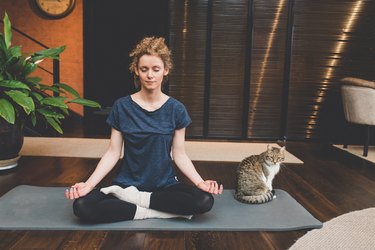
The 4-7-8 method is a simple technique that almost anyone can learn. It can indeed ease anxiety, affirms Heidi McBain, LMFT, a licensed professional counselor who helps women work through anxiety with breathing techniques in the Arlington, Texas, area.
"It helps quiet your mind while you focus on your breath," McBain says. "It may also be helpful to do this before bed if you have trouble sleeping."
The 4-7-8 breathing exercise is a form of Pranayama, an ancient Indian wellness practice.
Pranayama involves the manipulation of breath in three phases: inhalation, retention and exhalation, per a paper in the January 2018 issue of the Journal of Traditional and Complementary Medicine. (The breathing techniques used in yoga are also a form of Pranayama.
How to Do 4-7-8 Breathing
The numbers 4, 7 and 8 refer to the three time counts in this breathing method. Here are the steps for doing it correctly:
- Start by sitting up straight in a comfortable position.
- Next, place the tip of your tongue on the ridge of your gums, just behind your upper front teeth.
- Expand your diaphragm and slowly inhale through your nose for a count of 4.
- Hold your breath for another count of 7.
- Open your mouth slightly, keeping your tongue in place, and exhale for a count of 8.
- Repeat this cycle four times.
Proponents of 4-7-8 breathing recommend using this technique at least twice a day. The idea behind these scheduled sessions is to retrain your entire way of breathing. Alternatively, you can try adding it to your bedtime routine, as a deep breathing exercise to help you go to sleep.
For many of us, deep breathing feels unnatural. Body image may be one reason, according to Harvard Health Publishing. We tend to hold in our stomach muscles, which gradually makes shallow breathing seem normal and limits the diaphragm's range of motion.
As a result, the lowest part of the lungs doesn't get a full share of oxygen, which can make you feel short of breath and anxious.
Before You Get Started, Remember...
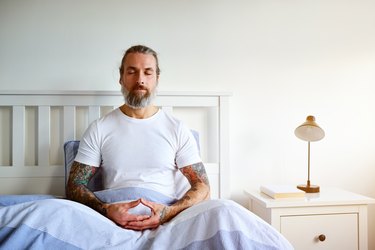
Not every breathing or relaxation technique is right for every person.
"This technique works well for some people, but others do better listening to a guided meditation or simply relaxing sounds while they focus on their breath," McBain says. "In times of great stress, creating time and space in your life to focus on your self-care is what's most important, whether it takes the form of breathing exercises, meditation, journaling, mindfulness or exercise."
And if you've tried to work through your anxiety on your own and you're not feeling better, it might be time to reach out to a therapist.
- National Institutes of Health: National Center for Complementary and Integrative Health: "Relaxation Techniques for Health"
- Journal of Traditional and Complementary Medicine: "Effects of Bhramari Pranayama on Health – A Systematic Review"
- Harvard Health Publishing: "Relaxation techniques: Breath control helps quell errant stress response"
Is this an emergency? If you are experiencing serious medical symptoms, please see the National Library of Medicine’s list of signs you need emergency medical attention or call 911.