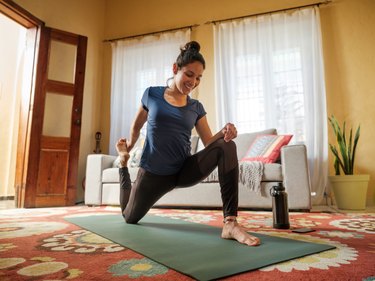
Stretching and strength training are good for your muscles and cardio is good for your heart, but what about your joints? Unlike muscles, joints have no direct blood supply, so they rely on movement to keep them functioning properly.
"If there's no motion in the joint it will degenerate — that's a law," says Robert Bates, DC, a chiropractor and preventive care specialist in Manhattan Beach, California. Joints rely on synovial fluid to "wash" away waste products that build up and compromise the integrity of the joint, he says.
Video of the Day
Video of the Day
Why Is Joint Mobility Important?
A daily joint-mobility routine can keep your joints healthy and prevent stiffness and muscle imbalances. It can also restore lost range of motion, making exercise more enjoyable, enhancing your athletic performance and protecting you from common aches and pains.
A single faulty joint affects the body as a whole, as the individual parts of the human body are meant to work synergistically, not independently. As long as there's not permanent damage in the joint, you can regain lost ranges of motion through preventive care, Bates says.
Additionally, joints that are able to move through their full range of motion allow connecting muscles to completely contract and expand, which gives muscles more strength and power and prevents injury, says Natacha Nelson, DC, a chiropractor in Hermosa Beach, California.
Do This Full-Body Mobility Routine Every Morning for Healthier Joints
Both Bates and Nelson recommend performing daily self-assessments and joint-mobility exercises.
"If you look at life, maintenance is one of the key principles. It doesn't matter if you're maintaining your car, your lawn or your personal relationships. Once you stop maintaining it, it goes down. Same thing with your body," Bates says.
Try this full-body joint-mobility routine when you wake up in the morning, before your workouts or whenever you need to loosen up and free yourself of tension.
1. Neck Circles
- Begin with proper posture: Stand tall with your feet shoulder-width apart, a slight bend in your knees, navel drawn in, hips tucked under, arms resting at your sides, shoulders rolled back and neck in line with the spine.
- Drop your chin to your chest.
- Slowly roll your right ear over your right shoulder.
- Gently drop your head back and slowly roll your left ear over the left shoulder.
- Gently come back to center.
- Perform the first few reps on each side slowly and make them fluid.
- Repeat for 5 to 10 reps before switching directions and doing the same on the opposite side.
Today's digital culture means hours spent in front of the computer screen or staring down at a smartphone and can create postural deficiencies like forward-head posture, Bates says.
Forward-head posture causes stiffness in the joints in the cervical spine and elongates the muscles at the back of the neck and shoulders, creating knots and tension. Neck circles are a simple and effective exercise for releasing that tension.
2. Backstroke
- With your arms straight and elbows locked (but not hyperextended), lift one arm straight out in front of you and slowly circle it backward. Avoid rotating the torso as you do so.
- Keep your hips squared forward and biceps close to your ear at the top of the movement without allowing your shoulders to shrug.
- Repeat on the other side and keep alternating in a fluid motion for 10 to 20 reps per side.
The ball-and-socket joint of the shoulder is one of the most mobile joints in the human body, but due to improper posture, motion can deteriorate over time.
"Ergonomics is not enough. You must get the movement in the joints," says Bates, who recommends practicing proper posture in the workplace and taking breaks to get your joints moving as well as keeping them hydrated.
3. Elbow Kickback Swoop-Around
- Hinge forward at the hips just slightly while maintaining a flat back.
- Draw your elbows along the sides of your ribcage, with your arms forming a 90-degree angle. Make fists with your hands.
- Extend your arms back behind you, palms facing each other.
- In one fluid motion, swoop your arms around to the front as you internally rotate your arms to bring the backside of your hands together.
- Then, externally rotate the arms and pull back to pinch your elbows to your sides as you return to the starting position.
- Keep repeating for 5 to 10 reps.
According to an August 2013 study published in the Journal of Elbow and Shoulder Surgery, progressive stretching (like the above move) is the best way to treat post-surgery joint stiffness. But as Bates points out, you can help prevent the need for surgery with daily mobility drills.
4. Pelvic Circles
- Stand with your feet hip-width apart, hands on your hips.
- Keep your feet planted and core engaged as you move your hips in a circular motion.
- Repeat 5 to 10 times in each direction.
"Every time you land, something has to absorb the shock," Nelson says. "The muscles, tendons and ligaments aren't designed to do it all." A stiff spine and tight hips means the impact is going to be translated to the muscles, tendons and ligaments.
"Over time, it leads to sprains, strains, knee and low-back pain," she says. So keep your lumbar spinal discs and hip sockets lubricated with pelvic circles.
5. Cat Cow
- Begin on your hands and knees in a neutral-spine position.
- Inhale as you arch your back and tilt your head and tailbone upward, allowing your stomach to lower toward the floor.
- Exhale as you round out your back, pull the belly button in toward your spine and tuck your chin toward your chest.
- Repeat, following your breath, for 5 to 10 reps.
Tip
If kneeling is too difficult, you can modify this pose by remaining standing and bending over slightly, supporting yourself with your hands on your knees.
This traditional yoga pose is excellent for opening up the thoracic spine and lubricating the discs. When your spine is out of alignment, neurological issues may arise.
"If you're not firing neurologically," Bates says, "you're going to create imbalances and movement-pattern problems. You've got to correct the neurological and then stabilize the structure of the spine."
6. Windshield Wiper
- Sit on the floor with your knees bent in front of you, your feet flat on the ground close to your butt and your hands out to the sides behind your hips.
- Drop your knees to one side, keeping your sit bones on the ground.
- Without lifting your feet off the ground, lift your knees back through center and drop them to the other side.
- Repeat in a fluid motion for 10 reps per side.
Tip
Perform this exercise after sitting for extended periods of time or before a lower-body workout or run for optimal range of motion.
Hip mobility may help provide relief from low-back pain. A 2011 study from the Journal of Manual and Manipulative Therapy reports that more than 60 percent of subjects reported improvements in chronic low-back pain after performing hip-mobility exercises.
If the hips aren't mobile, the body destabilizes the lower back or knees to compensate for the lost range-of-motion potential.
"The high degree of lower back pain and injuries and knee strain correlate directly to hip immobility — particularly from sustained sedentary seated lifestyle behaviors," says restorative mobility expert Scott Sonnon. According to Sonnon, the windshield wiper is a "high-yield benefactor of total health and performance."
7. Knee Circles
- Begin standing.
- Bend one knee up so that your thigh is parallel to the floor. Hold on to a chair or ledge for balance if necessary.
- Extend your leg straight out in front of you.
- Circle at the knee as you bring the heel to the outside of your hip, through to starting position.
- Then, circle it toward your opposite inner thigh and back around to the extended position.
- Perform 5 to 10 reps in each direction before switching legs.
Knee pain is often the result of loss of mobility at the hips, Sonnon says. This knee-circling exercise not only frees the muscles, tendons and ligaments around the knee joint, but it also frees the hips.
8. Ankle Circles
- Stand or sit and lift one heel off the ground.
- Flex your foot, brining your toes toward your shin.
- Circle the ankle around and point your toes for full extension at the bottom of the movement before circling around to the starting position.
- Repeat for 5 to 10 reps in each direction on both legs.
Mobilizing your ankles may be just what you need in order to let go of nagging running injuries and finally ditch that knee brace for good.
"The epidemic of plantar fasciitis and fallen arches is a result of the foot bones destabilizing in order to compensate for the ankle being incapable of absorbing and retranslating force," Sonnon says.
Ankle rolls restore movement to the joint and, as a result, re-stabilize knee alignment and helps prevent arches from falling, resolving pain from plantar fasciitis, he says.
9. Wrist Rolls
- With your arms outstretched in front of you, fully open your hands.
- Bring your fingers back toward your forearm, then circle at the wrist for 5 to 10 repetitions in each direction on both wrists.
Working at a computer all day, gripping heavy weights at the gym or having a history of past wrist strains can lead immobility in the wrists. This can make body-weight exercises like push-ups and certain yoga poses uncomfortable or even impossible. Wrist rolls can help facilitate those movements.
- Medical Journal of The Islamic Republic of Iran: The effects of scapular stabilization based exercise therapy on pain, posture, flexibility and shoulder mobility in patients with shoulder impingement syndrome: a controlled randomized clinical trial
- Journal of Elbow and Shoulder Surgery: Effectiveness of bracing in the treatment of nonosseous restriction of elbow mobility: a systematic review and meta-analysis of 13 studies
- Journal of Manual and Manipulative Therapy: Short-term response of hip mobilizations and exercise in individuals with chronic low back pain: a case series
Was this article helpful?
150 Characters Max
0/150
Thank you for sharing!
Thank you for your feedback!