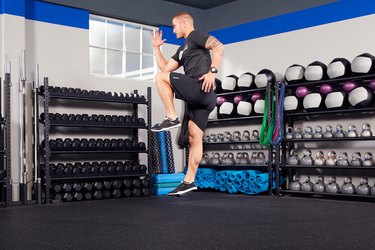
Let's just go ahead and say it: Nobody likes warming up. It's kind of boring and time-consuming and not nearly as "intense" as you want your workout to be, but arguably the most important part. Unfortunately, the warm up is also probably the most overlooked aspect of just about everyone's training regimen.
Here's what most warm-up routines looks like: walk around the gym listening to music or chatting, head for the dumbbell rack, do some toe touches and arm swings, and then start throwing weight around.
But not only are you setting yourself up for a lackluster workout, you're also putting yourself at risk for a workout injury. So instead, check out these 10 moves you can incorporate into your pre-workout warm-up routine.
Benefits of Warming Up Before a Workout
Warming up means raising your heart rate, which increases blood flow, raises your body temperature and wakes up your muscular and nervous system, according to the Mayo Clinic. Warm-up exercises improve your range of motion and address any imbalances, limitations or tightness your body has.
To maximize your time spent working out, you need the right muscles firing before you stress them with a run on a treadmill or heavy weightlifting session. Warming up ensures you're recruiting the right muscles for your specific workout as you move from exercise to exercise, according to Penn State University.
Warm-up exercises also teach you how to move. Once you've freed up your range of motion, it's time to use it to your advantage. Start with a small focus to improve your capacity to move, and then use the remainder of the warm up (and the workout) to solidify that new range. Ultimately, range of motion is pointless if you don't have the capacity to use it and control it.
Tips for a More Effective Warm Up
What follows is a basic warm-up that should help just about everyone move better, feel better and perform better. But remember, the best warm up is the one that's written just for you.
1. Begin by foam rolling. Some soft-tissue work using a foam roller or other massage tool can help further increase blood flow to your muscles. Target three to four big muscle groups, including your quads, lats, glutes and pecs.
2. Put a premium on breathing. Breathing is vital to your workout, so make sure to focus on it throughout both your warm up and workout. The diaphragm plays an enormous role when it comes to overall body positioning and functionality, so be sure to give it some attention.
3. Use dynamic stretches and exercises. A good warm-up involves more dynamic activity toward the end to help bring it all together. The human body is incredibly complex, and good movement involves a lot of working pieces. Use exercises that work multiple joints or muscles (or the entire system) and incorporate movement.
1. Cat-Cow
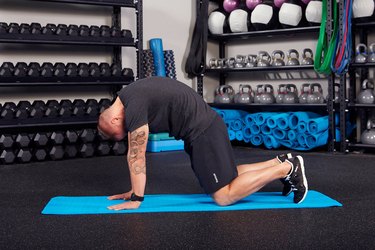
- Start on all fours.
- Inhale as you arch your back to the ceiling (like a scared cat).
- Next, exhale as you reverse the movement so that your belly presses toward the floor and lift your head to look at the ceiling (or as far up as is comfortable for your neck).
- Continue alternating between the two for two to three sets of 5 breath cycles (inhale and exhale).
Tip
This classic yoga pose also makes for a great warm-up exercise. Take your time and breathe through the entire movement to fire up your entire core, especially your back and abdominals.
2. Hip Lift With Reach
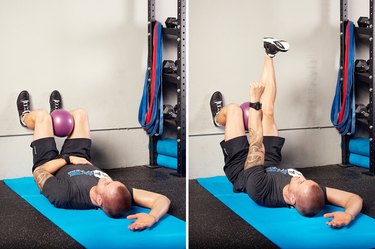
- Lie on your back, feet up on the wall with a small ball between your knees. Your knees and hips should be at 90 degrees.
- Use your hamstrings to push your knees upward about two inches, feeling your pelvis rotate backward (posterior pelvic tilt), coming off the ground slightly.
- From here, pull your left knee back and push your right knee forward.
- Now, lay your right arm on the ground overhead and reach your left arm out in front of you as far as you can.
- Lastly, take your right foot off the wall and take five breaths in through your nose and out through your mouth with a three- to five-second pause after each exhale.
3. Clamshell
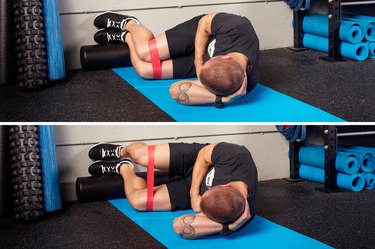
- Lie on your left side with a resistance band around your knees.
- Place your feet against the wall on top of a foam roller, scoot your butt down toward the wall and bend your knees.
- While keeping both feet on the wall, lift up your right knee. Focus on pulling your left hip further back on each inhale.
- Do 3 sets of 5 breaths on each side.
Tip
Your glutes are a huge muscle group involved in pretty much every lower-body movement. So it's essential to get them firing properly before launching into deadlifts and squats.
4. Breathing and Core Activation Drill
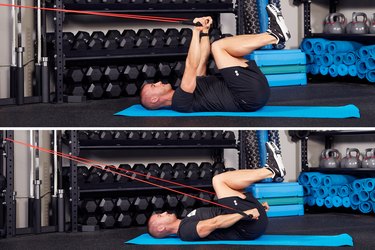
- Loop a resistance band around a pole and lie on your back with a handle of the band in each hand.
- Bring your knees to your chest, keeping your lower back on the ground.
- Knees together, pull your toes back toward your face and let your heels rest on your butt.
- Now pull the band as you straighten your arms down by your side.
- Hold for 8 breaths before returning to start.
5. Leg Lowering With Band
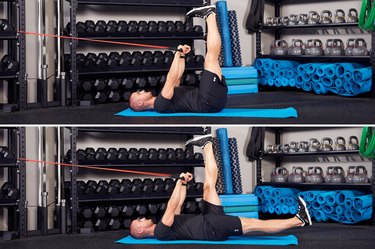
- Keep the resistance band around the pole, as above.
- Lie on your back, feet straight up in the air, quads squeezed, toes pulled back toward your face.
- Hold the handles of the band with each hand and pull the band down by your side.
- Keeping your lower back on the ground, lower one leg only as far as you can with good control.
- Lift your leg back up, doing 8 reps on each leg.
Tip
This is another core activation warm-up exercise to help solidify the center of your body — and the starting point for essentially every movement.
6. Half-Kneeling Quad Stretch With Stick
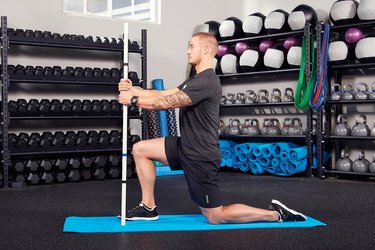
- Get in a half-kneeling position with both knees forming 90-degree angles. Your shoulder, hip and knee of the leg on the floor should be stacked on top of one another.
- Lay your back foot flat and tuck your tailbone underneath you. Hold a stick out in front of you with both hands.
- Rock back and forth several inches to stretch out your hips and quads.
- Continue for 30 seconds before switching legs.
7. Rib Roll
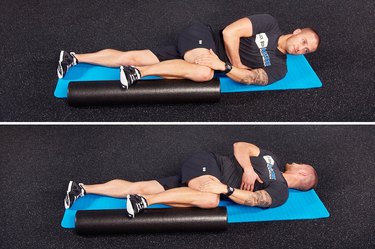
- Lie on your left side, right hip and knee flexed to 90 degrees across your body and your right knee resting on top of a foam roller.
- Straighten your left leg, reaching through your heel, and grab underneath your ribs with your right hand.
- On an exhale, use your right hand to "pry" your chest and torso open.
- Reset on your inhale and repeat.
8. Side-Lying Rotation Reach
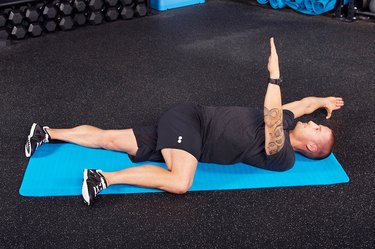
- Lie on your left side, right hip and knee flexed to 90 degrees across your body. Reach your left arm out in front of you.
- Hold that position and take your right hand from your left knee and reach back and to the right, following your hand with your eyes (aim for 10 on a clock).
Tip
The side-lying rotation reach is a great spine twisting exercise to give your back some more motion. The setup for this move is very similar to the rib roll, with one major exception: You’ll be starting in the “rolled open” position, never resetting.
9. Inchworm
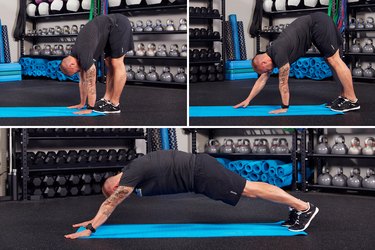
- Start off with a basic forward fold — stand with feet shoulder-width apart and fold forward at the hips with your hands on the ground.
- Walk your hands out as far in front of you as you can while maintaining a good spinal alignment.
- Once you reach the out position, take a full breath in and out.
- Walk your feet up to your hands.
- Slowly stand up, then repeat.
Tip
The inchworm is a great full-body warm-up exercise that stretches and strengthens every major muscle group, making it ideal before pretty much any workout.
10. Three-Way Squat
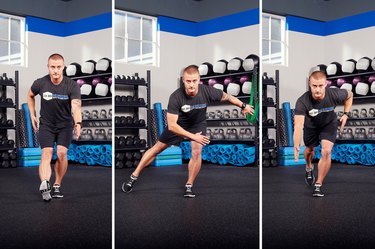
- Stand on one leg and reach out and tap your heel in front of you as you squat down.
- Then take your leg out to the side so you resemble a speed skater.
- Finally, bring your leg back behind you (you’ll tap your toes instead of your heel on this one). Try not to reset at all during this process.
- Repeat the process for 3 sets on each side.
Tip
Time for leg day? You'll want to do this warm-up exercise, which requires some balance and coordination, as well as a whole lot of lower-body strength.
Even More Warm-Up Exercise Ideas
After you've mastered this warm-up routine, you'll want to incorporate more specific drills based on what you'll be doing that day. For example, if you have heavy deadlifts, you'll want to hit a few light sets to prep yourself for that specific activity.
As multi-purpose as this warm up is, however, remember that the best warm-up is the one written just for you. So if you give this a try and aren't satisfied, then get assessed by a qualified coach and have him write you a specific warm up. Or take inspiration from one of these additional warm-up exercises:
- Jumping jacks
- High knees
- Arm/shoulder circles (forward and backward)
- Front kicks
- Back kicks
- Glute bridges
- Runner's lunges
- Reaching overhead side to side
- Clamshells with a resistance band
- Lateral shuffle
- Speed skaters
- Standing spinal rotation
- Chest openers/swimmer's hugs
- Body-weight squats
- Toe touches
- Calf raises
- Full-body extension