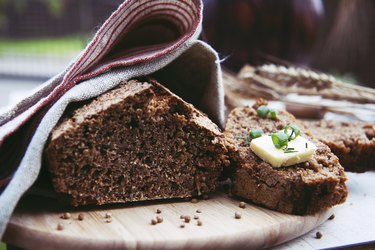
When it comes to making a health-conscious choice, opting for food with a lesser effect on your blood sugar levels can ensure you have more energy and could help your efforts to lose weight. Rye bread's glycemic index is reliably moderate compared with some other grain products.
What’s the Glycemic Index?
Video of the Day
As the American Academy of Family Physicians explains, the glycemic index of food — commonly called the GI — is a measurement between 0 and 100 that tells you how quickly the carbohydrate content breaks down in the body. Foods with a lower GI are digested more slowly, so they produce a less significant, more gradual rise in blood sugar, whereas foods with a higher GI spike your blood sugar very quickly. Pure sugar has a GI of 100. Foods like fruit, nuts, beans, seeds and vegetables tend to have lower indexes.
Video of the Day
There are a few aspects of food that can affect the glycemic index. The American Diabetes Association emphasizes that fat and fiber are nutrients that slow digestion, thus lowering the glycemic index of a food. This explains why fruit, although high in sugar, has a lower glycemic index — because of its fiber content.
It's also important to note that people who are watching their blood sugar levels can lessen the effect of high-GI foods by combining them with low-GI foods.
Rye Bread and Glycemic Index
So what about rye bread and its glycemic index? Well, rye flour has more fiber than wheat flour, according to the Grains & Legumes Nutrition Council, although many rye breads can be made from a combination of rye flour and wheat flour. Bread made entirely from rye flour is called pumpernickel, which explains why pumpernickel bread has a lower glycemic index than rye bread.
Both the American Academy of Family Physicians and the American Diabetes Association list rye bread as a moderate GI food, with a glycemic index level between 56 and 69. Pumpernickel bread's glycemic index is low, just as 100 percent stoneground whole wheat bread's is.
Finding a bread that has a lesser effect on blood sugar levels is a priority for people with diabetes, but it also might be able to help you lose weight. In a small study published in March 2016 in PLOS One, 19 people who consumed rye bread as opposed to white bread were more inclined to feel full, suggesting it can help prevent overeating and thus obesity.
Other Types of Bread
If you're looking for bread that's going to be good for your blood sugar, stick with whole-grain options like rye and pumpernickel. Avoid potato bread, which has a glycemic index that's on the higher side.
Even though potato bread might sound healthy — it's made with a vegetable, after all — the USDA lists potato bread as being made from refined wheat flour and sugar, with dehydrated potatoes included in the ingredients that make up 2 percent or less of the product. If you refer to the American Diabetes Association, you'll see that Russet potatoes and white bread have high glycemic indexes.
When you're comparing potato bread's glycemic index with rye bread's glycemic index or pumpernickel's glycemic index, it's clear why there is such a difference: Two slices of potato bread have less than 1 gram of fiber and about 5 grams of sugar. The USDA lists rye bread, when made from a combination of whole-grain rye flour and whole-grain wheat flour with some refined wheat flour as well, as having 4 grams of fiber and only 2 grams of sugar for two slices. Pumpernickel bread has 4 grams of fiber and not even a half-gram of sugar.
These numbers give a good explanation of why potato bread's glycemic index would be high while rye bread's glycemic index is medium and pumpernickel bread's glycemic index is low.
- Grains & Legumes Nutrition Council: “Rye”
- American Academy of Family Physicians: “Glycemic Index and Your Diet”
- PLOS One: “Rye-Based Evening Meals Favorably Affected Glucose Regulation and Appetite Variables at the Following Breakfast; A Randomized Controlled Study in Healthy Subjects”
- American Diabetes Association: “Glycemic Index and Diabetes”
- USDA: “Potato Bread”
- USDA: “Pumpernickel Bread”
- USDA: “Rye Bread”