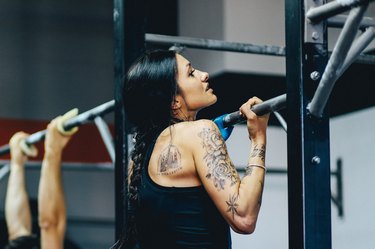
Chin-ups are one of the toughest bodyweight exercises you can do — using only your muscles to lift all of your weight up to the bar. Chin-up muscles include your back, chest, arms and even abs.
Tip
Chin-ups not only work your arms and shoulders — this bodyweight exercise also works your back muscles and abs.
Video of the Day
Chin-Up Form
The best technique for a chin-up starts from a dead-hanging position, which means that you are hanging from the chin-up bar with your feet off of the ground and elbows completely straight. Your palms face you and your hands are shoulder-width apart or slightly wider. From there you pull yourself up until your chin is above the bar, then you slowly lower yourself back down to the dead-hanging position.
Video of the Day
A proper chin-up is one of the best upper body exercises because it works so many different muscles at the same time. It's known as a compound exercise because it works more than one joint — your elbow and shoulder joints have to do an incredible amount of work to pull you up to the bar.
Read more: The Best Chin Up Bars
1. Back Muscles
The biggest muscle involved in the chin-up is the latissimus dorsi of the back. This massive muscle originates in your lower to middle back, and extends all the way into your shoulder. This muscle sticks out to the side of your torso and is very visible when well-developed. The lats pull your arms down and in towards your body, which is a big part of the chin-up motion.
Other back muscles that contribute are: the lower trapezius, rhomboid major and minor and teres major. The lower trapezius is a small muscle that sits between the bottom of your shoulder blades and your spine that helps initiate the pulling movement in the chin-up.
The rhomboid major and minor are smaller muscles that lie between the middle and top of your shoulder blades. They draw your shoulder blades closer together, which makes your shoulders retract down your back, assisting the action of the latissimus dorsi. The rhomboids originate from the bottom of your shoulder blades and insert into your shoulder.
2. Biceps
Your biceps are another major contributor to the chin-up. According to an August 2014 study sponsored by the American Council on Exercise that compared various biceps exercises to see which one worked the biceps the most, only two exercises (barbell curl and preacher curl) proved more effective than the chin-up. As you pull yourself towards the chin-up bar, you also flex your elbow, pulling your hands towards your shoulders, which is one of the main responsibilities of the biceps muscles.
Read more: Recommended Chin-Up Repetitions
3. Chest Muscles
The pectoralis major, or chest muscle, is also used in the chin-up. A February 2013 study published in Sports Biomechanics that measured electrical activity in various muscles during the chin-up, confirmed that the pectoralis major activates as you pull yourself up and over the bar. However, it doesn't contribute nearly as much as other muscles like the latissimus or biceps.
4. Abs
Your rectus abdominis, the ab muscle that creates the "six-pack," is also active in the chin-up. While you're hanging in the air, struggling to lift yourself over the bar, your abs keep your body in a straight line. Your abs keep control over your torso and legs as you pull up to prevent excessive swinging back and forth.
Was this article helpful?
150 Characters Max
0/150
Thank you for sharing!
Thank you for your feedback!