














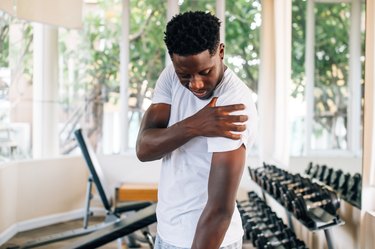












































The physical demands of basketball provoke large numbers of knee and ankle sprains, but rotator cuff problems represent frequent basketball injuries as well. Muscle strains and tears arise from acute and chronic overuse. Traumatic injury from collisions and falls can involve shoulder bones, joints, muscles, nerves and connective tissue.
Besides taking athletes out of play, shoulder pain and damage can have long-lasting effects that make future injury more likely. For this reason, treatment should concentrate on full recovery rather than swift return to play.
Tendinitis
Overuse basketball injuries such as tendinitis can result over time from repetitive or stressful overhead motions, including shooting and shot blocking. The muscles or tendons of the rotator cuff stretch and tear, causing inflammation and muscular weakness.
According to the University of Maryland (UM) Medical Center, x-rays and magnetic resonance imaging (MRI) can detect bone spurs, distinct muscle inflammation and tissue tears. These diagnostics provide direction for effective treatment of strains and tears.
Bursitis
Bursitis is a similar overuse condition that affects the bursa near the shoulder joint. Stiffness or shoulder pain will increase during movement, especially when the arm is raised above shoulder height. The UM Medical Center notes that the local area just under the joint capsule may show greater obvious signs of inflammation, becoming red, warm and swollen.
Separation
When the acromioclavicular (AC) joint is overworked, the ligaments that connect the acromion and clavicle bones can stretch or tear and separate. Shoulder pain will be intense at the top of the shoulder, which may swell and bruise.
As the American Orthopaedic Society for Sports Medicine (AOSSM) reports, doctors grade shoulder separations from mild to severe. Grade I indicates stretched ligaments that leave the shoulder structure intact. Grade II represents a slight tear and separation, which create instability in the rotator cuff. A grade III separation is complete, resulting in loss of shoulder function.
Dislocation
Basketball injuries involving falls or body blows to the shoulder may result in dislocation at the glenohumeral joint, where the ball of the humerus meets the glenoid cavity. The AOSSM notes that dislocation causes extreme shoulder pain and can also damage surrounding muscles, cartilage and nerves.
Stinger Syndrome
Stinger syndrome, whose incidents are also called burners, is unusual among basketball injuries, but does occur in connection with other shoulder trauma. The National Institutes of Health explain that the nerves of the brachial plexus extend upward into the neck and downward into the arm, so pain may radiate past the rotator cuff area. A stinging sensation may initiate this pain syndrome when nerve roots become compressed during play.


