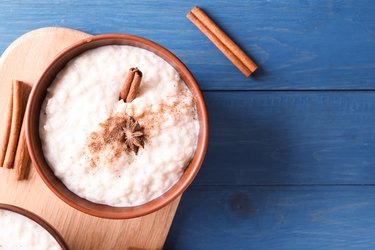
Creamy, sweet and comforting, rice pudding just may be the best way to enjoy rice. Rice pudding's nutrition information indicates that it's a relatively good dessert choice, when compared to ice cream or other high-calorie, high-sugar choices.
Tip
Calling rice pudding “healthy” may be a bit of a stretch, but it certainly offers some good nutritional qualities, including calcium, iron and protein. If you're going to have dessert, rice pudding isn't a bad choice.
Video of the Day
Rice Pudding Calories and Nutrition
As far as desserts go, rice pudding is a pretty healthy choice. The exact breakdown of rice pudding's nutrition information depends on the particular brand consumed, or your home recipe. A classic recipe made with whole milk, rice, sugar, cinnamon, vanilla flavor, salt and preservatives contains about 150 calories per ½-cup serving.
Video of the Day
Rice pudding's nutrition information shows that a ½-cup serving contains 4 grams of protein, 3.5 grams of fat (2 grams of which are saturated), 27 grams of carbohydrates and 1 gram of fiber. Rice pudding does have 14 grams of sugar per cup, but also 150 milligrams of calcium and 0.4 milligrams of iron.
Compare it to another favorite dessert: vanilla ice cream. Half a cup of that frozen treat contains 210 calories and 14 grams of fat, 8 grams of which are saturated — far more than the rice pudding.
Saturated fat intake is best kept below 13 grams per day, the American Heart Association recommends. This helps to reduce your risk of elevated cholesterol and lipid levels in the blood — both are risk factors for heart disease.
One serving of ice cream also has 18 grams of carbohydrates, but no fiber, and 3 grams of protein. The ice cream also has more sugar than the rice pudding —16 grams — and less calcium, offering just 100 milligrams. Vanilla ice cream offers no iron, either.
Read more: 10 Desserts That Won't Derail Your Diet
Compared to some restaurant offerings, rice pudding is downright saintly. For example, Uno Pizzeria and Grill offers an "Awesome, Insanely Large" Chocolate Cake with more than 1,700 calories, 32 grams of saturated fat and approximately 168 grams of sugar, reports the watchdog group Center for Science in the Public Interest.
Make Rice Pudding Healthier
Making homemade rice pudding means you have control over the ingredients. Any dessert can be made a little healthier with a few simple swaps advised by the Academy of Nutrition and Dietetics. Instead of making rice pudding with white rice, use whole-grain brown rice.
Brown rice has the entire germ included, and it is available in glutinous versions, so you can still achieve a creamy texture with your recipe. As compared to white rice, brown versions of rice offer slightly more fiber, vitamins and minerals, including vitamins B1 and B6, as well as phosphorous, magnesium, manganese and selenium. If you're still not sure about the swap, start with half brown rice and half white rice.
Choose low-fat or non-fat dairy instead of full-fat dairy, to decrease the saturated fat in your rice pudding recipe. You can also reduce the amount of sugar the recipe calls for by 25 percent without any noticeable change in flavor. This means you get 3.5 grams less sugar in each ½-cup serving.
You could choose to eat tapioca pudding instead of rice pudding as an even lower-calorie choice. In ½ cup of a standard, commercial tapioca pudding containing skim milk, sugar, tapioca, preservatives and flavorings, you get 131 calories, 2 grams of protein and 4 grams of fat, just 1 gram of which is saturated. Tapioca pudding also provides 24 grams of carbohydrates per ½-cup serving, but no fiber. You get only 61 milligrams of calcium from tapioca pudding and no iron.
- USDA Food Data Central: "Rice Pudding"
- American Heart Association: "Saturated Fat"
- USDA Food Data Central:"Vanilla Ice Cream"
- Academy of Nutrition and Dietetics: "Healthy Baking Alternatives"
- USDA Food Data Central: "Tapioca Pudding"
- Harvard School of Public Health: "Rice"
- Center for Science in the Public Interest: "Xtreme Eating"