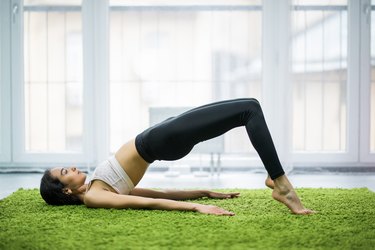
If you spend a lot of time sitting, want to build more power in your lower body or feel the need to work on a so-called "peach booty," you need hip extension exercises in your workout. These exercises primarily target your gluteus maximus, with an occasional assist from the hamstrings.
Tip
Hip extension is another way of describing the motion of straightening your leg at the hip.
Video of the Day
Your Hip Extension Muscles
The primary mover for most hip extension exercises is your gluteus maximus. Your hamstrings also aid with hip extension, as noted at ExRx.net, but it's the glutes that carry most of the load.
Video of the Day
Hip extension exercises pack some serious potential benefits. First, as the National Academy of Sports Medicine explains, if you spend a lot of time sitting, there's a tendency for your hip flexors to become overactive and your glutes to weaken. Training your glutes can help counteract that — especially when paired with stretching your hip flexors.
Your glutes are also an important part of building core stability, as explained by the American Council on Exercise. And finally, your glutes represent one of your body's major muscle groups.
So even if you're not looking at your backside in the mirror and thinking, "Hmmm, I wish that was bigger," you should still strengthen your hip extensors twice a week, along with every other major muscle group, as recommended by the U.S. Department of Health and Human Services.
Hip Extension Exercises
Surprisingly, two of the best hip extension exercises use only your body weight for resistance — although you'll find an excellent hip extension machine in many gyms too.
Move #1: Single-Leg Wall Squat
- Stand with your back to a wall, feet about hip-width apart.
- Walk your feet far enough forward that you can squat down into a sitting position, keeping your back against the wall.
- Check to make sure that your knees and toes point in the same direction, and your ankles are beneath your knees — not far behind or in front of them.
- Allow your back to slide up along the wall as you straighten your legs.
- Keep your hips and shoulders in contact with the wall as you continue squatting down — sliding your back down the wall — then pressing yourself back up the wall again.
For a more challenging variation, perform this exercise with just one leg on the floor; your other leg should be extended straight in front of you. In the February 2019 issue of the International Journal of Sports Physical Therapy (IJSPT), an analysis of EMG tests found this variation to produce the most activity in your glutes.
Move #2: Glute Bridge
- Lie flat on your back, knees bent and feet planted on the floor.
- Squeeze your glutes, lifting your hips off the floor so that your body forms a straight line from knees to shoulders.
- Return to your starting position with a slow, controlled motion.
For a more challenging version of this exercise, start with your legs bent to 90 degrees. Straighten one leg, while using the other leg/hip to press up into the bridge. In the aforementioned IJSPT article, this variation was cited as one of the exercises that produced the most glute activity.
Move #3: Four-Way Hip Extension Machine
- Step into the four-way hip extension machine and grasp the stabilizing bar, or rest your hips against the forward hip pad.
- Adjust the machine's resistance pad so it rests at your knee on the back side of the working leg.
- Stand on your free leg as you straighten your working leg at the hip, moving the resistance pad as you go.
- Return to your starting position with a smooth, controlled motion.
- Repeat on the other leg.
Despite its age, a small EMG study published in the January/February 2006 issue of the American Council on Exercise's Fitness Matters magazine remains noteworthy because it identifies the four-way machine as the best hip extension machine in the gym.
- ExRx.net: "Hamstrings"
- ExRx.net: "Gluteus Maximus"
- National Academy of Sports Medicine: "Addressing Overactive Hip Flexors With Corrective Exercise"
- American Council on Exercise: "6 Exercises for a Stronger Core"
- U.S. Department of Health and Human Services: "Physical Activity Guidelines for Americans"
- International Journal of Sports Physical Therapy: "Examination of Gluteus Maximus Electromyographic Excitation Associated With Dynamic Hip Extension During Body Weight Exercise"
- American Council on Exercise: "Glutes to the Max"
- Exercise Prescription on the Net: Exercises for the Hip