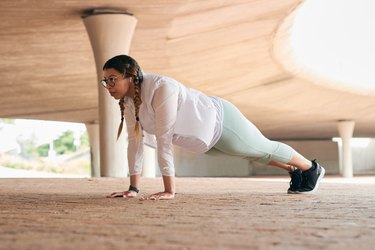
Push-ups are a quintessential upper-body exercise, but you may wonder exactly what you're working when someone tells you to drop and do 50.
The muscles worked in push-ups include your chest, shoulders, triceps, abs, back stabilizers and even your thighs. You probably realize how hard your upper body is working when you do push-ups, but in reality they are full-body movements.
Video of the Day
Video of the Day
Keep reading to learn more about what muscles push-ups work, plus push-up benefits and variations to try.
The Primary Push-Up Muscle Groups
When you do push-ups, you feel your arms and chest working, and you'll build muscle in those areas. The primary muscles used in push-ups, according to the American Council on Exercise (ACE), include:
Pectoralis Major
The pectoral muscles of the chest include the pectoralis major, a large fan-shaped muscle that makes up your chest wall.
It has a sternal, or lower, portion that is most activated during the push-up. The clavicular, or upper region, that's near the collarbones, also works during a push-up, but to a lesser extent, according to an older but frequently cited October 2012 guide to the biomechanics of a push-up in the Strength and Conditioning Journal.
Strong pecs assist you in throwing and pushing actions.
Triceps Brachii
The triceps muscles have three heads, or insertion points, located at the backs of the upper arms. The primary function of the triceps is to extend the elbow joints. You'll get greater triceps activation if you do push-ups with your hands placed closer to your body, according to the Strength and Conditioning Journal guide.
Anterior Deltoids
There's plenty of shoulder involvement in push-ups, including from the anterior deltoids, which are located at the front of the shoulder. During a push-up they support the action of the pectoralis major. Anterior, or front, deltoids also help you raise your arms up in front of you.
Other Muscles Used During Push-Ups
Smaller muscles, stabilizer muscles and other muscle groups are also worked when you do a push-up, according to the ACE, including:
Biceps
This two-headed muscle provides support for your arm as your triceps activate.
Rectus Abdominus
This long muscle covers the front of your torso and, when toned, is responsible for that six-pack look. During a push-up, the rectus abdominus engages as you hug it in to keep your body straight.
Obliques
These abdominal muscles along the sides of your waist are responsible for bending to the side and rotating. They activate during the push-up to prevent twisting and other unwanted torso movement.
Quadriceps
During a full push-up, the quads (the fronts of your thighs) also engage to support your lifted legs and keep your body straight, according to the ACE.
Erector Spinae
This is a set of muscles along your spine. They engage in conjunction with your rectus abdominus and obliques to keep your back straight during a push-up.


How to Do a Perfect Push-Up
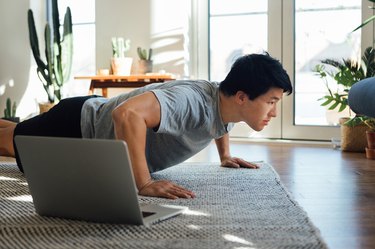
The push-up is a compound exercise, as it activates multiple joints. Your body is required to work in symmetry, making it one of the most functional exercises you can do.
Check your push-up form whenever you do the exercise:
- Plant your hands on the floor about shoulder-distance apart. Your shoulders should be stacked over your wrists and your hips should be in line with your head and heels. Engage your core and glutes.
- Bend your elbows at a 45-degree angle from your torso, rather than allowing them to flare out to the side, and lower your body toward the ground.
- On the way down, squeeze your shoulder blades together.
- When your chest hovers just above the ground (or however far down you can go), press into the ground and push your shoulder blades apart to return to the starting position.
- Keep your trunk stable and straight as you push up and down. This means no hiking of the hips or sagging into the lower back, which puts your shoulders, elbows and back at risk of injury.
Tip
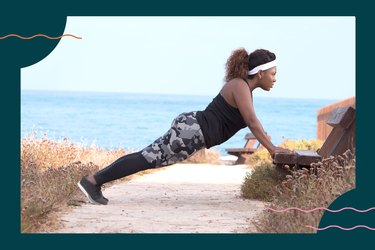
If you find it too hard to lower your chest to the floor without your hips sagging, try an incline push-up to build strength. That will be safer and more effective than dropping to your knees.
Push-Up Variations to Try
The way you do the push-up affects how much activation each of the primary muscles gets. Push-up variations can target those muscle groups differently and add an extra challenge. Start with these:
Decline Push-Ups
Place your feet on a box or weight bench to put greater emphasis on the anterior deltoids and upper, or clavicular, pectoralis major.
Diamond Push-Ups
Keep your hands close together under your chest with your index fingers and thumbs touching in a diamond shape. Hug your elbows in against your torso as you press up and down, your triceps brachii get more activation.
Unstable Push-Ups
Place your hands on a stability ball, BOSU ball or other unstable surface to challenge your core to work harder to stabilize you.
The Benefits of Push-Ups
Push-ups build muscle and strength, burn calories and help you move with ease through your day, among other benefits, according to the National Academy of Sports Medicine.
FAQ
Common Questions
Are there disadvantages of push-ups?
If your form isn't on point, you could risk injury to your back, shoulders or wrists, LIVESTRONG.com previously reported. And if you're not giving yourself ample rest and recovery, you won't see the gains you're expecting from your push-ups.
Can you do push-ups every day?
You can, but it's generally safer and more effective to vary your exercise routine so your muscles have time to rest and repair, unless you're an advanced exerciser and incorporating push-up variations, LIVESTRONG.com previously reported.
How many push-ups should you do?
The number of push-ups you should be able to do varies greatly with factors like age, experience and even sex assigned at birth. Check out our chart on the average number of push-ups adults can do.
What happens if you only do push-ups?
You risk injuring your shoulders, wrist or back, and you miss out on a chance to round out your workout routine with pulling upper-body exercises and lower-body exercises, LIVESTRONG.com previously reported.