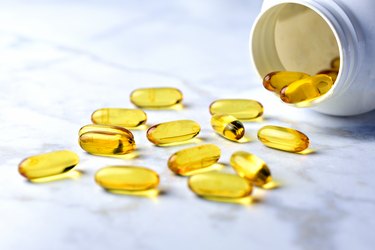
Looking for a new supplement to add to your growing collection? Fish oil and omega 3-6-9 may offer big health benefits, including improved cardiovascular and cognitive health. However, in many cases, a supplement isn't necessary.
The Omega Fatty Acids
Video of the Day
Fat gets a bad rap, especially when it comes to weight loss. But fats are crucial to your health, and you need certain fats for survival.
Video of the Day
Omega fatty acids are unsaturated fats, including polyunsaturated and monounsaturated fats. Unlike saturated fats primarily found in animal foods, unsaturated fats are liquid at room temperature and considered "good" fats. When eaten in moderation in place of saturated fats, they may help improve blood cholesterol levels, according to the American Heart Association.
Omega-3 and -6 are polyunsaturated fats, and they are often referred to as "essential" because your body can't make them. It is essential that you get them from your diet or from a dietary supplement. Omega-9 is a monounsaturated fat that your body makes; therefore, it is considered unessential in the human diet.
The essential fatty acids omega-3 and -6 get the most attention due to their many potential health benefits. Both may protect against heart disease. Omega-3, in particular, may help prevent and treat heart disease and stroke, reduce blood pressure and lower triglycerides, reports Harvard Health Publishing.
Omega-3s may offer a host of other benefits, including lowering the risk of Alzheimer's disease and preventing premature birth and low birth weight, according to the Linus Pauling Institute at Oregon State University.
Omega-9 may also offer specific health benefits, including protecting against cardiovascular insulin resistance that contributes to atherosclerosis, or hardening of the arteries, according to a research review published in Cardiovascular Diabetology in June 2015.
Fatty Acids in Your Diet
Since the body makes omega-9 fatty acids and it's found in a wide variety of foods, most people get plenty and there is no recommended daily intake. Top sources include olive oil and olives, almonds and canola oil.
Omega-6 is also widely found in foods such as vegetable oils, nuts, seeds, meat and eggs. The Food and Nutrition Board of the National Academies of Sciences, Engineering, and Medicine has established an acceptable macronutrient distribution range, or AMDR, for omega-6 of 5 to 10 percent of daily total fat intake. For reference, 20 to 35 percent of your total calories should come from various types of fat.
Omega-3 is not as widely available in foods, and that's where fish oil comes in. Fish is the top source of omega-3s in the human diet, especially fatty fish such as salmon, mackerel and sardines. Fatty fish provides the most important types of omega-3 fatty acids — in particular, eicosapentaenoic acid (EPA), and docosahexaenoic acid (DHA).
Some plant foods provide another type of omega-3 called alpha-linolenic acid (ALA), which the body can convert to EPA and DHA, albeit inefficiently. According to the National Institutes of Health (NIH), the conversion rate is reportedly less than 15 percent.
The Food and Nutrition Board doesn't specify intakes of EPA and DHA but recommends that 0.6 to 1.2 percent of your total fat intake come from omega-3 polyunsaturated fatty acids.
Tip
Did you know? Flaxseeds are a rich source of alpha-linolenic acid, which your body can convert to EPA and DHA in small amounts. However, whole flaxseeds are hard for the body to digest, explains the Mayo Clinic, and the seeds often remain intact throughout the digestive process and exit the body in waste. To get all the benefits of flaxseeds, grind them before adding them to breakfast cereal, yogurt or your favorite baked goods recipes.
To give you an idea of just how much of each omega fatty acids 3, 6 and 9 there is in common foods, here is some data from the USDA:
- 3.5 ounces of salmon: 0.69 grams omega-9, .05 grams ALA, 0.18 grams EPA and 0.33 grams DHA.
- 1 ounce of unroasted almonds: 8.76 grams omega-9, 3.45 grams ALA, and 0 grams EPA and DHA.
- 3.5 ounces of cooked sardines: 2.14 grams omega-9, 0.5 grams ALA, 0.47 grams EPA and 0.51 grams DHA.
- 1 ounce of ground flaxseeds: 0.52 grams omega-9, 1.6 grams ALA, and 0 grams EPA and DHA.
- 1 tablespoon of canola oil: 8.64 grams omega-9, 1.28 grams ALA, and 0 grams EPA and DHA.
Fish Oil vs. Omega 3-6-9 Supplements
Aside from fish, foods tend to be higher in omega-9 and -6 than omega-3. It's important to strike the right balance between the omegas. Getting too much omega-6 in proportion to omega-3 can cause inflammation and play a role in the development of heart disease, cancer and arthritis.
According to the University of Colorado, Colorado Springs, the typical North American diet contains far more omega-6 than necessary. The ideal balance is two to four times more omega-6 than omega-3, but the average person gets 11 to 30 times more omega-6 than omega-3.
Because of this, and since your body makes the omega-9 it needs, you don't need an omega 3-6-9 supplement. However, you may need a fish oil supplement. People who don't eat enough fish or can't eat fish may find it challenging to get what they need from their diet. The NIH reports that cases of clinical deficiency are rare, but any kind of deficiency may have negative outcomes, due to the potential protective effects of omega-3s.
So, do you need one? Dr. JoAnn E. Manson, professor of medicine and the Michael and Lee Bell Professor of Women's Health at Harvard Medical School, reports in Harvard Health Publishing that if you are in good health, aren't at risk for heart disease and eat plenty of fatty fish — at least two servings weekly — you can skip it.
Getting omega-3 from foods is always better than turning to a supplement. In fact, there is some speculation that fish oil from supplements may not have the same effects or benefits as fish oil from food sources, according to Howard LeWine, MD, Chief Medical Editor of Harvard Health Publishing.
However, if you are at risk for cardiovascular disease or you don't eat fish, supplemental omega-3s may be necessary. For vegetarians and those allergic to fish, algae-based omega-3 supplements may be a good option, says Dr. Manson. It's always best to get your doctor's opinion before you decide to start taking a supplement.
Tip
Trying to get in your two weekly servings of fish each week? The USDA's ChooseMyPlate recommends keeping preparations lean and flavorful and using cooking methods like broiling, grilling, roasting or baking, which don't require extra fat.
You can also get creative by putting grilled fish on a sandwich or a salad, or by making salmon patties instead of beef burgers. Canned fish is an easy and inexpensive option; just be sure to choose it packed in spring water without added sodium.
Finding a Quality Supplement
If you decide to take a fish oil supplement, knowing what to look for can help you get the most from your investment. Harvard Health Publishing recommends looking for a supplement containing 1 gram of omega-3s containing a combination of EPA and DHA.
Beyond that, it's all about quality. Fish oil is the most used supplement by adults in America, with 10 percent of the population currently taking one. Therefore, the supplement industry is overflowing with different varieties and dosages and thousands of brands making equally as many claims about the quality and effectiveness of their products.
The supplement industry is not regulated by the Food and Drug Administration (FDA), and the FDA does not verify the safety and effectiveness of products before they go on the market. According to Good Manufacturing Practice guidelines, manufacturers are responsible for producing substances that do not contain contaminants or impurities and that actually contain what is listed on the label.
Harvard Health Publishing recommends looking for quality indicators including seals from U.S. Pharmacopeia, NSF International, or ConsumerLab.com. These organizations perform independent testing to identify the highest quality supplements, which are then awarded certification. You can also visit these organizations' websites to read product reviews.
The FDA advises that consumers use noncommercial sites when searching for supplements on the internet, including the FDA website, the National Institutes of Health and the USDA. Additionally, consumers should be aware of statements that sound too good to be true, such as "works better than a prescription drug," or that a supplement is completely safe and free from side effects.
High-Dose Fish Oil
People whose triglyceride levels are abnormally high and who have an increased risk of cardiovascular disease may benefit from high-dose omega-3 by prescription. According to a science advisory from the American Heart Association published in Circulation in August 2019, a dose of 4 grams per day of omega-3s is generally an effective and safe option.
You should not attempt to take high doses of over-the-counter fish oil supplements without your doctor's approval. People are interested in taking high doses of fish oil for various reasons, for example, in response to evidence that doses up to 10 grams per day can help depression.
Higher than normal doses of fish oil may, indeed, be effective for several conditions, but there can also be drawbacks to excessive doses, including an increased risk of bleeding and stroke, according to Mayo Clinic. Harvard Health Publishing also reports that high doses may exacerbate some mental health conditions, including bipolar disorder.
Taking any amount of fish oil with anticoagulant and anti-platelet drugs, herbs and supplements may further increase the risk of excessive bleeding. Fish oil may also slightly lower blood pressure, so taking it along with other blood pressure drugs, herbs and supplements could cause dangerously low blood pressure.
Contraceptive drugs can reduce fish oil's effectiveness at lowering triglycerides. The weight loss drug Orlistat can also affect absorption of fish oil, and the Mayo Clinic advises taking the drug and supplement two hours apart. Last, fish oil could reduce blood levels of vitamin E.
- American Heart Association: "The Skinny on Fats"
- Harvard Health Publishing: "The Truth About Fats: The Good, the Bad, and the In-Between"
- Linus Pauling Institute at Oregon State University: "Essential Fatty Acids"
- Cardiovascular Diabetology: "Protective Role of Oleic Acid Against Cardiovascular Insulin Resistance and in the Early and Late Cellular Atherosclerotic Process"
- Food and Nutrition Board of the National Academies of Sciences, Engineering, and Medicine: "Dietary Reference Intakes (DRIs): Acceptable Macronutrient Distribution Ranges"
- National Institutes of Health: Office of Dietary Supplements: "Omega-3 Fatty Acids"
- Harvard Health Publishing: "Should You Be Taking an Omega-3 Supplement?"
- Mayo Clinic: "Does Ground Flaxseed Have More Health Benefits Than Whole Flaxseed?"
- USDA FoodData Central: "Canola Oil"
- USDA FoodData Central: "Flaxseeds"
- USDA FoodData Central: "Sardines"
- USDA FoodData Central: "Almonds, Unroasted"
- USDA FoodData Central: "Salmon, Raw"
- University of Colorado, Colorado Springs: "Omega-3, 6, and 9 and How They Add Up"
- Harvard Health Publishing: "Fish Oil: Friend or Foe?"
- USDA ChooseMyPlate: "10 Tips: Eat Seafood Twice a Week"
- Food and Drug Administration: "What You Need to Know About Dietary Supplements"
- Circulation: "Omega-3 Fatty Acids for the Management of Hypertriglyceridemia: A Science Advisory From the American Heart Association"
- Harvard Health Publishing: "Omega-3 Fatty Acids for Mood Disorders"
- Mayo Clinic: "Fish Oil"