


























































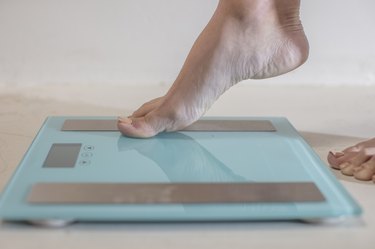





The body mass index, or BMI, is a way of determining if you are at a healthy body weight. By comparing an individual's weight to her height, the BMI will determine whether she is underweight, overweight, obese or at her ideal weight.
History
According to WhatHealth.com, the BMI was invented by Belgian statistician Adolphe Quetelet during the 19th century. Also referred to as the Quetelet Index, BMI is used as a measure of obesity by groups as widely varied as life insurance companies and the World Health Organization.
Basic BMI Equation
The equation to calculate BMI is (body weight in pounds X 703) divided by (height in inches squared). For example, the BMI of a 200-pound, six-foot man would be calculated as:
200 x 703 = 140,600, 72 x 72 = 5,184
140,600 / 5,184= 27.1219
By comparing the result against a standard scale, you can determine how healthy a subject's weight is. A score between 18.5 and 24.9 is considered ideal, with lower scores indicating a subject is underweight. Higher scores indicate overweight, with a score of 30 or over meaning obesity.
BMI and Health
The BMI is not as accurate a measure of lean body mass as more technical methods, such as hydrostatic weighing, skin-fold measurement or electrical impedance measures. However, Harvard-based nutrition and diet expert Walter Willett, author of "Eat, Drink and Be Healthy" and Dr. Mehmet Oz, co-author of "You: The Owner's Manual" both note that studies show a strong correlation between ideal BMI, longevity and health.
Problems of BMI
According to fitness coach Ben Cohn, the main problem of BMI is that muscle is denser than fat. Since the BMI makes no distinction between muscle weight and fat weight, this means that muscular athletes, such as body builders, wrestlers and gymnasts, will have a BMI that indicates overweight or even obesity despite being in top physical condition. Similarly, the BMI does not take into account changes in body composition due to aging or for the differences between males and females.
Adjusted BMI
Because of the limitations of the BMI scale, a number of adjusted ranges have been put forward in an attempt to mitigate the problems. These include different sets for endomorph, ectomorph and mesomorph body types, separate scales for males and females, age-adjusted scales and a special scale for performance athletes. Regardless of which adjusted scale you use, the equation for calculating BMI remains the same. It is what the end result number means that gets adjusted.
References
- What Health: Calculating BMI
- National Heart, Lung and Blood Institute: Calculate Your Body Mass Index
- "Eat, Drink and Be Healthy"; Walter Willett, MD; 2007
- "You: The Owner's Manual"; Mehmet Oz, MD; 2006


Member Comments