





















































Deep-breathing techniques can help you remain calm and relaxed while providing your bloodstream with sufficient oxygen and clearing out excess carbon dioxide. They also can lower blood pressure and reduce tension. By setting aside time each day to consciously practice deep breathing, you can more easily continue the process automatically throughout the day.
Step 1
Sit or stand erect to get in the position to practice deep-breathing exercises. According to Andrew Weil, a holistic medical doctor, you should lightly place the tip of your tongue just behind your upper teeth to help control your mouth movements throughout the exercise.
Step 2
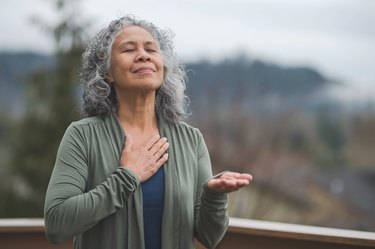
Place your hand over your abdomen to make sure that the air is going in and coming out properly. Your diaphragm should be sucked in and up as you inhale and pushed down and out when you exhale. Make sure the breaths are deep by placing your other hand over your chest, which should only move slightly during deep-breathing exercises.
Step 3
Push all of the air out of your lungs through your mouth. Make a whooshing sound when you exhale to provide force behind the movement, then close your mouth lightly and inhale through your nose.
Step 4
Count to four as you slowly inhale, then stop and hold your breath for a count of seven. Make noise once again as you push the air out around your tongue and through your pursed lips. Count to eight as you exhale. Repeat the breathing cycle three more times to complete the exercise.
Step 5
Lie on your back on a mat and bend your knees, placing your feet flat on the floor about eight inches apart. Point your toes slightly inward and perform the deep-breathing techniques--in through your nose and out through your mouth. According to the University of South Florida, beginners might find it easier to learn the breathing pattern when they are prone.
Tips and Warnings
- If you forget where the air should come in and out, remember: Inhale by smelling the flowers and exhale by blowing out the candle.
- Rapid, shallow over-breathing often occurs when people have a panic attack. You need to get more carbon dioxide in your bloodstream to calm your symptoms and stop hyperventilating. Cover your mouth and hold one nostril and breathe steadily through the other nostril for a couple of minutes to level out your carbon dioxide. According to the National Institutes of Health, you also can try taking short breaths through pursed lips until you calm down.
Things You'll Need
- Mat


