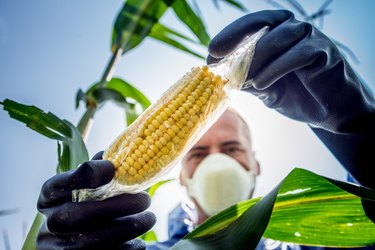
Depending on your background and personal beliefs, you might hear the acronym GMO and automatically think good. Or you may think the exact opposite. Here's what we can all agree on: The topic of genetically modified food isn't so black and white.
In recent years, major food brands including Cheerios and Chipotle have sworn off GMOs, arguing that these ingredients don't measure up to their standards and may negatively affect their customers' personal health and the health of the planet.
Video of the Day
Video of the Day
But that's only one side of the story. Let's examine the key things you need to know when it comes to these foods and ingredients, including the pros and cons of GMOs.
What Is a GMO, Anyway?
Genetically modified organisms (which you likely know as GMOs) are plants, animals or other living things that aren't found naturally in the world. Rather, they've had their DNA changed in some way.
In most cases, scientists pick and choose the genes they want — say, a certain gene from this plant or one from this animal — and move that gene into the cell of another plant or animal to alter its genetic makeup, according to the U.S. National Library of Medicine.
GMOs have technically been around for tens of thousands of years, ever since humans began practicing selective breeding, per Harvard University. Selective breeding occurs when farmers seek out plants with desirable traits, and then specifically breed those until the plant has changed. For example, tomatoes were once the size of marbles, but now they're much bigger thanks to the way farmers have bred them over time, per the FDA.
GMOs, as we know them today, started to take shape in the 1990s, and over the past few decades, consumers have become more aware of (and more confused by) them.
GMO vs. GE
Another acronym you'll hear when talking about GMOs is GE, which stands for genetically engineered. Sometimes, GMO and GE are used interchangeably when talking about foods that aren't 100 percent natural, but that's not exactly accurate.
Technically, genetic modification is the broader term and refers to a wide range of methods, such as selective breeding mentioned earlier, per the FDA. GEs are another example of genetic modification and are likely what comes to mind when you think about GMOs.
Genetic engineering involves specifically changing an organism's genes through biotechnology, per NC State University. The most common examples of GE crops are soybeans, cotton and corn, many of which are used to create processed foods. Potatoes, squash, apples and papayas are also commonly genetically engineered, per the FDA.
Related Reading
6 Pros of GMO Foods
GMOs are used in many everyday foods, so they can be hard to avoid completely. But should you be trying to sidestep GMOs in the first place? Let's dive into the potential pros and cons of GMO foods.
1. GMOs Can Produce Bigger Crop Yields
One of the major advantages of GMOs is that they help increase the production rate of crops, which can have a significant effect in countries faced with food shortages and famine, per May 2017 research in the Hong Kong Medical Journal.
Indeed, GMO crops can help fight malnutrition around the world, according to a July 2016 paper in Theoretical and Applied Genetics.
2. GMOs Can Offer Crop Protection
One of the ways GMOs can help produce larger yields is by altering a plant's genes to be less susceptible to disease, according to the World Health Organization (WHO).
In order for this to happen, the genetic makeup of a plant needs to be reworked to incorporate a bacterium called Bacillus thuringiensis, a January 2010 study in Bioengineered Bugs outlines. It helps crops avoid catching certain viruses, boosts the effectiveness of insecticides and is safe for people to consume, according to the WHO.
3. GMOs Can Provide Health Benefits
One of the main goals in producing GMOs is to amplify the nutrients in food, per the WHO. In 2000, for example, scientists developed a crop called Golden Rice that was created specifically to help decrease vitamin A deficiencies, Harvard University explains.
So, oftentimes, there are GMO health benefits that can't be naturally replicated without altering a food.
4. GMOs Are Regulated by the FDA
It may give you some peace of mind to know that GMOs are held to the same safety standards as other foods available to consumers in the US. The FDA, the U.S. Department of Agriculture (USDA) and the Environmental Protection Agency (EPA) regulate the products to make sure they're safe to eat. Foods that come from genetically engineered plants are just as safe as non-GE foods, per the FDA.
5. GMOs Can Reduce Harmful Ingredients
The science of GMOs makes it possible to alter or remove certain factors that can be harmful to individuals. Companies are working on decreasing potentially harmful chemicals and addressing allergens.
For example, biotech companies have received approval to develop gluten-free wheat. Some people have an autoimmune reaction that prevents them from being able to eat gluten, a protein found in wheat, rye and barley.
In 2014, the USDA approved the first GE potato designed to produce less acrylamide, a potentially dangerous chemical that has been linked to cancer, per Chemical & Engineering News.
6. GMOs May Help Prevent Food Waste
About 40 percent of the food produced in the U.S. goes to waste — a staggering statistic that contributes to climate change and draws on important resources, per the USDA.
But advances in GM science have, for example, helped to create a non-browning apple, which could potentially allow for more apples to be eaten than tossed, per the FDA.
Related Reading
4 Cons of GMO Foods
Despite their many potential benefits, some research suggests there is danger in GMO foods.
1. GMOs Might Have the Potential to Cause Allergic Reactions
Transferring genes into an organism means the organism now contains new proteins, which could cause an allergic response where a threat wasn't present before, according to a March 2013 study in Annals of Agriculture and Environmental Medicine.
So maybe you weren't allergic to one kind of tomato before, but after new proteins are added, you may experience a reaction.
The 2017 Hong Kong Medical Journal study notes that some people who fall in the anti-GMO camp blame GMOs for the increase in food allergies in the United States, especially among children.
Critics of this argument point to the fact that genetic engineering isn't typically used in the most common sources of food allergies: eggs, nuts, dairy and shellfish.
2. GMOs May Have a Negative Affect on the Environment
While there are possible environmental benefits to GMOs, they have also been linked to a few environmental concerns. For one, GMOs may become more tolerant of insecticides and herbicides and may lead to crop invasiveness, per a July 2017 review in Environmental Research. Some people fear that this resistance may lead to a greater reliance of more pesticides.
It's also possible for the GMO to move from its crop area into the wild, passing its modified genes along to the natural population, per the WHO.
3. GMOs Could Pose an Increased Risk of Toxicity
Some argue that people who fill their diet with GMOs will be at an increased risk of toxicity and that eating GMOs can increase the chances of developing tumors, such as in the lungs, breasts or colon, according to the 2013 study in Annals of Agriculture and Environmental Medicine.
Experts disagree on whether or not people really need to be worried about this. Harvard University, for example, reports that research doesn't support claims that GMOs lead to adverse health effects.
4. GMOs Can Affect the Livelihood of Independent Farmers
Genetically modified seeds are a patented product, and in order to purchase the seeds, farmers must sign an agreement for use with the seed manufacturer.
Monsanto, which was bought by Bayer in 2016 and given a new name, controls the vast majority of the GMO seed market; the company prohibits farmers from saving seeds or selling them to other growers. Independent farmers whose crops become contaminated by neighboring GM crops have been forced to pay patent fees or risk being sued.
This is a contentious story that was covered, among other places, in the 2009 documentary, "David versus Monsanto," per Harvard University.
A Final Word on GMOs
While the FDA regards GMOs as safe, many individuals, groups and institutions believe the opposite. Opponents of the U.S.'s widespread use of GMOs often cite the stance of the European Union, which has much tighter restrictions on GMOs, per the Library of Congress. GMOs are permitted to be imported into the EU only after passing strict evaluation and safety assessments on a case-by-case basis.
Furthermore, more than half the countries in the EU took to banning their farmers from growing GMO crops in 2015, per the New Scientist.
What's most clear about the safety of GMOs is the fact that there are great differences in opinion around the issue.
- Developing New Functional Food and Nutraceutical Products: "Chapter 27 - Genetically Modified Products and GMO Foods: A Game of Chance?"
- U.S. National Library of Medicine: "Genetically Engineered Foods"
- University of Utah: "Genetically Modified Foods"
- Australian Government Department of Health: "Guidance 21: Medicines Produced by Genetic Manipulation"
- Food and Energy Security: "Pesticides, Environment, and Food Safety"
- Food and Drug Administration: "Consumer Info About Food From Genetically Engineered Plants"
- Safety of Genetically Engineered Foods: Approaches to Assessing Unintended Health Effects: "Methods and Mechanisms for Genetic Manipulation of Plants, Animals, and Microorganisms"
- World Health Organization: "Food, Genetically Modified"
- Chemical & Engineering News: "FDA Approves Genetically Modified Apple And Potato"
- USDA: "Food Waste"
- Annals of Agriculture and Environmental Medicine: "Benefits and risks associated with genetically modified food products"
- Hong Kong Medical Journal: "Genetically modified foods and allergy"
- Environmental Research: "Environmental impacts of genetically modified plants: A review"
- Harvard: "Will GMOs Hurt My Body? The Public’s Concerns and How Scientists Have Addressed Them"
- Harvard: "The Patent Landscape of Genetically Modified Organisms"
- Library of Congress: "Restrictions on Genetically Modified Organisms: European Union"
- New Scientist: "More than half of EU officially bans genetically modified crops Read more: https://www.newscientist.com/article/dn28283-more-than-half-of-european-union-votes-to-ban-growing-gm-crops/#ixzz6oYaaDavM"
- FDA: "Understanding New Plant Varieties"
- Theoretical and Applied Genetics: "Genetically modified (GM) crops: milestones and new advances in crop improvement"
- Bioengineered Bugs: "Bacillus thuringiensis"
Is this an emergency? If you are experiencing serious medical symptoms, please see the National Library of Medicine’s list of signs you need emergency medical attention or call 911.