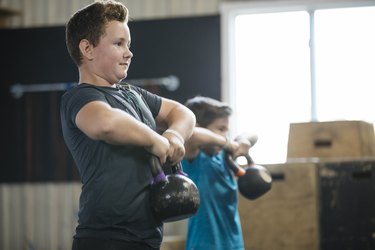
The benefits of strength training are endless: better mental and emotional health, improved self confidence, strong bones, a healthy heart, a longer and better quality of life — the list goes on.
So, it makes sense to think that starting to lift weights at an early age can kickstart these benefits and lead to a lifetime of healthy habits. But when should kids start working out and should kids even lift weights?
Video of the Day
Video of the Day
The notion of your child strength training may bring to your mind visions of them pumping iron at a gym, but rest assured that a strengthening program for kids is different than one for adults.
If you have a budding young athlete interested in strength training, you might be wondering things like, how old do you have to be to work out? or is 13 years old too young to work out? You'll be glad to know that while there is no "best" age to start working out, kids can start as young as 7 or 8 years old — with the proper precautions, of course.
Read on to learn more about what age you can start working out and tips to keep in mind for children's weightlifting.
Strength Training vs. Bodybuilding vs. Weightlifting
Strength training isn't bodybuilding or weightlifting. The latter activities emphasize competition and progressively large muscle gains. Trying to lift heavier weights or gain muscle mass can strain your child's tendons, muscles and growth plates (more on this below).
Readiness Is Key
If you've ever heard that weightlifting isn't safe for kids under 12 because it stunts their growth, you're not alone. This myth persists despite lacking any truth, according to the American Council on Exercise.
Beyond improving muscle strength, increasing bone density and lowering cholesterol, working out with weights has other, often overlooked benefits. It helps children develop a positive self-image, self-esteem and mental discipline.
So, at what age can a child lift weights? Generally, children can begin to work out with weights at the same time they are ready for organized sports. This means they are able to follow directions, understand proper form and adhere to safety procedures, including always warming up before and cooling down after a workout.
For most kids, this readiness occurs around 7 or 8 years old, according to Nemours KidsHealth, a nonprofit children's health system. It's not advisable to use weights before this time because their balance and body control skills are not yet fully developed.
Focus on Muscle Strengthening
Before puberty, children will not develop bigger muscles from working out with weights because the hormones responsible for increasing muscle size are not yet present. Although puberty begins sooner for some, and later for others, most girls begin puberty at 11, according to the American Academy of Pediatrics. Most boys begin puberty a couple of years later than girls.
As such, the focus of weight training before puberty should be on nailing proper form and technique, not building big muscles. Using weights at this age helps a child develop muscle strength, felt through firmer muscles.
Once the hormones are present during puberty, weightlifting helps the muscles grow in size. Note that children may also experience a temporary decline in balance and body control following a growth spurt. Trainers and coaches can work with children to adjust to their new body size while gaining strength with weight training.
Tips for Getting Started
Your child's strength training coach should focus on gradually helping them gain strength and encourage them to pay close attention to safety and technique.
Each session should start with at least a 5- to 10-minute warm-up to reduce your child's risk of becoming injured, include exercises for all areas of the body and end with some gentle stretches.
As children begin a weightlifting routine, they should start with light weights and focus on high repetitions. However, more than age, the beginning weight will depend on the child's strength ability.
If you're wondering how much should a 10-year-old (or any pre-teen child) lift with dumbbells (or any other piece of equipment), there's no one-size-fits-all answer because every child is different. However, the repetition rule is the same for all children — if a child can't do eight reps with the weight, it's too heavy, according to Neimours KidsHealth. After a child successfully performs 15 reps, they can progress to a weight 10 percent heavier.
Children should avoid lifting heavy weights as their growth plates mature into their teen years. These growth plates, located inside the ends of teenagers' bones, are more delicate than the surrounding bones, muscles, tendons or ligaments, according to the American Academy of Pediatrics. They are also weaker during periods of rapid growth.
According to Stanford Children's Health, too much weight may stress or damage the joints and ligaments and separate a teen's growth plates. To avoid injury, keep the focus on weight training and muscle strengthening rather than heavy lifting.
It's worth nothing, however, that even the most prepared child shouldn't participate in anything that is merely a scaled down version of an adult weight-training program, Nemours KidsHealth warns. At a young age, your child is still likely to enjoy game play, which can be incorporated into their exercise sessions.
For example, in coming up with exercises and workouts for 8- or 10-year-olds, their instructor may assign a strengthening exercise to each number on a pair of dice, allow your child to roll the dice and then instruct them to do the exercise that corresponds with the number they roll.
Our Favorite Weight Sets for Kids
- Crown Sporting Goods Neoprene 1-, 2- and 3-Pound Hand Weights ($49.99, Amazon.com)
- Crown Sporting Goods Neoprene 2-, 3- and 5-Pound Hand Weights ($69.99, Amazon.com)
- Amazon Basics 3-, 5- and 8-Pound Neoprene Workout Dumbbell ($45.36, Amazon.com)
Supervise Children as They Exercise
No matter what age they start working out, make sure children have adequate guidance to prevent injuries and get the most out of their training. Supervision and instruction from a qualified strength-training coach is imperative. Note that Olympic lifts, power lifts and single-repetition maximum effort aren't safe for a child of any age.
Without that supervision, children may practice unsafe behavior on home equipment. They might use weights that are too heavy for them or even drop weights on themselves while trying to work out.
It's also important to monitor children for any signs of overuse injuries. An overuse injury results from damage caused to a bone, muscle, ligament or tendon caused by repetitive stress.
When children don't have adequate time for muscles to heal from a weight-training session, injuries are more likely. To prevent overuse, children should aim to strength train about three times a week, according to the Physical Activity Guidelines for Americans.
Tip
Although your child may want to see physical gains as a result of their efforts, children won't gain muscle in the same way adults can until they go through puberty, according to the Hospital for Special Surgery. Explain this to your child in advance and emphasize that getting stronger and increasing athletic performance are more important than having bigger muscle fibers.
- Nemours KidsHealth: "Strength Training"
- American Council on Exercise: "Strength Training for Kids: A Guide for Parents and Teachers"
- Stanford Children's Health: "Weight Training for Teens"
- U.S. Department of Health & Human Services: "Physical Activity Guidelines for Americans"
- American Academy of Pediatrics: "Effects of Puberty on Sports Performance: What Parents Need to Know"
- Hospital for Special Surgery: "Strength and Conditioning for Kids: How and Why?"