
I grew up reading bodybuilding magazines. On page after page, they hammered home the importance of protein – how you need it to build muscle, how you should be consuming massive amounts of it, and how you should take X or Y supplement to make sure you're getting enough of it.
When I went on to earn a Ph.D. in nutrition, many of the textbooks I read stated just the opposite: Protein isn't all that important. In fact, it can be downright dangerous. Eat too much of it and your kidneys might explode.
Video of the Day
Video of the Day
This debate rages today.
Fitness types often recommend megadoses of protein, sometimes as high as three to four grams per pound of bodyweight. On the other hand, the medical establishment argues that most of us take in more protein than we need. The U.S. Department of Agriculture, meanwhile, has a recommended dietary allowance (RDA) of 0.36 grams of protein per pound of body weight. So if you weigh 160 pounds, your RDA for protein is 58 grams. Eat a 12-ounce sirloin steak, and bam, you've met your goal for the day.
The problem with both of these estimates is that neither really describes a realistic need.
The meathead bodybuilder protein portion might work if you want to look like Lou Ferrigno (although no one needs anywhere as much as three to four grams per pound of bodyweight). For the rest of us, it's a bit much.
And the USDA's recommendation? The organization describes that as "The average daily dietary nutrient intake level sufficient to meet the nutrient requirement of nearly all (97 to 98%) healthy individuals in a particular life stage." Basically, it's enough to make sure you won't die.
What we really need is a standard that tells us how much protein we should eat based on our own individual goals and aspirations. I prefer to call this the optimal intake level. And while that number might not be so high as the figures quoted in the pages of those magazines I used to read, it's certainly greater than the recommendation from the USDA.
"The USDA's recommendations don't cut it. What we really need is a standard that tells us how much protein we should eat based on our own individual goals and aspirations."
Dr. Mike Roussell
Finding Your Optimal Level of Protein for Your Body and Goals

Suppose you want to lose weight. That means you should probably follow some simple guidelines like eating less sugar. But research also indicates that eating more protein can help you towards this goal.
Scientists at the University of Illinois designed a weight-loss program in which one group ate the Recommended Daily Allowance (RDA) for protein, while a matched group ate two times the RDA recommended amount. Both groups also exercised. The RDA group lost 12 pounds of fat in 16 weeks, while the higher-protein group lost nearly 20 pounds during the same time period. The RDA group also lost two pounds of muscle. This suggests that you need more protein during a weight-loss program, both to lose fat and to preserve your muscle.
"But wait," protein naysayers will bark. "Won't eating all of that protein jeopardize your cardiovascular system? It's bound to clog your arteries."
To put that concern to the test, researchers pooled together a group of subjects with high blood pressure and less-than-ideal cholesterol, and tested the impact of adding more protein to their diets. (The OmniHeart study) No one was allowed to gain or lose weight during the test, so any changes couldn't be chalked up to the benefits of dropping a few pounds. Some subjects ate a diet with 18 percent of their total calories coming from protein, which is pretty close to the USDA's recommended amount. A second group upped their protein intake to 28 percent.
What happened?
The higher-protein group showed better health across the board. People in that group had greater decreases in blood pressure, LDL ("bad") cholesterol, and triglyceride levels. What's more, their estimated 10-year risk of heart disease decreased compared to those on the lower protein track. Had these subjects been allowed to lose weight, the results may have been even more dramatic.
So what is optimal? If you go by science, about 30 percent of your calories should come from protein.
At that level, you won't have to worry about deficiencies, and you'll know you're getting enough of the nutrient to lose fat while also improving your heart health. Have some protein at each of your meals and snacks, and you'll hit the target with ease.
Protein and Energy

Allow me to pause our protein discussion to talk about your blood sugar. When you eat a meal, your body breaks down carbohydrates into individual sugars and dumps them into your bloodstream. It doesn't matter if those carbs come from broccoli or biscuits. Your body needs energy, and this is how it's produced. The result is an increase in your blood-sugar levels.
Now, your body is very particular about blood sugar, just like Goldilocks was particular about her porridge – it wants your blood-sugar levels to be just right (70 to 99 milligrams per deciliter, for those of you interested in numbers).
When you eat a big meal, your blood sugar increases a lot. This makes your body freak out. Your pancreas responds by releasing the hormone insulin. Insulin's job in this case is very simple: Get the excess sugar out of your blood. It does this by going "door to door" throughout your body, knocking on the entry points of muscle and fat cells to see if they'll open and take in some sugar until blood levels return to just right.
If your body overreacts, your pancreas will release too much insulin. That insulin will knock on too many doors, pulling too much sugar out of your blood. Now you have a new problem: hypoglycemia (hypo = low; glycemia = sugar). You'll start to feel tired, or hungry, or perhaps both. You get tired because your body's most immediate energy source, the sugar in your blood, is suddenly depleted. You want to eat because low blood sugar is one of your body's most powerful hunger signals. Your body will crave carb-rich foods to get your blood sugar back up again, even if you just ate.
Here's how protein plays into the equation. Protein can help displace those carbs. The amino acids that form the building blocks of protein provoke a much-lower insulin response than the one triggered by a high-carb meal. So consuming more protein will have a less dramatic affect on your blood sugar.
Protein also triggers the release of a hormone called glucagon. Glucagon is the yin to insulin's yang. While insulin takes sugar from your blood and pushes it into muscle and fat cells, glucagon gets your fat cells to release stored fat into your bloodstream, where it provides fuel for your muscles, brain, and everything else that uses energy. Meaning that of all the types of food you can eat, protein is the most efficient for your body: It controls insulin and helps incinerate fat.
A Better Burn
When we talk about about burning calories, we tend to focus on exercise. But our bodies are constantly using energy throughout the day and night. Even when we're sleeping, we're still breathing and pumping blood. Our brains are dreaming. We're still digesting food and finding places to store it. And not all foods are digested equally.
The components of food—protein, carbohydrates, and fats —require different amounts of energy to digest and process, just as different types and intensities of exercise burn more or fewer calories. Scientists call this metabolic cost the thermic effect of food (TEF).
Protein has a much higher TEF than carbs or fat. That is, simply eating more protein means your body is burning more calories during the process of digestion. In some cases, doubling your protein intake will bump up the number of calories you burn throughout the day. That's one reason why protein, all by itself, helps you lose weight.
The Building Blocks of Muscle
During digestion, your body breaks down protein into individual amino acids. It uses them in many different ways, putting them together like a child combines Legos to build a castle. (Fortunately, your body does this in a more consistent way than your average elementary schooler.) These castles are your muscle tissue. To build them, you need an adequate supply of building blocks.
But imagine that the Legos did more than just stack on top of each other – they took part in your castle construction by telling you when to build your towers and walls. That's what the amino acids in protein do. They aren't just inert pieces of food waiting to be broken down. They actively signal your body to build muscle.
The most important amino acid in this process is leucine, which is found in just about every protein-containing food you'd ever eat. But in order for leucine to optimize and maximize your ability to turn protein into muscle there needs to be a certain amount present—a protein threshold, if you will.
Scientists estimate that this threshold is about 30 grams of protein. You can build muscle with less than this amount or more, but this dosage is what research has found is ideal for optimal functioning.
Once built, muscle is metabolically active, meaning it burns more calories than fat even while you're at rest. (It scorches through a lot more when you're active.) And the more muscle you have, the more effective and efficient you become at every activity, which helps you burn more calories.
The All-Day Protein Diet
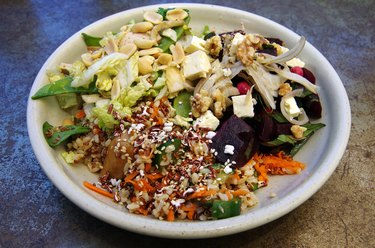
I recommend consuming lean protein throughout the day. Here are some quick and easy ways to work this essential nutrient into every meal.
*BREAKFAST: eggs, egg whites, lean breakfast meats, Greek yogurt, smoothies with protein powder.
*LUNCH OR DINNER: salmon, chicken breasts, extra-lean ground turkey, extra-lean ground beef, turkey or chicken sausage, lean beef (top round, shoulder roast, skirt steak), tuna, cod, tilapia, shrimp, tofu.
*SNACKS: Nuts and seeds, roasted edamame beans, protein bars (pick bars with at least 10 grams of protein and no more than 30 grams of carbs), protein shakes.