
















































How to Home Treat Spinal Stenosis

How to Home Treat Spinal Stenosis
Photo Credit back image by Valentin Mosichev from Fotolia.com

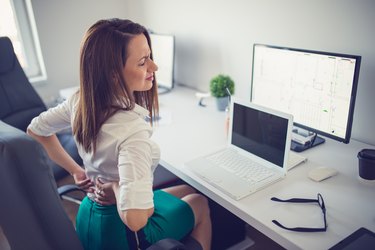
The American Academy of Orthopaedic Surgeons defines spinal stenosis as a narrowing of the spinal canal. As people age, normal wear on the spine can lead to hardening of soft tissues or increased bone growth, which in turn narrows the space in the vertebrae near the spinal cord. Spinal stenosis, which occurs most commonly in the lumbar region, puts pressure on the spinal cord and spinal nerves, leading to neurological symptoms such as pain, decreased sensation and muscle weakness. While home treatment won't cure the condition, home programs can help alleviate symptoms and make the disease easier to manage.

Step 1

Avoid postures or activities that exacerbate the stenosis, suggests H. Duave Saunders in "Evaluation, Prevention, and Treatment of Musculoskeletal Disorders." Keep a journal of when your back hurts, and what you were doing just prior to or during the onset of pain so you know which postures make your pain worse. Also, when the spine is extended, the intervertebral space narrows even more. Avoiding positions or activities that put your spine into extension, like lying on your stomach and walking downhill, may help reduce symptoms.

Step 2

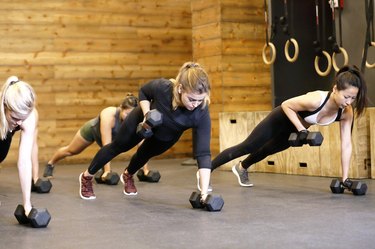
Strengthen your lower back and abdominal muscles to reduce the likelihood of symptoms in lumbar spinal stenosis, suggests the American Academy of Orthopaedic Surgeons. Try abdominal exercises that favor spinal flexion, such as crunches. When strengthening the lower back, avoid exercises that place the spine into hyperextension and opt for a lumbar stabilization program utilizing a neutral spine instead. Similarly, neck exercises that don't involve extension can help with cervical stenosis.

Step 3

Walk every day on a treadmill on an incline. While walking outdoors can sometimes increase back pain associated with spinal stenosis, a 2006 study in the journal "Spine" suggests that regular walking on a treadmill set on an incline can help alleviate symptoms. Over time, walking for 20 to 30 minutes on a treadmill, especially if you allow your arms to support some of your body weight, may reduce your overall perception of symptoms by encouraging a flexed posture.

Step 4

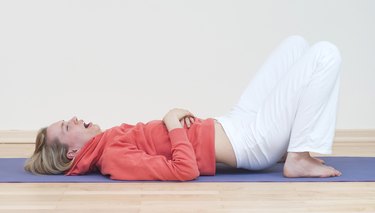
Perform single or double knee-to-chest several times a day and hold each pose for 30 seconds. According to the website Spine Universe, exercises that use lumbar flexion may help patients suffering from stenosis. For cervical stenosis, try bringing your chin to your chest and holding for 30 seconds instead.

Step 5

Sleep with your lower legs elevated on a pillow to keep your spine in mild flexion.

Things You'll Need

  • Pillow
  • Treadmill

References

Article reviewed by Roman Tsivkin Last updated on: Sep 13, 2010

Must see: Photo Galleries