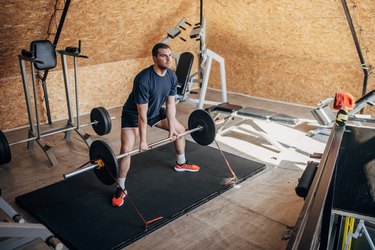
Your muscles have both force and stamina, aka muscular strength and muscular endurance. And while you want to have both, improving your muscular endurance can help you run longer, swim farther and even sit with better posture.
Learn how you can improve your muscular endurance and why it's so important for your workouts and day-to-day activities.
Video of the Day
Video of the Day
First, What Is Muscular Endurance?
The longevity component of muscular fitness is endurance, or the ability of a muscle to exert force over a given period of time. Your muscles are made up of slow-twitch and fast-twitch fibers, according to the American Council on Exercise (ACE). Ideally, you want to strengthen both types of muscle fibers, but your slow-twitch muscles play the biggest role in muscular endurance.
Your body uses these muscle fibers when you run long distances or perform exercises for a lot of reps. To increase your muscular endurance, you want to improve your slow-twitch fibers' ability to use oxygen and produce energy
In order to do so, you need to do more muscle-strengthening exercises that involve holding your muscles under tension for longer periods of time, per the ACE. In other words, you want to decrease the amount of time you rest between exercises and increase your actual work periods.
What's the Difference Between Muscular Strength and Muscular Endurance?
To improve your performance in activities like strength training, cycling or running, you need to practice both muscular strength and endurance exercises.
But while endurance focuses on your muscles producing force over time, strength is how much force your fast-twitch fibers can produce in total, according to the ACE. Think of it like this: Muscle endurance focuses on doing more reps, and muscle strength focuses on more weight.
Why Are Muscular Endurance and Endurance Training Important?
There are several benefits of muscular endurance training, and improving your muscles' endurance should be a priority regardless of your preferred form of physical activity.
When you train for muscular endurance, you're building up your muscles differently from when you train for strength, according to the University of New Mexico. With muscular endurance, you're building up capillaries in the muscle, which help get more blood in and out as you exercise.
That's mostly why muscular endurance exercises give you better endurance. The increased blood flow helps bring nutrients into the muscle to keep it going. It also helps bring waste out of the muscle to promote recovery.
Training for muscle strength and muscle endurance have different effects on your body. Getting better at muscular endurance exercises like push-ups and body-weight squats can make you better at aerobic exercise. Training with higher repetitions can improve your fitness.
Sure, endurance training is especially helpful for people who do activities that require energy over long periods of time (like long-distance running or swimming). But enhancing your endurance can help with everyday activities, too.
For instance, when you sit at a desk, your core and back work to keep good posture. But without adequate muscular endurance, you start to slouch in your seat, which can cause back pain or discomfort, according to the ACE.
So, whether you're an endurance athlete looking to improve sport performance or an everyday gym-goer looking to sit, stand and lift with more ease, endurance training is essential.
How to Improve Your Muscular Endurance
Your muscular endurance is your muscles' ability to produce force or energy over a period of time (more on that below), according to the ACE. And you can improve your stamina with specific training structures and workouts.
When it comes to resistance training, you want to decrease the weight you lift and the rest time between sets, focusing on higher reps, according to the ACE. Generally, you want to stick to these rep and set ranges to improve your muscular endurance:
- Reps: 10 or more
- Sets: 2 to 5 or more
- Rest Periods: 30 to 60 seconds
- Pace: consistent slow to moderate
Remember, the focus here is the amount of reps, not the weight you're lifting. So if you can't do a 15-pound dumbbell shoulder press for 15 reps, it's better to bring down the weight. But you also want your workout to be comfortably challenging.
The specific exercises you do depend on your fitness goals. But compound exercises, like squats and lunges, are an excellent place to start. These muscular strength and endurance exercises move multiple muscle groups at once, giving you a more efficient workout.
Below, see our muscular endurance exercises list.
Recommended Exercises for Muscular Endurance
1. Use Your Body Weight
In addition to weights or resistance bands, you can also use your body weight to perform muscular endurance exercises, per the ACE. Body-weight exercises are convenient, no-equipment muscular endurance examples that are suited to all levels. Plus, there are countless moves to choose from.
Do each exercise for the desired amount of time or reps, moving from one to the next without a break. When you get to the end, take a 30- to 60-second break and repeat. Cycle through 2 to 3 sets.
2. Train With Timed Exercises
Exercises that you do for a certain amount of time are also better for muscle endurance, according to Henry Halse, CSCS, CPT, a personal trainer based in New York City.
Planks and wall sits — two muscular strength examples — are held for a matter of seconds or even minutes. These moves build up muscle endurance because you're never pushing yourself to the brink, rather you're slowly fatiguing your muscles.
Some exercises for muscular endurance are in a grey area, depending on the person doing the exercise. Push-ups, for example, can be a strength exercise if you struggle to do more than six total repetitions in a set. However, if you can do 20 reps, they turn into an endurance exercise.
Exercises in the grey area tend to be body-weight exercises, like push-ups and triceps dips. Squats and step-ups are example exercises for muscular endurance in your lower body.
3. Add Some Circuits to Your Fitness Routine
Circuit training uses muscular endurance exercises that keep your body in motion, with very little rest. A typical muscular endurance workout involves completing a series of strength-training exercises, one after the other, with a rest at the end of each circuit.
Move through the following circuit 2 to 3 times with a 30- to 60-second rest between circuits. Reps and weight will vary based on your fitness level, but aim to keep the weight low to moderate and the reps high (12 to 15).
- Squats
- Lunges
- Jog (in place)
- Bent-over rows
- Push-ups
- Crunches
- Jumping (or step-out) jacks
- American Council on Exercise: "How to Select the Right Rest Intervals and Post-Training Recovery for Your Clients"
- Centers for Disease Control and Prevention: "Top 10 Things to Know About the Second Edition of the Physical Activity Guidelines for Americans"
- Physiological Reports: "The Effect of Training Volume and Intensity on Improvements in Muscular Strength and Size in Resistance-Trained Men"
- University of New Mexico: "Optimize Endurance Training"