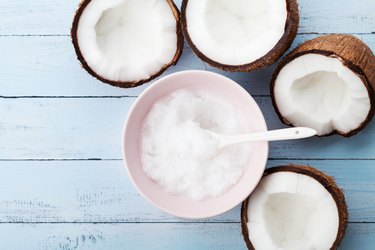
You're probably familiar with coconut milk and coconut oil, but did you know you can also eat the meat? If you're eating raw coconut, you're consuming the white flesh that is inside the fruit. But in order to get to the meat, you need to know how to prep and eat this fibrous one-seeded drupe.
Raw Coconut Nutrition
Video of the Day
Raw coconut meat is packed full of fiber, minerals, some vitamins and a lot of fat. While the raw meat from a whole coconut provides several nutrients, it's important to note that the oil from the coconut is 100 percent fat, according to Harvard T.H. Chan School of Public Health, with 80 to 90 percent saturated fat.
Video of the Day
It's the high levels of saturated fat that promoted the American Heart Association (AHA) to issue a scientific advisory for consumers to replace saturated fats, which includes coconut oil, with unsaturated fats. In this advisory, the AHA points out that coconut oil raised LDL cholesterol in the same way as other saturated fats such as those in palm oil, butter and beef fat. Because of the high levels of saturated fat, consuming coconut oil is best done in moderation.
In addition to fat, the meat, or raw coconut flesh also contains several important nutrients. According to the USDA, 1 cup of coconut meat, raw and shredded, provides:
- 284 calories
- 2.66 grams of protein
- 26.8 grams of fat
- 12.2 grams of carbohydrates
- 7.2 grams of fiber
- 4.98 grams of sugar
- 285 milligrams of potassium
- 25.6 milligrams of magnesium
- 1.94 milligrams of iron
- 90.4 milligrams of phosphorus
Eating Raw Coconut
When it comes to eating raw coconut, there are several ways to enjoy it including raw and shredded or dried and shredded. However, you can also buy a whole coconut from the store and prep it yourself. That said, getting to the meat requires more than just cracking the coconut open and digging in.
The Academy of Culinary Nutrition provides a tool-free method for cracking open a coconut. However, you still need to find a pointy surface, such as the corner of a counter, to crack open the coconut.
- Locate a sharp and pointy surface. If you are indoors, try the corner of a kitchen counter. If outdoors, some people have good luck using a rock.
- Place a bowl under the coconut prior to cracking it open. This will help catch the liquid that will drain after it's cracked.
- With the coconut in your hand, drive it into the point of the surface until the skin is pierced. Make sure you do this over the bowl and allow the liquid to drain out.
- Continue this process by going around the coconut until it cracks.
- Once you have it open, run a knife along the inside of the skin to scoop out the meat. You may also be able to use a spoon to scoop it out.
Read more: 5 Benefits of Coconut Milk and How to Use It
How to Use Coconut
Coconut can add flavor and texture to many recipes and food items. In addition to raw coconut recipes, consider adding the flesh, either shredded or in chunks, to items such as:
- Blend it into smoothies.
- Add it to dips and sauces.
- Shred it in fruit salads or mixed green salads.
- Use it as a topping for yogurt or oatmeal.
- Cut it into chunks and add it to a chicken or fish stir-fry or Thai coconut stew.
- Use as a garnish.
- Add it to cooked grains.
- Sprinkle it on top of ice cream.
- Add it to a pina colada.
- Purée it and use it as a topping on ice cream or sorbet.
- Add it to pancake or waffle mix or top your hotcakes with shredded coconut.
You can also reap the benefits of eating dried coconut by adding it to recipes for baked goods, such as coconut macaroons and coconut chocolate chip cookies, or using it as an ingredient in homemade snack bars. If you want toasted coconut, place the shredded raw coconut on a baking sheet and bake for 12 to 18 minutes at 350 degrees Fahrenheit. Give it a few stirs while it's baking to make sure it cooks evenly.