






















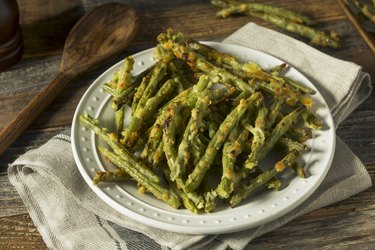












String beans are members of the legume family of vegetables. They are young versions of dried beans, harvested before they mature. Their pods are soft and edible when picked while they are still green. String beans are called such because of stringy fibers which tend to develop along the pod seams and have to be removed before cooking. Modern gardeners are developing varieties to reduce these strings, the results are now called snap beans.
Protein
Many people add dried beans to their diet for protein. String beans have a different nutritional profile. Picked earlier, they provide less protein but more dietary fiber. You can use them to add a green vegetable to a meal, instead of a protein supplement. The immature beans inside the pods do contain protein, however, which makes string beans a better source of protein than many other vegetables.
Carbohydrates
String beans are a starchy vegetable; they contain complex carbohydrates. Complex carbohydrates supply your body with several different forms of sugar. Simple carbohydrates from fruit, sugar or dairy products, contain only one or two forms of sugar. Your body takes longer to digest complex carbohydrates and to break them down into energy. Slower digestion keeps you feeling full for longer and enables your body to absorb more vitamins and minerals.
Dietary Fiber
String beans are a source of dietary fiber. Both soluble and insoluble fiber are important for a healthy diet. Insoluble fiber passes straight through your digestive system, easing its efficiency. Soluble fiber, which is present in string beans, dissolves in water and other fluids and has a beneficial effect on your blood chemistry. It can assist with the control of glucose and cholesterol levels.
Vitamins
String beans contain vitamins C, A and folic acid, which is a B vitamin. Vitamins A and C are both important for your body's immune system. Vitamin C and folic acid help your body to metabolize proteins. Although Vitamin A is fat-soluble, which means that your body can store it from day to day; water-soluble Vitamin C and folic acid must be replenished every day.
Minerals
String beans also contain some trace minerals--potassium, iron and calcium. Each of these elements plays an important part in a nutritious, balanced diet. Calcium is vital for bone density, iron for blood health and potassium for healthy muscles. Since string beans contain so many nutrients, they can make a useful addition to your daily diet.
References
- "Journal of Agricultural and Food Chemistry"; Nutritive evaluation of the seed, germinated seed, and string bean of Erythrina americana and the detoxification of the material by boiling; A. Sotelo et al.; 2003
- University of Illinois Extension: Watch Your Garden Grow: Beans
- The New York Times: Health Guide: Diabetes Diet


Member Comments