

























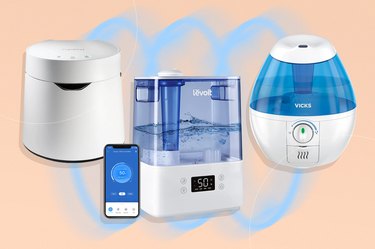
If you or a family member suffers from allergies, asthma or sinus and respiratory conditions, adding either a whole house humidifier or simply using a room humidifier can make a vast difference. Room air humidifiers can help to improve air quality and may reduce or alleviate symptoms caused by dry air, such as sinus headaches, dry skin, sneezing and coughing.
During the dry winter months, heating systems can leave the air in your home very dry. Humidifiers are a simple way for you to add back essential moisture into the air. Dry air affects everyone equally, whether or not you suffer with allergies or asthma. You might experience dry and itchy skin, cracked lips, or dry eye. Low humidity levels in the air can also dry out the mucous lining inside your nose and throat, causing sore scratchy throats, nose bleeds and sinus infections. Adding a room air humidifier to your bedroom can help you sleep more comfortably at night and is also a great way to help prevent colds and the spread of germs during the flu season.
A healthy range of humidity in the air is 30 percent to 50 percent relative humidity. You can purchase an inexpensive humidity/temperature gauge (hygrometer) that will allow you to monitor the relative humidity level in the room. Low humidity levels (below 30 percent) are unhealthy while levels higher than 50 percent can actually encourage the growth of mold, bacteria, fungi and dust mites. A simple way to tell whether or not you have too much humidity is by looking at your windows. Condensation buildup on windows is a telltale sign of too much moisture in the air. Most humidifiers have built-in humidistats that allow you to adjust and control the amount of humidity you add to the room. More expensive models also have hygrometers built in that can provide a readout or allow you to gauge the humidity level in the room and then you can specify the exact level of humidity you prefer.
What to Look for
There are many different types of humidifiers available for purchase. They vary in both size (the number of gallon output per day and the time it will run) and method of humidification (cool mist, evaporative, warm mist and ultrasonic). Console humidifiers are capable of humidifying multiple rooms and very large areas. Room humidifiers are smaller units and are used in a single small, medium or large room. Here is a brief look at the different types of humidifiers:
Cool Mist Evaporative Humidifiers: Adds moisture into the air similar to natural evaporation and offers the cleanest method of humidification. It uses a simple filter to absorb the water and trap minerals or impurities. A fan then blows dry room air through the saturated filter, causing the water in the filter to evaporate into the room, thereby adding moisture into the air. As long as the filter is clean, this system ensures clean and moisturized air is put into the room.
Warm Mist Humidifiers: Uses a heating element to release mist into the air in the form of a warm steam. If you live in a cold climate, using a warm mist humidifier will help make the room feel warmer. With this method, the heating element boils the water into a steam, which rises into the air in a purified form. The mineral content is left in the humidifier and can be cleaned by using vinegar; some models use a mineral absorption pad. Because there is not a fan, warm mist steam humidifiers are quieter than cool mist evaporative humidifiers.
Ultrasonic humidifiers: As the quietest humidifiers, they are sometimes described as "silent." This type utilizes a high frequency sound waves that vibrates a metal diaphragm at an "ultrasonic" frequency, which breaks the water in the humidifier down into an ultra-fine vapor mist. The vapor mist is then released into the air using a very small and quiet fan, often looking like fog. Because any minerals or impurities that are present in the water are released into the air with the mist; many ultrasonic humidifiers use demineralization cartridges, which serve to trap these minerals before they are released into the air. Some ultrasonic humidifiers heat up the water before releasing it into the air. This eliminates bacteria growth in the water and helps keep the room from feeling too cold.
Common Pitfalls
Cool Mist
Pros: The filter ensures a pure and clean mineral-free moisture output as long as the filters are clean. This humidified requires very low power consumption and provide enough humidity to cover large areas with a single humidifier due to the power of the fans.
Cons: Depending on the speed of the fan, it can make more noise than other types of humidifiers. The filter needs to be replaced approximately every 2 months. Bacteria and mold can grow on a wick filter. This is usually apparent by the color of the filter.
Warm Mist
Pros: There are no filters to replace, which makes it less costly to use. It offers a quiet system that provides pure, clean and mineral-free moisture output.
Cons: These units cost slightly more to run (heating elements use more electricity) due to a higher power consumption. They work best when used in small rooms. Because they become hot, they can be dangerous and may not be the best safety choice if children are present due to the risk of being knocked over or touched, which can result in burning. There is controversy over whether or not this is the best choice if you have allergies or asthma.
Ultrasonic
Pros: These systems run very quietly. There are no wick filters to replace, which makes them very cost effective and they take low power consumption.
Cons: These are also limited to use in small rooms. You may need to use distilled water to prevent impurities from entering the air in the form of "white dust." This can sometimes be controlled with a demineralization cartridge, however, demineralization cartridges are usually not 100 percent effective.


Member Comments