The glycemic index is a measure of how quickly the body can use the carbohydrates in food as energy. Some foods release their energy quickly while others release theirs over a slower period. If the carbohydrate is released too quickly, it may cause disturbances in your blood sugar levels. You may experience a sudden surge of energy which quickly drains away, leaving you feeling tired, weak and hungry again. Foods that release their energy slowly can help to keep your blood sugar levels stable.
High and Low GI Values
Foods are given a glycemic index, GI, value depending on how quickly the carbohydrates they contain reaches the bloodstream. Low GI foods release their energy slowly and have GI values of 55 or less. Medium GI foods have values between 56 and 69 and high GI foods, which release their energy quickly, have GI values of 70 or above.
GI of Honey
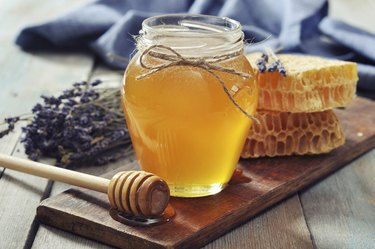
Honey is a naturally sweet substance produced from nectar by bees. According to the American Dietetic Association, honey is made up of several sugars including fructose, glucose and sucrose. The glycemic index will vary depending on the type of honey you use. Floral honeys tend to have the lowest GIs, so use them to sweeten the foods you eat. According to the Glycemic Index Database, locust honey has a GI of 32, yellow box honey has a GI of 35 and stringy bark honey has a GI of 44. Other honeys release their energy faster and are classed as medium on the glycemic index. These tend to be the commercial blends, clover honey which has a GI of 69 and pure honey which has a GI of 58.
GI of Sugar
Ordinary supermarket sugar is also known as sucrose, or refined sugar. According to the database, sucrose has a GI of 60. Other sugars are found naturally in foods such as fructose, which is a fruit sugar, or lactose which is a milk sugar. According to the database, fructose has a GI of 11, glucose has a GI of 100, lactose has a GI of 46 and maltose has a GI of 105.
Formation of Sugar
Refined sugar is made from one glucose molecule and one fructose molecule joined together. Glucose has a high GI and fructose has a low GI, producing an average GI of around 60. Look out for honey which contains larger amounts of fructose as this will give it a lower GI value overall.
Honey or Sugar
According to the American Dietetic Association, the nutrients in honey and white sugar are similar. Honey contains slightly more calories than sugar, however it is sweeter, so you need less of it to get the same effect. With regards to the glycemic index, use sugar sparingly and sweeten foods using a low GI honey.


