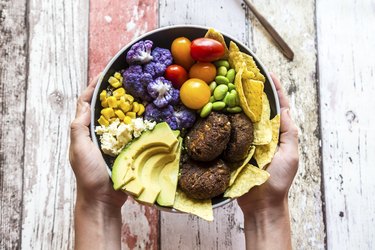
If you eat a plant-based diet or have ever considered giving it a try, you've probably heard about the potential for nutritional shortfalls — specifically, protein, iron, vitamin D, calcium, omega-3s and vitamin B12.
But one nutrient deficiency you probably haven't heard a lot about is choline. But in its August 2019 issue, the British Journal of Medicine featured an article authored by a nutrition researcher warning of the potential for a "choline crisis," due to the recent interest and societal shift toward a more plant-based diet.
Video of the Day
Video of the Day
Her argument centers around the fact that current choline intakes in Europe and the U.S. are below the recommended amounts (a 2015 study from the Journal of the American College of Nutrition found that only about 11 percent of Americans get enough choline) and that removing foods high in choline — which are largely animal proteins like eggs, beef and chicken — would further exacerbate the issue.
Below, registered dietitian nutritionist Whitney English MS, who follows a plant-based diet herself, explains why choline is important, what the risks are if you fall short on your intake and which plant-based foods are the best sources.
What Is Choline and Why Is It Important?
Choline is what's called an "essential nutrient," meaning you have to get the majority of it from your diet. Your liver does produce a small amount, but it's not enough to meet your daily needs. This vitamin-like nutrient plays a role in overall metabolism and is crucial for your brain, specifically your mood, memory, muscle control and other nervous system functions.
While everyone needs choline, it's even more crucial for certain groups of people. Pregnant women need to be conscious of their choline intake, as it plays a role in brain and spinal cord formation, says English. "I recommend that pregnant women who do not eat eggs consume a choline supplement. Also, people with genetic variations in the PEMT gene, many of European ancestry, may also be at risk of choline deficiency."
On the flip side, according to the National Institutes of Health, premenopausal women might actually need less choline, as estrogen induces the gene that helps create choline. It's also worth noting that if you're deficient in folate — another crucial vitamin for everyone, especially pregnant women — you also have an increased need for choline.
Read more: Pros and Cons of a Vegetarian Diet
How Much Choline Do You Need?
To date, there isn't a ton of research available on choline, at least in comparison to other nutrients. That's why the Institute of Medicine created "Adequate Intake" guidelines for the nutrient. These guidelines help consumers understand how much to eat even though there isn't enough evidence to create more stringent recommendations like the Recommended Daily Allowances (RDAs) and the Estimated Average Requirements (EAR).
For adults ages 19 and older, the guidelines are:
- Men: 550 mg per day
- Women: 425 mg per day
- Pregnant Women: 450 mg per day
- Lactating Women: 550 mg per day
What Are the Best Plant-Based Sources of Choline?
Yes, animal proteins are rich in choline, but plant-based foods can be a good source, too. "Choline is found in a wide range of plant foods including soybeans, sunflower, wheat germ and peanuts," English says. "A half-cup of soybeans contains a little over 100 milligrams of choline (one egg contains 140 milligrams of choline, for reference)."
Here's a breakdown of some of the best plant-based food sources of choline:
- Soybeans, roasted (1/2 cup): 107 mg (19% DV)
- Shiitake mushrooms, cooked (1/2 cup): 58 mg (11% DV)
- Red potato (1 large): 57 mg (10% DV)
- Wheat germ, toasted (1 ounce): 51 mg (9% DV)
- Canned kidney beans (1/2 cup): 45 mg (8% DV)
- Quinoa, cooked (1 cup): 43 mg (85% DV)
- Brussels sprouts, boiled (1/2 cup): 32 mg (6% DV)
- Broccoli, cooked (1/2 cup): 31 mg (6% DV)
- Peanuts (1/4 cup): 24 mg (4% DV)
- Green peas, boiled (1/2 cup): 24 mg (4% DV)
- Cauliflower, cooked (1/2 cup): 24 mg (4% DV)
- Sunflower seeds (1/4 cup): 19 mg (3% DV)
- Brown rice, cooked (1 cup): 19 mg (3% DV)
What About Choline Supplements?
So, should you try a choline supplement if you eat plant-based or are considering giving it a go? Consider this: Ninety percent of Americans are already not meeting their choline needs, the majority of which are probably not following a plant-based diet. The issue here is a poor diet. Focusing on eating whole, minimally processed foods should be the first action of attack, not supplementing because of poor diet choices.
Additionally, supplementing doesn't come without risk. "I think there needs to be more research on choline needs before we recommend that adults (other than pregnant women) up their intake or supplement," says English.
"Consuming too much choline can result in a fishy body odor, vomiting, excessive sweating and salivation, extremely low blood pressure and liver toxicity. Additionally, choline has been shown to be converted in the liver to a compound known as TMAO, which is associated with an increased risk of heart disease."
If you're concerned about getting enough choline, plant-based diet or not, work with a dietitian to incorporate more natural food sources into your diet or discuss your individual needs for supplementation.
- British Medical Journal: "Could We Be Overlooking a Potential Choline Crisis in the United Kingdom?"
- Journal of the American College of Nutrition: "Assessment of Total Choline Intakes in the United States"
- National Institutes of Health: "Choline Fact Sheet for Health Professionals"
- Institute of Medicine: "Dietary Reference Intakes for Thiamin, Riboflavin, Niacin, Vitamin B6, Folate, Vitamin B12, Pantothenic Acid, Biotin, and Choline."
Was this article helpful?
150 Characters Max
0/150
Thank you for sharing!
Thank you for your feedback!