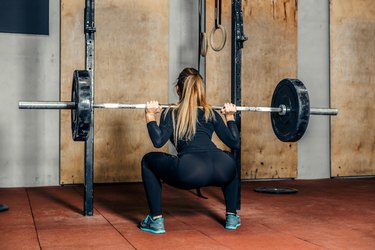
Lifting weights offers you many health benefits, but many dangers of weight training exist too. These dangers include risks from your equipment and risks from your technique. Learning more about these dangers will help you stay safe while exercising in the gym.
Tip
Weight lifting has many dangers, according to an August 2014 review in the Texas Heart Institute Journal. These dangers can affect your muscles, heart and brain. You can decrease your risk by using proper form, warming up and staying fit.
Video of the Day
Benefits of Resistance Training
All types of resistance exercise can improve your physical health. The authors of a small study in the January 2013 issue of Experimental Gerontology tested 16 older women and men using high-resistance circuit training. Training for 12 weeks increased bone mineral density, muscular strength and muscle mass. It also decreased fat mass.
Video of the Day
Amazingly, doing resistance training seems to help everyone. The writers of a February 2015 paper in JAMDA tested nearly 200 older adults and showed that every participant had a positive response to 12 to 24 weeks of resistance training. That is, they benefit in some way from the training, and they rarely had exercise-related side effects.
Resistance training can also improve your mental health. The authors of a July 2014 article in Frontiers in Psychology described the anxiety-fighting effect of resistance exercise. Surprisingly, you only need to do a low-to-moderate level of training to see positive effects.
These positive effects have clinical utility. The writers of a December 2017 paper in Sports Medicine studied nearly a thousand cases and found that resistance training decreases anxiety in people with physical and mental illness. It also helps healthy adults manage their day-to-day worries.
Risks of Resistance Training
You have to make good choices when you exercise. Lifting too much or too fast can easily cause an injury. For example, it's easy to rupture a pectoral tendon while doing bench press exercises.
Pushing yourself during a competition might cause excessive tissue damage, according to a September 2016 report in the British Journal of Sports Medicine. Not letting your body properly recover increases your risk of injury and illness too. The author of a July 2016 article from the Cleveland Clinic suggested taking a 48-hour break between workouts.
Doing movements beyond your normal range of motion can also cause injury. A study published in the October 2015 issue of the American Journal of Sports Medicine illustrates this effect. These researchers studied the relationship between shoulder flexibility and injury risk in nearly 300 pitchers. Athletes with limited flexibility had twice as many injuries. You should work on your mobility to extend your range of motion as being flexible has many benefits.
You can also get hurt by improperly using gym equipment. Dropping weights is a surprisingly common problem, according to a March 2018 paper in the Journal of Orthopaedics. It causes nearly two out of three upper-body weight lifting injuries. Of these injuries, about nine out of ten bone breaks happen while lifting free weights.
You can also get trapped under the bar during a bench press or a squat. That's why it's important to always lift an amount you can handle and have a spotter. You can also do your lifting in a cage with safety bars. You can set these bars to catch the weight for you, if you can't lift it back up.
You will also need to have good form. If you don't know the proper technique, don't hesitate to work with a personal trainer. They can share their extensive knowledge about the exercises as well as the repetitions, sets and form needed to get the most out of them.
The troublesome issues with free weights suggest that exercise machines might give you a safer workout. In most gyms, these machines have a label with detailed instructions on how to use them. The labels also describe the muscles worked and offer safety guidelines.
Read more: How to Get Started With Weightlifting
Dangers of Weight-Lifting Supplements
Manufacturers offer a variety of weight lifting products from creatine to whey. The authors of a July 2012 paper in the Journal of the International Society of Sports Nutrition showed that creatine offers athletes many benefits including increased muscle strength and muscle mass. Whey can also improve athletic performance and increase muscle mass, according to a July 2017 paper in the British Journal of Sports Medicine.
Unfortunately, some supplements cause side effects. Most multi-ingredient supplements seem safe, according to an August 2018 article in the Journal of the International Society of Sports Nutrition, and most people take them under this assumption.
However, the researchers also noted that the studies assessing supplement safety typically are assessing only short-term usage. The long-term effects of supplements are less known and could be harmful to your health. For example, a June 2013 report in Applied Physiology, Nutrition and Metabolism showed that the long-term combination of resistance training and whey protein damaged the organs of laboratory animals.
The supplement-related deaths of two soldiers prompted the military to study the possible risks of workout supplements. So the authors of a June 2013 article in Military Medicine looked at supplement use in more than 300 Marines training overseas. About 70 percent of the men and 40 percent of the women used supplements. Approximately 80 percent of the marines felt that supplementation improved their physical performance, but more than 10 percent had side effects.
Read more: How to Build Muscle Without Supplements
Nearly 90 percent of the Marines used supplements featuring a stimulant like caffeine. Not surprisingly, many of them experienced dehydration, jitteriness and insomnia. Some also reported experiencing an energy crash when the effects of the supplement wore off.
- Texas Heart Institute Journal: "More on Weightlifting Injuries"
- Experimental Gerontology: "Effects of High-Resistance Circuit Training in an Elderly Population"
- JAMDA: "There Are No Nonresponders to Resistance-Type Exercise Training in Older Men and Women"
- Frontiers in Psychology: "Anxiolytic Effects of Resistance Exercise"
- Sports Medicine: "Effects of Resistance Exercise Training on Anxiety"
- British Journal of Sports Medicine: "How Much Is Too Much?"
- Cleveland Clinic: "Don’t Make These 4 Mistakes When You’re Lifting Weights"
- American Journal of Sports Medicine: "Deficits in Glenohumeral Passive Range of Motion Increase Risk of Shoulder Injury in Professional Baseball Pitchers"
- Journal of Orthopaedics: "Upper Extremity Weightlifting Injuries"
- Applied Physiology, Nutrition and Metabolism: "Effects of Resistance Training Associated With Whey Protein Supplementation on Liver and Kidney Biomarkers in Rats"
- Military Medicine: "Patterns and Perceptions of Supplement Use by U.S. Marines Deployed to Afghanistan"
- Annals of Epidemiology: "Bodybuilding, Energy and Weight-loss Supplements Are Associated With Deployment and Physical Activity in U.S. Military Personnel"
- Nutrition Reviews: "Energy Drinks Mixed With Alcohol"
- Journal of the International Society of Sports Nutrition: "Creatine Supplementation With Specific View to Exercise/Sports Performance"
- Journal of the International Society of Sports Nutrition: "Multi-Ingredient Pre-Workout Supplements, Safety Implications and Performance Outcomes"