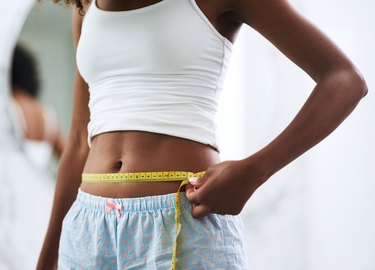
Many times, when we hear someone talk about their weight-loss journey or how they transformed their lifestyle, they won't just reference the pounds they shed. Rather, they'll also note the difference in their inches over months or years. Measuring various body parts — like our hips, waists, legs and arms — is a common way to track progress toward a health goal, and for good reason.
As chiropractor, clinical nutritionist and doctor of natural medicine Josh Axe explains, logging inches allows us to see how our body composition is changing thanks to our diet and exercise efforts. It often gives a clearer picture than the scale, as you can sometimes see the inches decrease even if the number on the scale goes up.
Video of the Day
Video of the Day
"If you are strength training as part of your exercise and weight-loss routine, you'll want to measure changes in muscle tissue — which weighs more than fat," he explains. "And which can indicate that you are toning up, losing fat and possibly also gaining lean muscle mass."
But there are smart and effective ways to track your measurements, and then there are some strategies that can leave you feeling defeated. Here, certified personal trainers and doctors share the essential dos and don'ts of using a measuring tape to keep tabs on your progress.
Read more: How to Estimate Your Body Fat Percentage
1. Don’t Measure Yourself Daily
Though ensuring your diet is balanced with the right vegetables, protein and healthy fats is part of losing weight, so is keeping a positive attitude. And if you wake up each and every morning and pull out your tape measure to see if you've lost a fraction of an inch, you might be measuring too much.
Rodrigo Garduño, certified personal trainer and owner of 54D Miami, explains that weight-loss goals aren't met overnight. His advice is to measure on day one — and then again in four weeks. "It takes time for your body to change," he says. "So too often is not good, as a lot of weight loss acceptance is psychological."
Remember that weight loss is a marathon, not a sprint, so the most you should be measuring yourself is about once a week.
2. Do Measure the Exact Same Spot Each Time
Though it might seem like a few inches up or down your arm doesn't make a huge difference, Axe says accuracy is essential. Especially if you want to truly understand your progress through numbers, using a full-length mirror to locate the exact point you want to measure will help guide your tape.
To measure your waist circumference, wrap the tape around your belly button and two inches above the top of your hip bone. And for your hips, wrap the tape around your body at the widest point between your butt and hips.
Read more: 2 Reasons Why Weighing Yourself Daily Can Help You Lose Weight — and 2 Reasons It Might Not
3. Don’t Only Measure One Part of Your Body
(Not so) fun but true fact: Fat isn't limited to your stomach area. Rather, when you lose weight, you'll lose fat (and inches) from many different areas of the body. Even so, many people make the mistake of only measuring their tummy, says David Greuner, MD, a surgeon with NYC Surgical Associates. Because each area of the body drops pounds and tones up at various speeds, you could become discouraged if you're just measuring this one spot.
After all, if your abdominal muscles show little progress, yet your arms are seeing major improvements, you'll never know if you're not measuring them. "Focus on your progress overall rather than just one area," Dr. Greuner says.
So, where should you focus your efforts? Axe suggests four to five areas, including the upper arms, chest, waist, hips, thighs and calves. "Measure several body parts that you are hoping to tone up, lose weight from or otherwise change," he notes. "Measuring multiple body parts is a good idea, since this gives you an overall picture of how your body is changing."

4. Do Remain Consistent With Clothing
The best way to measure yourself is in your birthday suit. But if you aren't comfortable standing in the nude, either alone or with someone else, Axe encourages folks to ensure they're wearing the same outfit each time they take measurements — preferably underwear or snug-fitting garments.
"You don't want to make the mistake of wearing clothing that adds extra inches to your frame, or different outfits that throw off your measurements," he explains. "Ideally, measure right against your skin or over the same shirt and pants every time."
"You might not be seeing a difference with the measuring tape method or even a scale because your body is gaining healthy muscle."
5. Don’t Compare Yourself to Others
And this goes for any statistic about your body, says Dr. Greuner. All too often, he says, people set unrealistic goals for themselves that are purely based on other people's experiences — whether it's friends or Instagram strangers.
This can be detrimental to your ability to stay the course, since your system will react differently to diet and exercise depending on your current weight, history of weight loss and other lifestyle factors. This is especially true if you are exercising frequently, and thus, molding your form. "You might not be seeing a difference with the measuring tape method or even a scale because your body is gaining healthy muscle," he explains.
Though it's important to be mindful of your starting point and various milestones along the way, don't compare your health goals, weight, measurements or BMI to others. Instead, focus on yourself and how you are feeling to maintain self-control and confidence.
6. Do Measure Yourself Monthly Once You've Hit Your Goal
When you think about the road trips you've been on, there was a beginning, a drive and a destination. The same can be said about a weight-loss journey. And once you've met your goal via the scale and measuring tape, it's important to decrease your frequency.
As Axe explains, for those maintaining their size and weight, monthly measurements are effective to help keep you in check. On the other hand, if you whip out the tape every week, you're putting unnecessary pressure on yourself — and your confidence — since ebbs and flows are part of living a normal, healthy life.