
What Really Happens to Your Body When examines the head-to-toe effects of common behaviors, actions and habits in your everyday life.
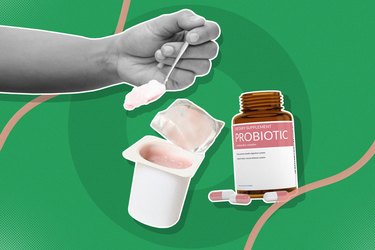
Probiotics, good-for-you bacteria best known for their connection to healthy digestion, naturally occur in plenty of foods — often the fermented kinds, including kimchi, miso and yogurt. They also come in the form of dietary supplements, and some food brands have taken to adding them to their products (these days, you can even find probiotic ice cream!).
Whether probiotics in food or supplemental form is better is still up for debate; certain conditions seem to benefit from food-based probiotics, but this isn't always the case.
Video of the Day
Video of the Day
A December 2010 study in the International Journal of Food Microbiology examined human saliva and fecal samples after participants consumed either yogurt (a great source of probiotics) or probiotic pills and found that both options provided the body with comparable amounts of microorganisms.
Probiotics get their good reputation for benefiting gut health, but they can potentially support the entire body, according to the Cleveland Clinic. While probiotics are naturally part of the human system, increasing your intake — through food or supplements — can be a good way to improve your health.
"Although more research is needed to understand the exact impact of the gut microbiome when it comes to heart health, we now know our gut affects more than digestion."
And sure, while there's still a lot of work to be done around these beneficial bacteria, a multitude of studies answer the question, what do probiotics do? Here's a rundown.
Your Mood May Lift
You may have heard of the gut-brain connection, a term used to describe the link between our microbiota and our brains. While the research is still in its early phases, emerging studies suggest that probiotics can have a beneficial effect on mental health.
An August 2017 study in the journal Gastroenterology found 64 percent of participants with irritable bowel syndrome (IBS) and mild-to-moderate anxiety and/or depression who took a probiotic supplement every day for six weeks reported decreased depression symptoms during that time.
Just 32 percent of people taking an inactive placebo showed similar results. The study also showed, with MRI examinations, that those taking the probiotic had greater changes in the parts of the brain that deal with mood. The findings suggest that probiotics can have antidepressive properties, the researchers note.
A March 2016 study in Nutrition observed that participants who took a specific cocktail of probiotics — a mixture of three Lactobacillus and Bifidobacteria strains — over eight weeks experienced significantly reduced symptoms of depression.
While some supplement studies appear promising, not all indicate that probiotics are a mood-boosting panacea. Dietary interventions, such as a low-FODMAP diet, can trump probiotic supplements for managing anxiety, per a May 2019 review of 21 studies in General Psychiatry.
A small June 2018 study in Clinical and Translational Gastroenterology found a possible connection between brain fogginess and probiotic use. Taking probiotics can lead to a possible increase in small intestinal bacterial overgrowth (SIBO) and D-lactic acidosis, which can result in disorienting brain fog.
There isn't much science on what happens to the brain after taking probiotics for a short period of time, but research has seen positive, more immediate effects of taking the bacteria, as you'll learn as you read on.
Your Digestion Will Benefit in the Long Run
There's a lot of promise around probiotics' benefits for digestive health. "Probiotics can balance out intestinal microflora and potentially mediate bloat, diarrhea or constipation," Monica Auslander Moreno, RD, LDN, nutrition consultant for RSP Nutrition, tells LIVESTRONG.com.
Probiotics can help prevent diarrhea associated with antibiotics and periodontal disease and help induce or maintain ulcerative colitis remission, per the National Institutes of Health (NIH).
Tip
It’s really important to be thoughtful about the kind of probiotic strain you take, Moreno stresses, as the wrong kind can potentially worsen your condition. Probiotics are not a one-size-fits-all remedy because everyone’s microbiome is different. For this reason, she suggests talking with your gastroenterologist and dietitian to determine if fermented foods or supplements are appropriate for you.
Taking probiotics may provide the body with more good-for-you bacteria, which can help restore balance in the gut, per a June 2018 study in the BMJ. Probiotics may be especially helpful in preventing diarrhea for people taking antibiotics and those with Clostridioides difficile (C. Diff), according to the Cleveland Clinic.
What's more, probiotics have the potential to ease constipation, per a January 2010 Word Journal of Gastroenterology study.
Unfortunately, on the immediate side of things, taking probiotic supplements might bring about side effects like diarrhea, gas and bloating. These various tummy-related side effects are the result of the sudden increase of bacteria in the digestive system; for most people, they should subside within a few days, per the Cleveland Clinic.
Your Heart Health Might Improve
There's evidence that probiotics may give your heart the cleanup it's been throbbing for.
For people with high cholesterol, certain strains of probiotics, like Lactobacilli, may help prevent the production of cholesterol and break down the excess that already exists. Lactobacillus probiotics significantly reduced total cholesterol as well as LDL cholesterol (the bad kind) levels in a June 2017 study review in PLOS One.
Probiotics may also have a positive effect on blood pressure. People who drank a beverage containing the probiotic L. plantarum every day for six weeks saw a significant reduction in blood pressure levels, while the control groups' levels remained unchanged, per a small December 2002 study in the American Journal of Clinical Nutrition.
There's a lot more to learn about the effect of probiotics on the heart. "Although more research is needed to understand the exact impact of the gut microbiome when it comes to heart health, we now know our gut affects more than digestion," Brittany Modell, RD, founder of Brittany Modell Nutrition and Wellness, tells LIVESTRONG.com.
"We know probiotics can help with gut health, which can ultimately help with heart health."
You Might Lose Weight
The findings around probiotics and weight are a little muddy, but certain probiotics may be a useful tool for weight loss and reducing belly fat.
A strain called Lactobacillus gasseri may slow down dietary fat absorption and, instead, increase the amount of fat excreted by the body, per a March 2015 study published in Lipids in Health and Disease.
Eating yogurt with the probiotic Lactobacillus fermentum or Lactobacillus amylovorus is linked to lowering body fat by three to four percent over a six-week period, per a January 2013 study in Journal of Functional Foods. Similarly, an April 2014 study in the British Journal of Nutrition observed that women with obesity who took Lactobacillus rhamnosus supplements lost more weight than the control group over three months.
While probiotics for weight loss may seem auspicious, certain strains of probiotics, namely, Lactobacillus acidophilus, are linked to promoting weight gain, per an August 2012 Microbial Pathogenesis study.
This discovery further supports the fact that more research on individual probiotic strains is necessary for understanding probiotics' effects on our health.
Related Reading
You'll Enjoy Fresher Breath
Our mouths are no stranger to bacteria, but adding more of the good kind seems to have some payoff. Research suggests that probiotics may help kick bad breath to the curb.
Oral probiotics, including streptococcus salivarius strains K12 and M18, are linked to combating the growth of bacteria that's associated with halitosis, per the University of Connecticut. After one week of using probiotic lozenges, 85 percent of study participants showed a reduction in volatile sulfur compounds associated with bad breath.
Stinky smells aren't the only mouth-related condition that probiotics may be able to tackle. An October 2009 pilot study in Clinical Periodontology tested the effect of drinking probiotic milk daily for eight weeks and found that those who drank probiotics saw a decrease in gum inflammation.
A 2006 Swedish Dental Journal study, in which participants were given a certain dose of probiotics or placebo, found that those given the highest probiotics dosage showed the greatest reduction in gingivitis symptoms over a two-week period.
The Takeaway
If there’s anything conclusive about how probiotics affect parts of the body, it’s that just about every variable about probiotics affects people differently.
“Mechanisms, strains and clinical direction are poorly understood at this point,” Moreno says, “but one day we should have a way to tailor probiotic strains/doses for individuals based on their health needs.”
- International Journal of Food Microbiology: "Persistence of probiotic strains in the gastrointestinal tract when administered as capsules, yoghurt, or cheese"
- Cleveland Clinic: "Probiotics"
- Gastroenterology: "Probiotic Bifidobacterium longum NCC3001 Reduces Depression Scores and Alters Brain Activity: A Pilot Study in Patients With Irritable Bowel Syndrome"
- Nutrition: Clinical and metabolic response to probiotic administration in patients with major depressive disorder: A randomized, double-blind, placebo-controlled trial
- General Psychiatry: "Effects of regulating intestinal microbiota on anxiety symptoms: A systematic review"
- Clinical and Translational Gastroenterology: "Brain fogginess, gas and bloating: a link between SIBO, probiotics and metabolic acidosis"
- NIH: "Probiotics: What You Need to Know"
- BMJ: "Role of the gut microbiota in nutrition and health"
- Cleveland Clinic: "How to Prevent Diarrhea While You Take Antibiotics"
- PLOS One: "Effect of probiotic Lactobacillus on lipid profile: A systematic review and meta-analysis of randomized, controlled trials"
- American Journal of Clinical Nutrition: "Effect of Lactobacillus plantarum 299v on cardiovascular disease risk factors in smokers"
- Lipids in Health and Disease: "Lactobacillus gasseri SBT2055 suppresses fatty acid release through enlargement of fat emulsion size in vitro and promotes fecal fat excretion in healthy Japanese subjects"
- Journal of Functional Foods: "Lactobacillus fermentum and Lactobacillus amylovorus as probiotics alter body adiposity and gut microflora in healthy persons"
- British Journal of Nutrition: "Effect of Lactobacillus rhamnosus CGMCC1.3724 supplementation on weight loss and maintenance in obese men and women"
- University of Connecticut: "Contribution of Probiotics Streptococcus salivarius Strains K12 and M18 to Oral Health in Humans: A Review"
- Clinical Periodontology: "The influence of a probiotic milk drink on the development of gingivitis: a pilot study"
- Swedish Dental Journal: "Decreased gum bleeding and reduced gingivitis by the probiotic Lactobacillus reuteri"
- Persistence of probiotic strains in the gastrointestinal tract when administered as capsules, yoghurt, or cheese.
- Probiotics
- The gut-brain connection
- Probiotic Bifidobacterium longum NCC3001 Reduces Depression Scores and Alters Brain Activity: A Pilot Study in Patients With Irritable Bowel Syndrome
- Clinical and metabolic response to probiotic administration in patients with major depressive disorder: A randomized, double-blind, placebo-controlled trial.
- Effects of regulating intestinal microbiota on anxiety symptoms: A systematic review
- Brain fogginess, gas and bloating: a link between SIBO, probiotics and metabolic acidosis
- Monica Auslander Moreno, MS, RD, LD/N
- Probiotics: What You Need To Know
- Role of the gut microbiota in nutrition and health
- Systematic review of randomized controlled trials of probiotics, prebiotics, and synbiotics in inflammatory bowel disease.
- Use of probiotics in the fight against Helicobacter pylori
- Systematic review of randomised controlled trials: Probiotics for functional constipation
- Effect of probiotic Lactobacillus on lipid profile: A systematic review and meta-analysis of randomized, controlled trials.
- Effect of Lactobacillus plantarum 299v on cardiovascular disease risk factors in smokers.
- Brittany Modell, MS, RD, CDN
- Lactobacillus gasseri SBT2055 suppresses fatty acid release through enlargement of fat emulsion size in vitro and promotes fecal fat excretion in healthy Japanese subjects.
- Effect of Lactobacillus rhamnosus CGMCC1.3724 supplementation on weight loss and maintenance in obese men and women.
- Comparative meta-analysis of the effect of Lactobacillus species on weight gain in humans and animals
- Contribution of Probiotics Streptococcus salivarius Strains K12 and M18 to Oral Health in Humans: A Review
- The influence of a probiotic milk drink on the development of gingivitis: a pilot study.
- Decreased gum bleeding and reduced gingivitis by the probiotic Lactobacillus reuteri.