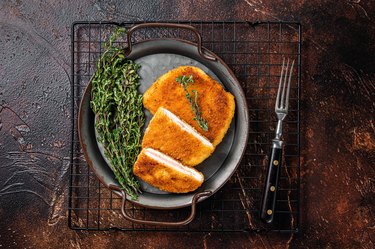
Traditional chicken cordon bleu calls for boneless skinless chicken breasts to be pounded thin, wrapped around slices of ham and cheese, dipped in seasoned breadcrumbs and whisked eggs, then pan- or deep-fried in oil and butter. The result is far from healthy. Prepare your own with low-fat cheese and egg substitute and bake rather than fry it for a dish with far less fat and saturated fat per serving. If you prefer to purchase packaged frozen cordon bleu, look for brands low in fat and sodium.
Baking Freshly Prepared Cordon Bleu
Video of the Day
Step 1
Coat a large baking dish lightly with nonstick cooking spray. Place the prepared breaded chicken cordon bleu in the middle of the dish.
Video of the Day
Step 2
Bake the cordon bleu in the middle of an oven preheated to 350 degrees Fahrenheit for 25 minutes. Remove the pan from the oven, place a sheet of aluminum foil over the dish and bake for approximately 15 more minutes.
Step 3
Remove the dish from the oven. Insert an instant-read meat thermometer into the thickest portion of the chicken and check that the meat has reached an internal temperature of 165 degrees Fahrenheit.
Baking Packaged Frozen Cordon Bleu
Step 1
Preheat a conventional oven. Set the oven to 350 degrees Fahrenheit.
Step 2
Coat a baking sheet with a light film of nonstick cooking spray. Place the frozen chicken cordon bleu onto the sheet.
Step 3
Bake until an instant-read thermometer inserted into the chicken registers 165 degrees Fahrenheit, or between 50 and 60 minutes. Remove the baking sheet from the oven and allow the chicken cordon bleu to cool for several minutes before serving.
Things You'll Need
Large baking dish
Nonstick cooking spray
Aluminum foil
Instant-read meat thermometer
Baking sheet
Tip
Try serving baked breaded chicken cordon bleu with steamed fresh vegetables and a salad of mixed greens tossed with a low-fat vinaigrette.
Warning
Carefully check the nutrition information on frozen packaged chicken cordon bleu. For some brands, a single serving can contain as much as 31 grams of fat, 9 grams of saturated fat and 105 milligrams of cholesterol. Consume commercially prepared cordon bleu in moderation.
The melted cheese filling of baked chicken cordon bleu will be extremely hot. Use caution when cutting and eating freshly baked cordon bleu.