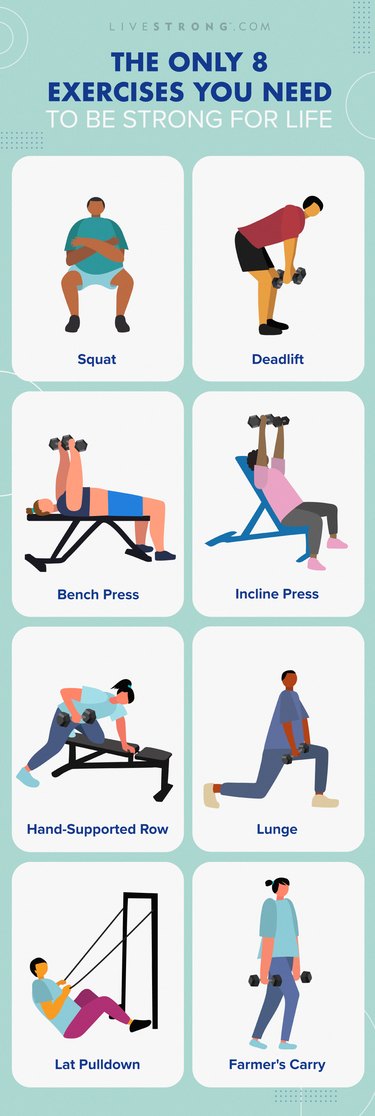
There's no shortage of flashy exercises out there. But when it comes to building and maintaining lifelong strength, the only exercises you need are a handful of basic moves.
The effort you put into your workouts translates to everyday life, making things like sitting down on a chair and climbing a staircase easier. And an effective fitness routine should keep you moving about your daily activities with strength and confidence.
Video of the Day
Here are the only exercises you need for healthy aging, according to trainers. Make sure to sprinkle these functional exercises into your workouts.
1. Squat
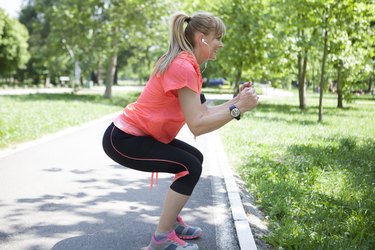
When you sit down onto a chair or couch, you're essentially doing a squat, according to Pete McCall, CPT, a certified personal trainer and host of the All About Fitness podcast. Squats are a fundamental movement you do every day, so make sure you're doing them correctly to avoid injury.
And because this lower-body exercise targets so many muscles — including your core, quads, glutes and hamstrings — it's one of the best strength exercises for seniors.
How to Do a Squat
- Stand with your feet hip-width apart.
- Extend your arms out in front of you and slowly bend your knees as you push your hips back to squat down. Focus on lowering your body as if you were going to sit on a chair.
- Squat down until your thighs are parallel with the floor (or as low as you can comfortably go while maintaining good form). Your knees should be over your toes and your gaze straight ahead.
- Pause for a moment at the bottom of your squat.
- On an exhale, reverse the motion by pressing through your heels to return to standing.
- As you stand, lower your arms back down to your sides.
2. Deadlift
The deadlift is one move everyone should do, in some variation, at least once a week, says James Shapiro, CPT, a California-based personal trainer. Most daily tasks you do happen in front of your bodies, so it's easy to forget about the muscles in the back (aka your posterior chain). These muscles help keep your back strong and pain-free.
Dumbbell deadlifts strengthen your back, core, glutes and hamstrings, making them essential among strength-training exercises for seniors.
How to Do a Dumbbell Deadlift
- Stand with your feet hip-width apart, holding a dumbbell in each hand in front of your thighs, palms facing your body.
- Hinge from the hips, softening your knees as your hips press back and sink enough to lower the weights toward the middle of your shins.
- Check your posture: Your spine should be straight and long, chest open and shoulders back. Make sure to keep a neutral neck.
- Engage your core to maintain this posture as you press your feet into the floor (as if you're pushing the floor away from you with your glutes and hamstrings) to pull the weights up and return to standing.
Tip
Although they focus on the lower body, deadlifts are a great core exercise for seniors as well. As you lower and lift the weight, think about engaging your abs by pulling your bellybutton to your spine.
3. Bench Press
Bench pressing with a barbell is fun, but dumbbells have some big advantages, too, according to McCall. The barbell is a single, straight bar that only allows for a certain range of movement. Chest pressing with dumbbells, on the other hand, allows you to dip your elbows lower, giving your pecs (chest muscles) a better workout.
Plus, dumbbells place less stress on the wrists, whereas a barbell keeps your wrists locked in a fixed position. You can also hold dumbbells at slightly different angles for added comfort.
How to Do a Bench Press
- Lie on your back on an exercise bench or the floor with a dumbbell in each hand. Hold the weights with straight arms above your chest. Plant your feet firmly on the floor and tighten your abs.
- Bend your elbows and lower the weights until they're in line with your chest or until your triceps barely touch the floor.
- Press the weights back up over your chest.
Tip
Keep your feet firmly planted on the floor, McCall says. This stable base helps you produce more power as you press the weights over your chest.
4. Incline Press
Whenever you stretch your arms overhead, you're doing some variation of a shoulder press. So it's an important movement pattern that should be worked on regularly to build and maintain upper-body strength with age, McCall says.
However, most overhead shoulder exercises are hard on your shoulder joints. The dumbbell incline press is the perfect alternative. It works your shoulders at a more comfortable angle while providing extra back support.
How to Do an Incline Press
- Sit back on an incline bench press with a dumbbell in each hand, palms facing forward.
- Bring the weights up to shoulder height and press your back flat against the seat, heels rooted into the floor.
- On an exhale, press the weights straight up from your shoulders.
- Reverse the motion and bring the weights back to your shoulders.
5. Hand-Supported Row
Most people spend a majority of their day at a desk, which can wreak havoc on your posture over time. But maintaining back strength through dumbbell rows can counter these effects and help prevent pain and injury.
Although there are several row variations, McCall recommends the hand-supported version. Standing in a bent-over position with your hips back helps target the deep stabilizing muscles in your core, which are responsible for protecting your back.
"Plus, doing rows from a standing position helps you stabilize when lifting objects, like a suitcase, from the ground," he says.
How to Do a Hand-Supported Row
- Stand alongside a flat exercise bench with your left palm on the bench directly above the shoulder.
- Place your left knee on the bench directly below the hip.
- Root your right heel into the ground with a slight bend in the knee.
- Hold a dumbbell in your right hand with your arm extended toward the ground.
- Draw your elbow up toward your ribs and pull the weights up alongside your lower abdomen.
- As you lift the weights, focus on squeezing the right shoulder blade.
- Lower back down toward the ground with control.
Tip
As with all strength exercises for seniors, safety comes first. As you row the weights up, keep your palms facing one another, McCall says. This helps protect your wrists from injury.
To give your back some extra protection, you can do this move seated on the end of an exercise bench. Just maintain the bent-over position with the support of the seat.
6. Lunge
Like squats, lunges target your quads and help you develop core strength. But there's one big difference: Lunges are a unilateral exercise, meaning they focus on one leg at a time.
Single-leg exercises help improve balance and correct any muscle imbalances you may have, according to the American Council on Exercise (ACE). And neglecting unilateral movements limits your ability to develop long-term strength on both sides of your body.
Lunges also build glute and hamstring strength, which is needed for activities like walking or climbing stairs — another reason they're one of the only exercises you need as you age.
How to Do a Forward Lunge
- Stand holding a dumbbell in each hand. The weights can hang at your sides or you can lift them up to your shoulders.
- Step a few feet forward with your left foot.
- Lower into a lunge until both knees are bent to 90 degrees. Your back knee should hover just above the ground, and your front knee should be stacked over your ankle.
- Hold for a beat before pushing through your front foot to return to standing.
- Repeat on the other leg.
7. Lat Pulldown
Back pain is the leading cause of disability worldwide, according to the American Chiropractic Association, and it prevents many people, especially older adults, from carrying out everyday tasks.
While the dumbbell row involves pulling a weight horizontally, the lat pulldown is a vertical pulling exercise, which most people don't practice enough. This can lead to muscle imbalances in your back, according to McCall.
Practicing the lat pulldown will improve your posture and help combat chronic pain, he says.
How to Do a Lat Pulldown
- Anchor a long resistance band at a high point above your head. (You can also use the lat pulldown machine at the gym.)
- Sit down on the ground beneath the band and grasp the opposite end with both hands, arms extended in front of you. This is the starting position.
- On an exhale, pull the band down toward your chest.
- Pause and squeeze your shoulder blades together.
- Reverse the motion with control to return to the starting position.
8. Farmer's Carry
"[This is] one of the best exercises that everyone should be doing on a regular basis," McCall says, citing the fact that it mimics the act of carrying heavy groceries and suitcases.
The farmers' carry is a full-body move that works your legs, glutes, arms and back. But it's an underrated core-strength exercise for seniors. With each step you take, your abdominals work to stabilize your pelvis and back against the movement of the weights.
Also a hip-strengthener, the farmers' carry builds balance to help reduce the risk of falling and/or injury, McCall says.
How to Do a Farmer's Carry
- Hold a dumbbell in each hand. Choose a weight that's heavy enough to challenge you yet light enough that you can maintain good posture while walking.
- Engage your core, pull your shoulder blades back and down and stand tall. Avoid allowing the weights to touch your outer thighs.
- Take a step forward and begin walking. Walk quickly while still keeping your spine tall, shoulders back and head up.
- Continue walking for a specified time, distance or number of steps.
Tip
You can give yourself an extra challenge with the farmer's carry by only holding one dumbbell on one side. Technically called a suitcase carry, this variation forces your core to work harder to offset the weight imbalance. Just make sure you do the same number of steps with a weight on each side.