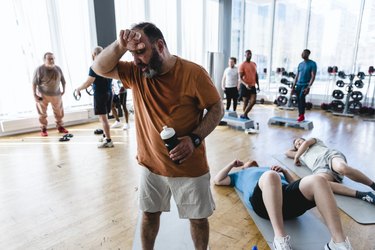
We all want to get the most out of our workouts, whether we're just getting started with a fitness plan or are exercise pros. There's a lot of outdated, misguided or simply wrong information out there about improving fitness — and a lot of us make the same fitness mistakes.
We spoke with experts and scoured the most recent research to narrow down the top fitness mistakes you didn't know you were making, as well as how to fix them.
Video of the Day
Video of the Day
Mistake 1: Sleeping Less Than Seven Hours per Night
"Sleep is way more important to your fitness goals than you might think," Bradley Dyer, DO, physician and founder of Premier Integrative Health, says. "It is essential for recovery, repair, and overall health. It is during sleep that your body repairs muscle tissue and releases growth hormones."
A June 2021 study in Current Sports Medicine Reports found that sleeping for less than seven hours per night for at least 14 days puts you at a 1.7 times great risk of a musculoskeletal injury. In addition to a higher risk of injury, Dr. Dyer says it also leads to low energy and decreased mental focus.
Fix It
"Aim for seven to nine hours of quality sleep per night to support your fitness goals," he says. If you are having a hard time getting to sleep and staying asleep, evaluate your habits so you can make sleep a priority.
Related Reading
Mistake 2: Too Much Cardio, Not Enough Strength Training
If you are running or cycling five days a week, but not lifting any weights, then you are missing out on a key component of staying healthy. "While cardio is important for heart health and burning calories, building muscle is the currency of longevity," Dr. Dyer says.
"Building muscle helps increase your metabolism and burns more calories throughout the day. Building muscle as you get older is especially important as age-related muscle loss (sarcopenia) is a major cause of frailty and disability."
Fix It
For best results, a well-balanced exercise routine should include both cardio and weights. A December 2012 study in the Journal of Applied Physiology looked at 119 overweight adults and found that a combination of cardio and strength training was better than only cardio or only strength training in losing weight and fat and gaining muscle.
Dr. Dyer says to aim to include a strengthening routine to hit all your major muscle groups at least two to three times a week. That might look like a Monday workout focused on the lower body, a Wednesday workout focused on the shoulders and triceps and a Friday workout focused on the chest, back and biceps.
Mistake 3: Stretching the Wrong Way Before a Workout
"I see a lot of people performing passive and static stretches before their workout. This is essentially a waste of time," Grayson Wickham, DPT, CSCS, a physical therapist, strength and conditioning specialist and founder of Movement Vault, says.
A passive stretch, or a static stretch, is often what you think of when you do a traditional stretch, such as a lying hamstring stretch or butterfly stretch. In static stretching, you lengthen your muscles and other connective tissues and hold that lengthened position for a given amount of time
It's relaxing, but a March 2013 review in the Scandinavian Journal of Medicine and Science in Sports suggests that static stretching can negatively affect muscular performance.
"Passive stretching, when performed before a workout or athletic endeavor, has been shown to decrease performance and increase injury risk . You need to be actively stretching," Wickham says.
Fix It
Active or dynamic stretches, such as walking lunges, walking knee to chest and straight leg kicks, are a great warmup to get your muscles primed for exercise.
"An effective warmup should include active stretches and muscle activation exercise that will help you improve your range of motion, activate specific muscles and get your nervous system and specific muscles primed for your workout ahead," he says.
Passive stretching is great when used correctly: in a cooldown, when muscles are already warm and looser due to increased blood flow. For best results, perform active or dynamic stretches before your workout to get your muscles primed, and static stretches after a workout as a cooldown and to improve your flexibility.
Mistake 4: Not Taking Rests Days
"Rest days are all about recovery. Recovery is needed to rebuild the muscle, tendon, and ligament microdamage that occurred during your workouts," Wickham explains. "The analogy is that you break down your muscles when working out, and rebuild your muscles when you rest. If you consistently skip your rest days, your performance in your workouts will suffer. Eventually, this can lead to over-reaching and over-training, which can negatively impact sleep, hormones, energy levels and happiness."
Fix It
Wickham says to plan one to two rest days per week.
For a productive rest, you can still do low-impact activity, such as walking or leisure biking around the neighborhood, but keep it light and relaxing. "Think of rest days as a time to recharge your battery," he says.
Related Reading
Mistake 5: Not Running Because It’s Hard on Your Knees
Have you been avoiding running because you think it could hurt your knees and lead to injuries or arthritis? Studies have found that's not the case. A June 2017 meta-analysis in the Journal of Orthopaedic & Sports Physical Therapy found that recreational runners had less pain and less chance of developing knee osteoarthritis than non-runners.
Recreational runners had a 3.5 percent chance of developing arthritis, while non-runners jumped up to a 10.2 percent chance. Competitive or elite runners who ran a high number of miles per week (at least 57) did have an increased chance of arthritis. This suggests that having a long-term, low-key running habit may be beneficial for bone health.
If you already have knee osteoarthritis, a September 2018 study in Clinical Rheumatology found that running actually strengthens your knees and resulted in less pain. Of course, it is always a good idea to check in with your doctor before starting a new exercise.
Running has a slew of other benefits as well, including helping you live at least three years longer, according to a June 2017 study published in Progress in Cardiovascular Disease that observed that participants who ran lived about three years longer than non-runners.
Fix It
Try incorporating a day or two of running into your regular workout routine to reap the rewards. If you have knee pain while running, talk to your doctor or a physical therapist so they can evaluate your running form and shoewear.
Mistake 6: Performing Partial Repetitions
"I see a lot of people performing partial repetitions," says Wickham. "This is OK from time to time to target a different stimulus — or if you have poor joint mobility and partial range of motion is all that you can perform with good technique. However, you should try to always perform every rep through your full range of motion as this will help you maintain — and even improve — your joint range of motion and mobility."
"It has also been debated that full range of motion reps can lead to more hypertrophy or muscle growth," he says.
Fix It
Watch your form in the mirror to ensure you are performing the exercise through the entire motion. If your form starts to falter, consider going lighter in weight or doing fewer repetitions.
A trainer can also ensure you are doing the exercise in a way to get maximum benefits.
Mistake 7: Not Using the Right Reps and Sets for Your Goals
Speaking of reps, it is important you are doing the right amount of reps and sets to meet your goals. Using the correct amount of weight and resting time between sets are also key factors.
If you are trying to build muscle mass, you will be doing more reps and a shorter resting time than if you have the goal of more strength, which requires fewer reps and longer rest.
Fix It
Check out our training guide for more information, however, the National Strength and Conditioning Association (NSCA) says to use these science-backed guidelines for weight training parameters:
- To build muscle mass: Use a moderately heavy weight and perform 6 to 12 reps of 3 to 6 sets with a 30- to 90-second rest between sets. The last two reps should be difficult to gain muscle. If it's not difficult, you need to increase your weight.
- To build muscle strength: Perform 6 reps of 2 to 6 sets with a 2- to 5-minute rest in between. The last two reps should be difficult. If not, increase the weight.
- To build power: Use a heavy weight and perform 1 to 5 reps of 3 to 5 sets, resting for 2 to 5 minutes between exercises.
- To build muscular endurance: This is good for runners or cyclists. Use a moderately light weight and perform 12 or more reps of 2 to 3 sets. Rest 30 seconds or less between sets.
Mistake 8: Ignoring Nutrition
"Nutrition is a key component of any fitness program. Ignoring nutrition can lead to sluggishness, lack of energy and can negatively impact your workouts," Dr. Dyer says. "Eating a balanced diet that includes a variety of whole foods can help fuel your workouts and promote overall health."
Without properly fueling before and after workouts, you're not doing your muscles or energy levels any favors. It could also be holding you back from better performance.
"Protein is important for building and repairing muscle, while non-starchy carbohydrates provide energy for your workouts. Healthy fats are also important for brain and heart health," Dr. Dyer explains.
Fix It
The Academy of Nutrition and Dietetics says to not eat immediately before a workout, as it could cause some stomach issues, but plan on fueling up one to four hours before. A good pre-workout snack should have protein and carbs, such as peanut butter and banana or Greek yogurt with berries.
They recommend eating within one hour of an intense workout to replenish the glycogen lost in the muscles so they can repair and rebuild. Snacks should be high in protein, but also include carbs, such as a turkey on a whole-grain wrap or a post-workout smoothie.
Mistake 9: Skipping a Workout if You Don’t Have a Full Hour
If you don't have a full hour to exercise, you may be tempted to blow off working out completely. However, new research shows that short bursts of intense exercise are very beneficial.
A December 2022 study in the European Heart Journal looked at 72,000 adults and found that two-minute bursts of vigorous exercise for a total of just 16 minutes per week was associated with an 18 percent reduced risk of death and a 15 percent reduced risk of cardiovascular disease. And increasing the total amount of time each week from 16 minutes to 53 minutes was even better.
Keep in mind that to get these benefits it needs to be vigorous exercise, which experts say you can gauge by how you are feeling while exercising. Vigorous exercising feels like a 6 to 8 on the RPE (rate of perceived exertion) scale, where you're breathing quickly and can only take in spurts.
Fix It
Try to incorporate short bursts of high-intensity interval training a couple of times a week to get to that vigorous level.
You should be breathing rapidly, can't say more than a few words without stopping to take a breath, and may start to sweat. You can also use your target heart rate as a guide. Examples of vigorous exercise include running, jumping rope or race walking.
Related Reading
Mistake 10: Not Scheduling Your Workout Times in Advance
Doing things like scheduling your workouts in advance, setting reminders on your phone, and giving yourself a reward for working out will increase weekly gym visits from 9 to 27 percent, a 2021 megastudy in Nature discovered.
This study, which looked at more than 60,000 Americans, also found that pairing something you like with working out (such as watching a show while on the treadmill or listening to a favorite song) also helped people stick to working out. Also, try not to miss more than two planned exercise sessions in a row, as they found that it's hard to get back into the workout habit once you break the streak.
All of these things ensure you will stick to a regular exercise plan. "Making fitness a priority means carving out time in your schedule for exercise and prioritizing healthy habits like meal planning and rest," Dr. Dyer says. "When you prioritize your fitness, you are more likely to stick to your goals and make progress."
Fix It
Plan your week in advance by either signing up for workout classes or carving out specific times to work out each week. It can be helpful to sit down with a calendar and plan out your workouts before each week starts. (And if you don't want to plan your own workouts, there are some great apps that will plan your workouts for you.)
When you're first starting to work out, set a reminder on your phone and give yourself a reward (such as a spa visit, or new lipstick, for example) to help keep you motivated. You can also enlist a workout buddy to help keep you both accountable.
- Current Sports Medicine Reports: "Sleep and Injury Risk"
- Journal of Applied Physiology: "Effects of Aerobic and/or Resistance Training on Body Mass and Fat Mass in Overweight or Obese Adults"
- Journal of Orthopaedic & Sports Physical Therapy: "The Association of Recreational and Competitive Running With Hip and Knee Osteoarthritis: A Systematic Review and Meta-analysis"
- National Strength and Conditioning Association: "Essentials of Strength Training and Conditioning 4th Edition"
- Academy of Nutrition and Dietetics: "Timing your Pre and Post Workout Nutrition"
- European Heart Journal: "Physical Activity Volume, Intensity, and Incident Cardiovascular Disease"
- Mayo Clinic: "Exercise Intensity: How to Measure It"
- Nature: "Megastudies Improve the Impact of Applied Behavioural Science"