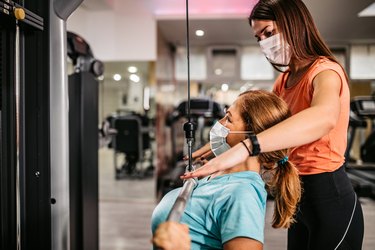
Even the Rock wasn't born with bulging biceps and a hulk-like back. He had a personal trainer behind the scenes to help him get the buff physique he's known for.
Personal trainers help everyone from everyday athletes to professionals to realize their strength and work toward their individual goals of improving endurance, performance and self-confidence. But above all, personal trainers help you build a healthy relationship with exercise.
Video of the Day
Video of the Day
Having a passion for fitness is just the beginning; becoming a certified personal trainer requires a few key steps. First, consider what you want your career to look like and give some thought to what setting you want to work in, says Tony Ambler-Wright, a master instructor for the National Academy of Sports Medicine (NASM). This might mean a commercial gym, boutique studio, corporate fitness or in-home training.
"One may feel more satisfying and rewarding over another, according to your interests," Ambler-Wright says.
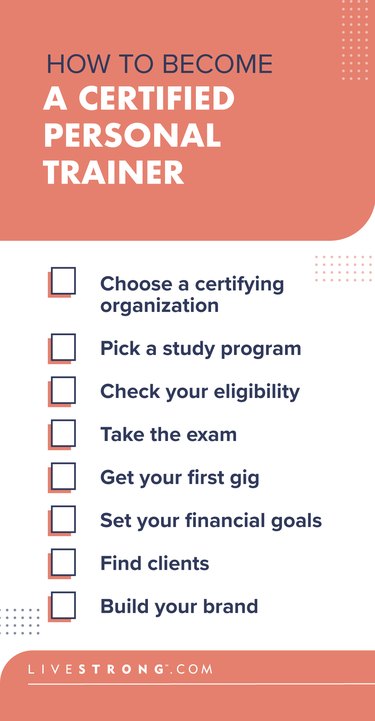
When you have a general sense of what you want to do, here are the next steps to take for how to become a certified personal trainer.
1. Choose a Certifying Organization
There are several organizations that the fitness world recognizes as the top certifying programs, including NASM. These organizations offer personal-training programs, which can often be done online and at your own pace with the help of a study manual.
To actually earn a personal training certification, you also need to take a final exam at testing sites around the country. During the COVID-19 pandemic, many organizations are also offering virtual test-taking. The American Council on Exercise (ACE), for example, offers their three-hour exam at different testing sites in the U.S. and Canada and currently has the option for an online proctor.
While you'll typically find deals on bundles for the study materials and testing, the regular price for a personal trainer certification can range in cost from about $350 to $2,200, depending on which organization you choose and any study materials you want included.
Keep in mind that each organization has its own rules for re-taking an exam (some bundles offer a free re-test if you fail the first time), and all require a current cardiopulmonary resuscitation (CPR) and automated external defibrillator (AED) certification, as well as continuing education courses that allow for recertification every two to three years.
To help you decide which certifying organization to go for, Ambler-Wright suggests checking to see if the particular gym or facility you want to work for has requirements for your certification or an organization they team up with. That will help you narrow down your choices.
If you don't have a gym in mind that you want to work with, think about the type of client you want to train, Ambler-Wright says. "If there's a particular client demographic or training style that you're more interested in and one of these providers caters to that market, then that might influence what you go with," he adds.
Here are the most respected organizations to consider:
National Academy of Sports Medicine
The price for the NASM certification starts at $799 for the self-study program, which includes the online course, practice exams, a certification exam and videos. In the program, you'll learn movement science, assessments, training concepts, program design, an overview of nutrition and supplementation, plus client interaction and professional development. The most expensive version costs $2,199, and includes an instructor-led, 10-week course, an internship and job guarantee, plus recertification for life.
The NASM also offers specialist programs in corrective exercise and performance enhancement, among others.
American Council on Exercise
Pay $849 for the basic personal training study program, which includes the online program, textbook, certification exam and practice tests. Or, you can try the advanced bundle for $1,499, which provides digital, audio and hardcopy study materials, a supplement to better learn anatomy and physiology and one-on-one support through your studying.
This program features information on a personal trainer's scope of practice, principles of behavior change and goal setting, assessments, programming — including progressions and regressions — and professional responsibilities.
In addition to personal training, the ACE offers specialist programs for trainers who are interested in working with certain demographics, like athletes, seniors, people in injury recovery and those seeking to lose weight.
American College of Sports Medicine (ACSM)
The ACSM certification exam itself costs $349, making it one of the cheapest personal trainer certifications. The organization also offers book bundles, with the manual alone costing $60 to $80, plus additional fees for online practice questions and learning webinars.
From the ACSM program manual, you'll learn anatomy, exercise physiology, biomechanics, behavior change, nutrition, assessments and program development. The ACSM has specific certifications for exercise physiologists and group exercise instructors as well.
The ACSM also offers education in functional movement systems, which helps trainers optimize movement in a wide range of athletes of different abilities.
International Sports Sciences Association (ISSA)
Pay $999 for this certification. The study materials include practice exams and quizzes, audio and video lectures, an online study guide and student forum, plus a free professional website and support post-certification. With this study program, you'll learn how to customize training programs for your clients, understand the body's muscle and skeletal structure and principles of movement, as well as assessments, and how to coach clients.
National Strength and Conditioning Association (NSCA)
For $202, you get the digital study package for this certification. If want all the extra materials the NSCA has to offer — which they suggest for those new to the fitness industry — the full package is $511. It's an additional $435 to actually take the certification exam. With NSCA, you'll learn about the client consultation and assessment, programming, exercise techniques and safety and emergency procedures.
If you're specifically looking to work with athletes, your best bet is becoming a certified strength and conditioning specialist (CSCS) through the NSCA. Study materials for this certification range from $216 to $523, plus an additional $475 to take the exam. The course material focuses on exercise science (including anatomy, physiology, biomechanics and differences among athletes), sports psychology and its foundations in performance, plus how nutrition affects health and performance.
To earn your CSCS, you also have to be able to write programs for a wide variety of sports and the exam evaluates your knowledge of anaerobic and aerobic training programs, strength and conditioning levels and training goals based on those specific sports.
Certified Functional Strength Coach (CFSC)
As the name implies, the focus of this certification is functional movement. Coaches are trained to excel in live demonstrations and modifications for athletes of many different abilities.
The Level 1 certification online course costs $650 and includes the final exam. You'll learn regressions, progressions, program design and a variety of plyometrics and strength-training exercises, plus coaching and cueing tips. Level 2 costs $750 and explores speed and power training in more depth.
In addition to passing a written exam, you'll also need to take a live practical exam in a small group led by a CFSC instructor.
2. Pick a Study Program
No matter what certifying organization you go with, make sure it's accredited by a third party, like the National Commission for Certifying Agencies (NCCA). All the personal training certs listed above have the NCCA seal of approval, except ISSA, which has a third-party accreditation from the Distance Education Accrediting Commission (DEAC).
Within the bundles mentioned above for each organization, you can decide what materials will best help you study for your exam. Some organizations not only have a full manual to learn from but also videos, online seminars and access to current professionals who can answer questions. Decide what you need to succeed in the exam.
3. Make Sure You're Eligible
While a background in exercise science, including a college degree, might help you with the personal training certification exam, it's not a requirement, Ambler-Wright says.
"The majority of the certifying organizations develop curriculum and content and provide education that would essentially deem somebody entry-level competent at being a personal trainer," he explains. "Upon completion of the certification, you come away with the bare minimum that you'd need to effectively and safely train somebody to reach their fitness goals."
Keep in mind, he adds, that more learning typically equals more earning. Earning potential grows with a bachelor's or master's degree in exercise science, as well as continuing your education with a certification in specific modalities, like kettlebells or TRX, or how to address specific populations like pre/post-natal training, senior fitness or sports performance.
Tip
You may be eligible for state, federal or college grants, scholarships or other financial aid to pursue degrees in exercise science. Learn more about financial aid for students at USA.gov.
Certain personal trainer certification organizations also offer their own scholarships, such as the Ash Hayes Scholarship from the ACE, which is awarded to 25 applicants every year who want to work with kids and teens.
While a background in exercise science — such as a college degree in kinesiology, physical education or exercise physiology — might help you with the personal training certification exam, you don't need a specific college degree to become a personal trainer. However, a high school diploma is required. You also need to be at least 18 years old.
And in order to sit for the exam, you'll have to complete a CPR/AED certification and present proof of that certification. To sign up for a CPR course, check out the American Red Cross or the American Heart Association.
While certifying organizations typically require in-person CPR training for the live skills check, many have waived that requirement right now, due to COVID-19 restrictions. That means you can likely do your certification exam with just the online portion of the CPR/AED training completed, but be sure to confirm that with the certifying organization you choose to pursue.
4. Enroll for the Exam
Some organizations, like the NASM and ACE, have the exam fee included in your study bundle, whereas others will require an extra fee, like the NSCA and ACSM. If you prefer the exam cost included in your up-front total, make sure it's listed as a component of your purchase.
In many cases, you can set your exam date for whenever you think you'll be ready, although some organizations require you to register within a certain number of months. Make sure you give yourself enough time (most organizations suggest at least a few weeks to a few months) to study all the materials and take a few practice exams.
"The more challenging part is understanding that the job is also about the ability to relate to people — the ability to be empathetic and guide and coach someone to change their behaviors."
To actually sit for the certifying exam, you need to register on the organization's website. The ISSA allows you to take the exam online, with no proctor, while the NSCA requires in-person testing, even during COVID-19 when centers operate at 50 percent capacity.
The ACE, NASM and ACSM have the option for you to take the exam in-person with a proctor present, or online with a virtual proctor. For most organizations, you can expect results immediately. Most also then provide a digital certificate to show you passed and/or will ship one in the mail to arrive a few weeks after you've passed your exam.
5. Get Your First Personal-Training Gig
If you didn't give much thought to where you want to work before your exam, once you pass your test, you'll want to figure out where to apply for jobs.
"I would encourage you to go contact different facilities and see if they will allow you to shadow or observe a day in the life of the trainer there, just to get an idea of what it's like," Ambler-Wright says. "Each setting has a different vibe, energy and client population."
Over time, you'll also want to think about the niche or demographic you want to train and then where you might want to focus your continuing education and specializations.
For example, if you have a passion for kettlebell workouts, you can get certified in kettlebells, and find a fitness studio or gym that caters to clients who want this type of training. The same goes for pre/post-natal training or senior fitness.
Ambler-Wright points out some of the benefits of being a personal trainer, especially once you establish your own client base, including a flexible schedule, rewarding work, plenty of room to grow and nearly limitless financial potential.
However, sometimes it can lead to working off-hours, as you're typically coaching people before they head to the office or after work; this is especially true if you work in a bigger fitness facility.
D'Annette Stephens, ISSA-CPT, owner and coach at D.Termined Fitness and chief operations officer of the Fit Pros Black Alliance, learned in her first few months on the job that a personal trainer's hours can definitely run long. After leaving an office gig, Stephens enrolled in Equinox's personal trainer program, which included classes and floor shifts, in which she would aim to get clients to sign up to train with her.
She'd hit the floor in the morning, around 5 a.m., to try to gain clients, then take classes midday with the Equinox program and then go back out to the floor in the evenings, usually staying until about 8 p.m.
"It was a new adventure and I took it with vigor," she says. After three months of building up her client base, she stopped working the floor shifts and could set hours that worked better for her, coming in a little later in the morning and taking more breaks throughout the day.
6. Set Your Hours and Financial Goals
Being a personal trainer isn't your average 9-to-5 job. As a personal trainer, you have to be available when your clients are not working, which often means early mornings and evenings. Some clients may be interested in lunchtime workouts. Your hours may be different from one day or week to the next.
Because the hours for a personal trainer are variable, it can be difficult to set boundaries — but it's critical for success. "Don't make the common mistake of spending 12 to 14 hours at the gym and sacrificing your life and health in the process," Ambler-Wright says. "Burnout can happen if you don't keep tabs on that."
To help you set your hours, determine your financial goals, and then figure out how much you have to work to meet those goals, Ambler-Wright says.
You might need to consider ways you can increase your revenue-providing opportunities, like small-group training, in addition to one-on-one sessions. Or consider ways to increase your one-on-one rate, particularly by factoring in travel, equipment and programming time.
How Much Does a Personal Trainer Make?
A personal trainer’s salary can vary widely, but the median for fitness trainers and instructors was $40,390 a year in 2019, according to the U.S. Bureau of Labor Statistics. The median hourly salary was $19.42.
7. Find Common Ground With Clients
Creating a workout program that caters to clients' goals is an essential part of the job, but the role of the trainer goes beyond teaching fitness.
Establish a process to follow from client intake to assessment to determining needs, capabilities and goals, and then design a program based on that information. Most of the certifying organizations' curriculums will help you nail down this process, but it's important to put it into practice, Ambler-Wright says.
Gather Information
You'll learn about a client throughout your relationship, but there's some information you'll need up front. Client intake involves collecting details on a person's medical history, age, height, weight, activity level, diet, sleep habits, and more — all of which plays a role in program design.
Remember to be empathetic in these conversations and look for a connection with potential clients, Stephens says.
"You spend an hour with them, so you want to have common ground and something to talk about," she says. "Talking about weight and body insecurities can be touchy subjects, too, so you want to have an emotional-based approach, not technical-based." Being a curious coach and learning to train the client's mindset and up their mental game will help you build trust, she says.
Assess a Baseline
Early in your work with a new client, you'll perform a fitness assessment to gauge their current fitness level. This baseline will help you customize their workout program and measure progress over time.
During a fitness assessment, you'll typically have the client perform a number of exercises that can help determine muscular strength and endurance, mobility, flexibility and posture, according to the NASM.
Design a Program
It's important to understand when to push a client and when to back off, plus how to tailor your programs and advice to the individual you're working with so you keep things safe, effective and engaging.
Based on the client's health history and fitness assessment, you'll create a custom program to help them reach their fitness goals, such as a building muscle, getting stronger or losing weight.
The program will include the kinds of exercises they'll do, as well as how much weight to use, how many reps and sets to complete and how many times a week to work out. You'll demonstrate proper form for the moves and evaluate the client's technique and progress over your sessions together, according to the NASM.
Provide Motivation
"Learning about exercise and how to leverage that, along with other health components, is probably the easiest part," Ambler-Wright says. "The more challenging part is understanding that the job is also about the ability to relate to people — the ability to be empathetic and guide and coach someone to change their behaviors."
The individuals you're training probably won't have the same enthusiasm and perspective on wellness that you do, he adds, so you have to learn how to encourage and relate to that person. And keeping the positive energy going throughout a session is super important.
"Trainers make the best actors — we have to keep a smile on our faces even if something else is going on," Stephens says.
8. Create an Online Presence
When Stephens left Equinox after two years, she began her own personal-training business. Some of her most committed clients and those she was closest to joined her in the new gig and helped her fine-tune parts of her business, like creating her own website, scheduling and billing. Today, she trains about 13 to 15 clients a week (four or five a day).
COVID-19 restrictions have also pointed out the necessity for building a brand you can expand virtually. Taking your business digital can mean many things, Ambler-Wright says, including writing programs for clients who follow them on their own but check in with you virtually, doing one-on-one Zoom sessions or streaming classes on your personal Instagram account or through a major gym or studio's social media accounts.
Tip
If you need help setting up your business online, NASM now has a virtual coaching specialization. Sites like TalentHack and TrueCoach can also help you seamlessly make the switch to virtual training.
Figure out how to leverage your online presence from the start, Ambler-Wright suggests, and it'll pay off down the line. "Get familiar with delivery methods, tools and tech that allow you to interact with people digitally, which could mean via chat, email or face-to-face in real-time," he says.
Click below to pin and save this checklist!