It's no secret that excess fat poses a health risk; carry too much extra weight, and you'll face a higher risk of dementia, cardiovascular disease and even certain types of cancer. With their body measurements, women can use one of a few methods to determine if they're at a higher risk for disease. Which method -- or methods -- you choose depends on your current weight and fitness goals.
Healthy Body Mass Index Measurements
Video of the Day
You can easily calculate your body mass index, which looks at your weight and height to determine if you're likely at a healthy weight, at home. Use an online calculator -- like the one provided by Cornell University -- to get your BMI, or calculate it yourself using your weight in pounds and height in inches:
Video of the Day
Your BMI = [weight / (height x height)] x 703
A woman who weighs 125 pounds and is 5 feet, 60 inches tall, for example, could calculate her BMI like this:
BMI = [125 / (60 x 60)] x 703.
So, her BMI is 24.4, which falls at the high end of the "healthy weight" range.
The BMI guidelines are the same for women and men. A BMI under 19 indicates that you're underweight; a BMI from 19 to 25 suggests a healthy weight; a BMI from 25 to 30 indicates overweight; and a BMI from 30 to 40 indicates obesity.
Healthy Waist and Waist-to-Hip Measurements
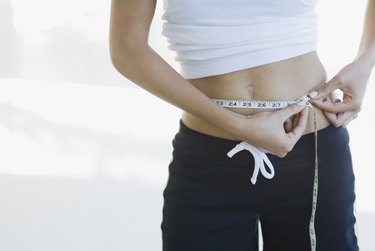
You can also use physical measurements to determine whether you're at a healthy size or if you need to lose weight to improve your health. Start by measuring your waist size; a waist larger than 35 inches indicates a higher risk of obesity-related disease, since it means you're likely carrying too much belly fat. Excess belly fat causes chronic inflammation, and it contributes to cardiovascular disease and other weight-related illnesses, even if you're at a healthy weight.
Your waist-to-hip ratio also provides some insight into your health. Calculate your ratio by dividing your waist circumference, in inches, by your hip circumference, in inches. While there's no standard for a "healthy" waist-to-hip ratio for women, a ratio above 0.85 indicates that you're carrying excess belly fat and therefore have a higher risk of weight-related illnesses.
Healthy Body Fat Measurements for Women
While BMI and waist and hip measurements indirectly estimate your body fat levels to assess your disease risk, body fat tests conducted by a professional directly measure how much body fat you carry. Skin-fold measurements, X-ray-based body imaging and underwater weighing techniques let you know whether you're at a healthy body fat level, or if you should focus on fat loss to lower your disease risk.
Women need more body fat than men for fertility and childbearing, but it's still possible for women to carry too much body fat. Your ideal body fat levels depend on your age. Women between the ages of 18 and 39 should aim for a body fat percentage of 21 to 32 percent. That ideal body fat level increases to 23 to 33 percent for women aged 40 to 59, and to 24 to 35 percent for women between the ages of 60 and 79. If you're currently carrying too much fat, diet and exercise interventions can help you lose about 1 percent of your body fat each month, according to the American Council on Exercise.
Tracking Your Goals With Body Measurements
Which measurements you use to gauge your health depends on your physique. If you currently carry a lot of excess fat, your BMI to track whether you're at risk of obesity. A quick look in the mirror will also let you know if you carry that extra weight in your midsection, which means you have too much belly fat, and a higher risk of disease, or if you carry the excess weight primarily in your hips and thighs.
If you're at a healthy body weight according to BMI, though, you should look at other measurements to get more insight into your health. If your waist -- or your waist-to-hip ratio -- is too large, you'll face a higher risk of weight-related illness, even though your BMI seems healthy. And if you're at a healthy weight and trying to tone up, it might be worth investing in a few professional body fat measurements, done at various times over a few months, to track your progress. You'll be able to get an accurate read on how much fat you've lost, even if you don't see a big difference in your weight or BMI.