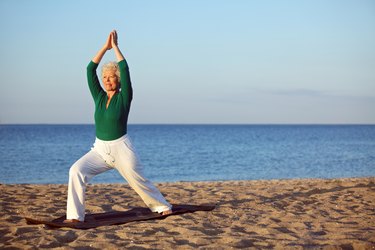
Without strong legs, it's difficult to engage in everyday activities such as getting in and out of chair, walking around the neighborhood and chasing after your grandkids. Leg-strengthening exercises don't require special equipment — you can exercise in your living room while you watch your favorite show.
As with any new activity, check with your doctor to make sure leg exercises are safe for you.
Video of the Day
Video of the Day
Read more: Exercises for Senior Citizens
Chair Exercises for Your Legs
If you're new to leg-strengthening moves, start with chair exercises. Sitting down relieves some pressure on your legs and, if you have balance issues, chair exercises might be the safest alternative for you.
For each of the following exercises, sit up straight on a firm chair and perform 10 repetitions on each leg. Hold each finish position for one to two seconds; then lower back down to the start position. Work up to three sets of 10 repetitions in a row.
- Marches: Lift one knee up toward the ceiling as far as possible without leaning backward. This movement works the muscles at the front of your hips.
- Kick-outs: Straighten one knee all the way and contract the muscles on the front of your thigh.
- Toe raises: Keeping your heels on the ground, lift your toes up toward the ceiling. You should feel the muscles on the front of your shins tighten.
- Heel raises: Press your toes down into the ground and lift your heels. This movement will tighten the muscles on the back of your calves.
Read more: How to Strengthen Weak Legs
Standing Leg Exercises
Standing exercises challenge your muscles by adding body weight to the movements. Stand next to a wall or other sturdy surface if you have concerns about your balance.
For each of the following, stand up straight with your feet shoulder-width apart and perform the movements 10 times on each leg, working up to three sets in a row. Hold each finish position for 1 to 2 seconds before lowering back down.
- Four-way leg lifts: Lift your leg straight out in front of you as far as possible, keeping your knee straight throughout each movement. Don't allow your upper body to lean. Repeat this exercise lifting your leg out to the side, backward and across midline, in front of your opposite leg.
- Marches: Lift one knee at a time until your thigh is parallel to the ground. Alternate legs each time, as if you are marching in place.
- Hamstring curls: Bend one knee and try to touch your buttocks with your heel. Don't allow your upper body to bend forward during this movement.
- Heel and toe raises: Raise up on your heels, lifting your toes up toward the ceiling. Then perform the opposite movement by lifting up on your toes. Make this exercise harder by doing them on one leg at a time.
- Mini-squats: Bend forward at your hips and push your butt backward as if you are going to sit in a chair. Bend your knees and slowly lower yourself down. Stop before your thighs are parallel to the ground. Hold for one to two seconds; then stand back up. Avoid this exercise if you have knee issues.